I am no expert on the posturing associated with high stakes diplomatic negotiations, so maybe there is less to this than meets the eye: Iran Derides Incentive Bid To Resolve Nuclear Dispute But, to someone with a good deal of experience in more conventional negotiations, it seems pretty clear that there is no hope of getting Iran to stop its nuclear enrichment program diplomatically. The Europeans are in the riduculous situation of bidding against themselves over and over again and Ahmadinejad is rejecting the offers before they are even made. Not only is he rejecting them, he is mocking them. What makes the Europeans -- or anyone -- think there is any hope for accomplishing anything by offering ever sweeter deals? They ought to quit. The more they offer, the more adamant and contemptuous Ahmadinejad becomes; the sweeter the deal becomes, the more joy Ahmadinejad takes in belittling it. With considerable jusitifcation, he senses weakness and is willing, even eager, to exploit it. He does so, of course, becuase he sees nothing but upsides for him.
What we have to recognize is that, for Ahmadinejad and Iran, this debate is no longer about uranium enrichment. It is about pride, and "honor;" about standing up to the West; about proving that neither Ahmadinejad nor Iran can be pressured, cowed, bribed or bought.
Basic negotiation theory tells you that a party will agree to a settlement proposal only when the outcome of agreement is percieved to be better in terms of what the party values than the probability-weighted average of the outcomes of no agreement. Given that what Ahmadinejad values is prestige of resisting the West, a survey of the possible outcomes of "no agreement" makes it pretty clear why Ahmadinejad has no interest in reaching agreement:
Outcome 1: The EU and the US secure a security council resolution imposing sanctions. Russia and China may well agree to this much, but the threat of sanctions alone holds no fear for Ahmadinejad. Indeed, he may well welcome sanctions. Given that this is fundamentally a test of wills for Iran, sanctions, even if authorized, will have about as much affect on Iran as the Blitz did upon England. If anything, sanctions will serve only to buttress Iranian's sense of pride, harden their resolve and increase their resentment of the US and the West. This, in turn will only serve to make Iran more dangerous.
Outcome 2: The US and EU seek a security resolution authorizing use of force but this resolution is vetoed by Russia or China. From Ahmadinejad's perspective, this outcome is even better than outcome 1 above. Not only does it limit UN-authorized actions to sanctions, the defeat of the force resolution provides Ahmadinejad with an additional propaganda victory.
Outcome 3: The security council passes a resolution authorizing the use of force. This might begin to give Ahmadinejad pause. But his calculus is (a) China and Russia won't let this happen and (b) even if they do, Europe won't move without the US and he US is in no position to actually use force given its exisiting commitments in Iraq and Afghanistan. Morover, Ahmadinejad propbably figures (with considerable justification) he can forestall any actual of force for years, maybe even decades, by playing the sort of cat-and-mouse games that Hussein played so successfully throughout the 90s. Finally, the threat of force -- so long as it remains just that -- will serve to further solidify the siege mentality of the Iranian people and thereby increase Ahmadinejad's own internal political power. His refusal to be cowed by that threat will also increase his standing throughout the Muslim world, with the people if not their leaders. The threat of force, in short, holds no fear.
Outcome 4: With or without UN authorization, the US, perhaps with NATO support, actually does use force. Ahmadinejad's calcualtion on this outcome is that, if force is used, it is will almost certainly to be limited to bombing. But bombing holds no greater fear for Ahmadinejad than sanctions. In his mind, and in the mind of his people and the rest of the muslim world, stand-off bombing is the act of a coward, of a person who lacks the courage to actually confront his enemy face to face. Moreover, Ahmadinejad proably believes, rightly or wrongly, that he has the capability, with the oil weapon, Iran's influence in Iraq, and his contact with terrorist organizations world-wide, to inflict as much dmage on the US and the West as they can inflict on him though bombing.
Outcome 5: The US, with or without European support, actually invades. This is probably the one outcome that Ahmadinejad actually fears, since it would likely mean the end of him and his government. Yet, he probably considers this possibility to be vanishingly remote given the exisiting commitments in Iraq and Afghanistan, the US electorate's weariness of war, and the ambiquity of the threat posed by Iran's nuclear program. In addition, he probably believes that even if the US were willing and able to invade, Russia and/or China would act to raise the stakes for such an invasion to unacceptable levels. Finally, even under the best if circumstances, any actual invasion is probably years off, giving him time to "do the little soft-shoe" in an effort to head it off.
In short, from Ahmadinejad's prespective the probability weighted downsides of non-agreement are almost non-existant while the benefits of non-agreement are huge. Indeed, so long as he believes he can avoid an actual invasion, non-agreement is what he wants most of all, since it vindicates Iran's honor, demonstrates that Iran cannot be cowed or bought, solidifies Iranian nationalism, distracts Iranians from their other problems (much as 9/11 distracted us), and increases his and Iran's status in the muslim world.
Given this situation, the West's best option at this point is to to disengage; to simply stop trying to negotiate with Iran on this issue. Even if nothing else ensued, the sudden cessation of talks would likely give Ahmadinejad considerable pause precisely becuase it would be so unexpected. In addition, disengagement would, at a stroke, deprive Ahmadinejad of the principal benefit of the current standoff: no longer would he be able to portray himself as fighting Western desires to keep Iran backward. He would, almost immediately, be deprived of the ability to portray himself as being involved in a glorious struggle to defend Iranian "honor," since there would no longer be a struggle. With the cessation of immediate threats, the Iranain people and the muslim world will go back to worrying about other things. Ahmadinejad will pass from page 1 to page 15 in the world's press. One can only imagine his disappointment.
But, in addition to disengagement, we should make him (and commit ourselves to keeping) the following promise: "OK. You claim that your only goal is the peaceful use of nuclear power. We are skeptical, but we are going to give you the benefit of the doubt. But know this: we consider you undeterrable and we are not going to let you have a nuclear weapon. So, we will be watching (as only we can), and if we ever find out that you are making highly enriched uranium or plutonium, materials that have no use other than to make weapons -- indeed, if we ever become convinced that you are likely to be doing this -- there will be no further negotiations, diplomacy or warnings. We will take you and your entire government down, without announcement or preamble, at a time and in a manner or our choosing, and we will do this in Iran as quickly and as surely and as easily as we did in it in Iraq and Afghanistan. However [and here's he key part], in contrast to Iraq and Afghanistan, we will not stay to rebuild your country. Once you and your cohorts are dead or captured and your nuclear capabilties destroyed, we will leave and let your people sort things out for themsleves. "
The combined effect of these two elements is four-fold. First, it at once deprives Ahmadinejad of his principle advantage in the current stalemate and at the same time imposes on him the risk of his worst fear. No longer will he be able to claim that this is a struggle between the big bad West and the poor but proud Iranians. We are telling him: go ahead; do what you say you are going to. If that is all you do, we will stay out of it. At the same time, we are telling him that if he does go beyond peaceful uses of nuclear power, his life and the life of his government will be very much at risk. This fundamenatlly alters the whole negotiation framework.
Second, this approach provides Ahmadinejad with an honorable way out. After all, he can foreswear atomic weapons and yet claim that he has achieved all he ever wanted: a peaceful atomic energy program. It also gives him an incentive to make his nuclear program tansparent, since convincing us that he is not seeking to develop weapons is his only insurance policy against invasion.
Third, this aproach raises the stakes conisderably for the Iranian people. After Iraq and Afghanistan, there can be little doubt in anyone's mind that we can make good on the threat to take down Iraq's government and armed forces. Our problems have all been with nation building, not state destruction. Yet the promise to leave once we have done that raises the stakes considerably, since the prospects of the anarchy that would follow from the destructiuon of the exisiting government are so obvious and frightful as to give all but the most ardent jihadist pause.
Finally, this approach gives us time to get out of Iraq. The Iranian bomb is years away. Over that period, our involvemet in Iraq will decline precipitously. The more we disengage from Iraq, the more credible our threat to the Iranian government becomes.
The idea of taking a government down and then just leaving is a hard one for Americans to swallow. We believe we can fix things, make them better. And the human suffering that would flow from this is mind-boggling. But it seems to me to be the only real alternative. We can't fix things unless the people involved want our help. Absent that, all we can do is protect ourselves and our allies. That's not nothing, and it is something we can, clearly, do.
Man, I am turning into the neocon's neocon.
Thoughts, criticisms, whatever welcome.
Thursday, May 18, 2006


Billy Bob's Bulletins -- May 18, 2006
 Cry of 'God Is Great' Mobilizes Secular Baghdad Neighborhood Against Attack (WaPo)
Troop Cuts Uncertain, Rumsfeld Testifies (WaPo)
A Safer Weapon, With Risks (LAT)
Fighting in Afghanistan Kills Dozens (LAT)
Must be boring over there, billy bob. So far as we can tell, there's just not too much going on. We are all to obsessed with illegal aliens and NSA spying, I guess.
Wednesday, May 17, 2006
Realizing What What Have
The WSJ Opinion Journal published a poem today by Ray Bradbury, (Something Wicked This Way Comes, The Martian Chronicles, Fahrenheit 451, etc.) entitled "America." It is subtitled "An Ode To Immigrants," but it really is not. Its' really a lament that Americans, so caught up with what is wrong with America, seem to lose sight of what is right with it. As poetry, I can't give it much but as a sentiment it seems right on. Especially the first and last lines:
We are the dream that other people dream.None of this is any reason, of course, to ignore what needs to be changed or to resist changes that seems likely to make us less "the dream that others dream." But, it is, I think, a reason leaven the outrage with a sense of proportion.
The land where other people land
When late at night
They think on flight
And, flying, here arrive
Where we fools dumbly thrive ourselves.
Refuse to see
We be what all the world would like to be.
Because we hive within this scheme
The obvious dream is blind to us.
We do not mind the miracle we are,
So stop our mouths with curses.
While all the world rehearses
Coming here to stay.
We busily make plans to go away.
How dumb! newcomers cry, arrived from Chad.
You're mad! Iraqis shout,
We'd sell our souls if we could be you.
How come you cannot see the way we see you?
You tread a freedom forest as you please.
But, damn! you miss the forest for the trees.
Ten thousand wanderers a week
Engulf your shore,
You wonder what their shouting's for,
And why so glad?
Run warm those souls: America is bad?
Sit down, stare in their faces, see!
You be the hoped-for thing a hopeless world would be.
In tides of immigrants that this year flow
You still remain the beckoning hearth they'd know.
In midnight beds with blueprint, plan and scheme
You are the dream that other people dream.
Billy Bob's Bulletins -- May 17, 2006
Slow news day. Lots pf bloviating on the immigration issue, but not much else. I suspect you'll get a kick out of the cartoon, though.
Violence Rages, Talks Inch Along (LAT)
Help With Reactor Included in European Offer to Iran (NYT)
Confidence In GOP Is At New Low in Poll:Democrats Favored To Address Issues (WaPO)

Violence Rages, Talks Inch Along (LAT)
Help With Reactor Included in European Offer to Iran (NYT)
Confidence In GOP Is At New Low in Poll:Democrats Favored To Address Issues (WaPO)

Tuesday, May 16, 2006
Border Wars III -- A Slow Motion Train Wreck
Now that I have started on this topic, I find it hard to stop.
You have to almost feel sorry for Bush. He just can't win. The lead NYT editorial charachterized his proposals a "a victory for the fear-stricken fringe of the debate" for those "who say illegal border crossings must be stopped immediately, with military boots in the desert sand." But those who are calling for that are even more upset that the Times. James Taranto sums up some of it:
It takes rare skill to piss off the NYT editorial page and Michelle Malkin at the same time.
You have to almost feel sorry for Bush. He just can't win. The lead NYT editorial charachterized his proposals a "a victory for the fear-stricken fringe of the debate" for those "who say illegal border crossings must be stopped immediately, with military boots in the desert sand." But those who are calling for that are even more upset that the Times. James Taranto sums up some of it:
Sailer has the answer! We could eliminate the whole immigration issue at a stroke. All it would take would be to make Mexico the 51st state! The border between Mexico and Guatemala/Beliz can't be more than a few hundred miles. We could fortify that no problem.The Nativists Are Restless
Was President Bush's immigration speech last night a success? CNN suggests so:
In a CNN snap poll of 461 people who watched Monday's speech, 42 percent said they had a positive opinion of the president's immigration policies before they heard him speak. Afterward, 67 percent said they had a positive view, a jump of 25 percentage points.
. . ."People who watch the speech do tend to be somewhat more Republican than the voters as a whole," CNN senior political analyst Bill Schneider said. "But that wasn't the best response he's gotten compared to other speeches, in fact it was lower than any speech we've measured since he took office." [Empasis added].
One reason for that is that the nativist right is as implacable as the Angry Left. "If the purpose of the speech was to shore up the president's standing with conservatives, it failed," declares an editorial in Michelle Malkin, who has actually written a book defending Franklin D. Roosevelt's internment of Japanese-Americans, remarks: "The only good thing about watching the speech was getting to watch it in the Fox News green room with Colorado GOP Rep. Tom Tancredo, a stalwart immigration enforcement advocate. It was nice to have someone to shake heads along with as empty platitude after platitude was laid on thick."
Steve Sailer on VDare.com writes: "The Bush Administration has seemed never to notice that Mexico is not the 51st state, but a foreign country--one that is engaged in a slow-motion invasion of America. . . . Why is Bush doing this? I have suggested that his motives are dynastic--that he is selfishly sacrificing the GOP to build a family vehicle, much like Brian Mulroney sacrificed the Canadian Progressive Conservative party in a vain effort to build a personal fief in the French-speaking province of Quebec. Brenda Walker speculates he is a 'MexiChurian Candidate.' What he is not is an American patriot.
It takes rare skill to piss off the NYT editorial page and Michelle Malkin at the same time.
Border Wars -- More
Ok. Ok. I decided to go read Bush's immigration speech since I hadn't actually heard it and since it seems to have made a bit of an impression on my small audience (see comments to this post).
Not a bad speech, but it was a bit like Soviet-era supermarket: something for everyone but not enough for anyone.
He ends the speech by acknowledging that we have to legalize the 13 or so million illegals who are already here. However, he wants to make that tough. They
The rest of the speech is devoted to trying to articulate a plan for assuring that we do not face this situation again in another 5-10 years. But here he is torn between the poles of his base. In a nod to the law-and-order folks, he spends nearly half of his speech talking about all the steps he is going to take to "secure our borders: double the size of the border patrol, build more fences, install more hi-tech detection devices, interim use of the national guard, etc., etc. But he then, almost plaintively, admits that all of this is probably pointless:
It seems to me that the key to this issue is to let 'em come. Bush effectively admits, I think, that we can not keep them out and that once they have been here for a few years and have put down roots, they are not going to leave and we are not going to throw them out. Why not, then, just eliminate the whole charade and allow anyone who can prove he has a job waiting for him to enter legally -- and provide all such people with a path to citizenship?
Not a bad speech, but it was a bit like Soviet-era supermarket: something for everyone but not enough for anyone.
He ends the speech by acknowledging that we have to legalize the 13 or so million illegals who are already here. However, he wants to make that tough. They
should have to pay a meaningful penalty for breaking the law, to pay their taxes, to learn English and to work in a job for a number of years. People who meet these conditions should be able to apply for citizenship but approval would not be automatic, and they will have to wait in line behind those who played by the rules and followed the law.He argues that this is not an "amnesty", but that is splitting hairs. The fact is that the current illegals will be allowed to stay, their children will become citizens automatically -- which is probably why most of them come anyway -- and, if they want, they can try to become citizens. Not muuch different from and amnesty in substance, but what else are we going to do with 13 million people?
The rest of the speech is devoted to trying to articulate a plan for assuring that we do not face this situation again in another 5-10 years. But here he is torn between the poles of his base. In a nod to the law-and-order folks, he spends nearly half of his speech talking about all the steps he is going to take to "secure our borders: double the size of the border patrol, build more fences, install more hi-tech detection devices, interim use of the national guard, etc., etc. But he then, almost plaintively, admits that all of this is probably pointless:
The reality is that there are many people on the other side of our border who will do anything to come to America to work and build a better life. They walk across miles of desert in the summer heat, or hide in the back of 18-wheelers to reach our country. This creates enormous pressure on our border that walls and patrols alone will not stop. To secure the border effectively, we must reduce the numbers of people trying to sneak across.The operative word in this last sentence is "sneak". Bush is not talking about reducing the number of immigrants; he is only talking about reducing the number or people who sneak in. He proposes to achieve this by letting them come in legally, as "guest workers." These guests will not be "true" immigrants, becuase Bush expects them to "return to their home country at the conclusion of their stay." But why would they do that? It is exactly at that point that the "guest workers" will have developed the roots in this country that Bush argues should entitle them to a path toward citizenship. And, once they can come in legally, requiring employers to verify that they are legal is simply paperwork.
It seems to me that the key to this issue is to let 'em come. Bush effectively admits, I think, that we can not keep them out and that once they have been here for a few years and have put down roots, they are not going to leave and we are not going to throw them out. Why not, then, just eliminate the whole charade and allow anyone who can prove he has a job waiting for him to enter legally -- and provide all such people with a path to citizenship?
Billy Bob's Bulletins -- May 16, 2006
IMMIGRATION: A sampling of the reactions to Bush's Speech
The right words (LAT Editroial)
A Balancing Act of Policy And Politics (WaPo "Analysis")
One Nation (WaPo Editorial)
Behind Bush's Address Lies a Deep History (NYT Analysis)
Border Illusions (NYT Editorial)


THE REST OF THE NEWS Not much of it. We are all navel-gazing I guess.
For Water Truck 103, a Perilous Path to the End (WaPo)
'Not Guilty' Plea Is Entered for Hussein (LAT)
Hussein Ruling Seems to Raise Execution Odds (NYT)
Iran Must Halt Enrichment Effort, China Official Says (LAT)
Monday, May 15, 2006
The Border Wars
From Reuters: Bush admits broken border, to send [6,000] Guard troops
I have so far studiously refrained from expressing any opinion, here or anywhere else, on the immigration issue. And, I (again studiously) did not listen to Bush's speech tonight. But I got the following e-mail from my brother after the speech:
The gist of Bush's proposal is this I gather: beef up border enforcement by sending in 6,000 national guardsmen and deal with the illegals already here by adopting a "guest-worker" program (i.e. make them legal and provide some sort of a path to ultimate citizenship). Have I got it about right?
Does anyone think 6,000 (or even 60,000) national guardsmen is going to make any difference? Does anyone think there is any alternative to legalizing (in some way or another) the millions of illegals already here?
Bush is caught between the two components of his "base": the business side that wants -- needs -- the illegals and the non-business conservatives that want to enforce the law. He'd love to make the latter happy, but he knows it's impossible, So he has come up with this "compromise." Trouble is, the compromise will no more stem the tide of illegals than it will stop the tide from coming in.
Trying to stop illegal immigration is absolutely hopeless. It is like trying to stop the flow of illegal drugs. So, so long as we continue to kid ourselves that we can stem the flow, every 5-10 years we will have another "crisis" where we have to try to figure out what to do with the millions of illegals that have come to this country since we last dealt with the issue. And, just as we have done now and 5 years ago, we will make them legal. There is just no alternative.
If all of that is true (and I defy you to argue that it isn't), you have to ask yourself: why bother? Why not just open the borders and let anyone come in who can get a job, pay taxes, etc. The principal downside of this is the downward pressure it would put on American wages. Well, what of it? American workers are going to have to learn to compete in the global economy anyway. We can build all the fences and deploy all the soldiers we want and it will make no difference. The fact is, we are losing maufacturing jobs becuase American labor has priced itself out of that market. We need to get over the idea that we are ever going to return to the days when you could make $25-30/hr doing work a robot (or immigrant or Vietnamese) can and wants to do for 10-20% of that. We have to focus instead on training/educating our people so that they can do things they Mexicans or Vietnamese or Indians, or Chinese can't do. Or we have to accept the fact that, if we want to make clothes or computers or anything else you can buy at Wal-Mart, we are going to have to compete with Chinese, Mexican, Vietnaese, Idian workers on the basis of prodcutivity-adjusted labor costs.
It's a tough world, but there is little point in denying that it is what it is. Indeed, continuing to deny reality does nothing to change the outcome. It just makes the outcome much more painful once it happens (as it inevitably will).
Just a thought. Have at 'er.
I have so far studiously refrained from expressing any opinion, here or anywhere else, on the immigration issue. And, I (again studiously) did not listen to Bush's speech tonight. But I got the following e-mail from my brother after the speech:
Friends - I'm frightened!So, (fool that I am) let me venture in where angels fear to tread.
I agreed with Bush on most of the things he proposed on immigration tonight. This is frightening, because I don't trust him, and don't agree with him on anything else.
What have I misunderstood? Please tutor me!
The gist of Bush's proposal is this I gather: beef up border enforcement by sending in 6,000 national guardsmen and deal with the illegals already here by adopting a "guest-worker" program (i.e. make them legal and provide some sort of a path to ultimate citizenship). Have I got it about right?
Does anyone think 6,000 (or even 60,000) national guardsmen is going to make any difference? Does anyone think there is any alternative to legalizing (in some way or another) the millions of illegals already here?
Bush is caught between the two components of his "base": the business side that wants -- needs -- the illegals and the non-business conservatives that want to enforce the law. He'd love to make the latter happy, but he knows it's impossible, So he has come up with this "compromise." Trouble is, the compromise will no more stem the tide of illegals than it will stop the tide from coming in.
Trying to stop illegal immigration is absolutely hopeless. It is like trying to stop the flow of illegal drugs. So, so long as we continue to kid ourselves that we can stem the flow, every 5-10 years we will have another "crisis" where we have to try to figure out what to do with the millions of illegals that have come to this country since we last dealt with the issue. And, just as we have done now and 5 years ago, we will make them legal. There is just no alternative.
If all of that is true (and I defy you to argue that it isn't), you have to ask yourself: why bother? Why not just open the borders and let anyone come in who can get a job, pay taxes, etc. The principal downside of this is the downward pressure it would put on American wages. Well, what of it? American workers are going to have to learn to compete in the global economy anyway. We can build all the fences and deploy all the soldiers we want and it will make no difference. The fact is, we are losing maufacturing jobs becuase American labor has priced itself out of that market. We need to get over the idea that we are ever going to return to the days when you could make $25-30/hr doing work a robot (or immigrant or Vietnamese) can and wants to do for 10-20% of that. We have to focus instead on training/educating our people so that they can do things they Mexicans or Vietnamese or Indians, or Chinese can't do. Or we have to accept the fact that, if we want to make clothes or computers or anything else you can buy at Wal-Mart, we are going to have to compete with Chinese, Mexican, Vietnaese, Idian workers on the basis of prodcutivity-adjusted labor costs.
It's a tough world, but there is little point in denying that it is what it is. Indeed, continuing to deny reality does nothing to change the outcome. It just makes the outcome much more painful once it happens (as it inevitably will).
Just a thought. Have at 'er.
Billy Bob's Bulletins -- May 15, 2006
IRAQ:
2 Suicide Car Bombers Kill 14 and Wound 16 Near Baghdad Airport (NYT)
Iraqi Lawmakers Appear to Be Mired in Minutiae (LAT)
On Baghdad Patrol, a Vigilant Eye on Iraqi Police (WaPO)
Hussein: I am still the president (CNN)
Hussein Is Formally Charged for War Crimes (NYT)
DOMESTIC POLITICS:
Bush Set To Send Guard to Border
Conservative Christians Criticize Republicans (NYT)
Divide Is Sharpening Among Republicans (WaPo)
Sunday, May 14, 2006
Billy Bob's Bulletins -- May 14, 2006
Cheney Pushed U.S. to Widen Eavesdropping (NYT)
Military Plans Tests in Search for an Alternative to Oil-Based Fuel (NYT)
At Falwell's University, McCain Defends Iraq War (NYT)
Iraq Begins to Rein In Paramilitary Force (WaPo)
In Iraq, Soccer Field Is No Longer a Refuge (LAT)
Iraqi Children Falling Victim to Malnutrition (LAT)
A Pattern of Excess (WaPo Editorial)
Why Can't We Be Friends II
A propos of this post from yesterday, there was an interesting article in the NYT Magazine today on the The Perils of Soft Power. It makes somewhat the same point I was trying to make in the previous post, except that it talks not about the Arab world but about Europe:
First, there is an undertone of resentment in the Times piece that is every bit as tempting a target for Freudian analysis as is the European "compensation" to which that resentment is directed. The Euorpean inferiority is that of the Ancien Regime fallen on hard times. The American inferiority is that of the nouveau riche not getting the respect it thinks it deserves. The root of the resentments are the same: injured pride.
Second, as Billy Bob points out, it is easy to exaggerate the importance of these sorts of mewlings. Billy Bob is "not so sure" about my claim that "they hate our way of life." Depending on to whom "they" are, this is a point well taken. The Arab world and Europe are every bit as diverse as the United States in their attitudes, and just as it would be a mistake for an Iranian to think Pat Robertson speaks for America, it is a mistake to think that those excoriating America speak for their countires. In this regard we would do well to develop a little bit thicker skin.
But to me, Iran is different in one all important regard. Just as there are in Europe, there are "cultural guardians" in many countries -- perhaps every country -- for whom "America [is] the Great Seductress," who consider the millions of "little people" who yield to "America-the-beguiling" as "cultural traitors," and who resent most of all that these little people are "ignor[ing] the stern verdict of their own priesthood." In almost every case, probably even in Iran, these "cultural guardians" are no more representative of their countries than Pat Robertson is of ours. But in Iran, these cultural guardians are in power. They control the government. And it is this fact that makes Iran a unique threat. Think of the threat the United States would pose under Pat Robertson or worse yet, Fred Phelps
I do not for a minute believe that all or even most Iranians or Iraqis or Arabs hate they way we live or what we believe in. Quite to the contrary, I think many, perhaps most, would like nothing better than to walk in our shoes. But the Ahmadinejads and Zarqawis and bin Ladens are not among those. Those people truly do hate us and everything we stand for and they hate us all the more becuase our way of life is so alluring to their own people. It is this fact -- and I think it is a fact -- that to me makes the idea of controlling their nuclear aspirations through rapproachment so chimerical. Our choices really are between deterrence and preventative war. Which brings me back to this.
In recent years, a number of American thinkers, led by Joseph S. Nye Jr. of Harvard, have argued that the United States should rely more on what he calls its "soft power" -- the contagious appeal of its ideas, its culture and its way of life -- and so rely less on the "hard power" of its stealth bombers and aircraft carriers. There is one problem with this argument: soft power does not necessarily increase the world's love for America. It is still power, and it can still make enemies.Two points:
. . .
In the affairs of nations, too much hard power ends up breeding not submission but resistance. Likewise, great soft power does not bend hearts; it twists minds in resentment and rage. And the target of Europe's cultural guardians is not just America, the Great Seductress. It is also all those "little people," [who] . . . [b]y yielding to America-the-beguiling, . . . commit[] cultural treason -- and worse: they ignore[] the stern verdict of their own priesthood. So America's soft power is not only seductive but also subversive.
. . . .
Europe, mourning the loss of its centuries-old supremacy, either resorts to insulation (by quotas and "cultural exception" clauses) or seeks solace in the disparagement of American culture as vulgar, inauthentic or stolen. If we could consult Dr. Freud, he would take a deep drag on his cigar and pontificate about inferiority feelings being compensated by hauteur and denigration.
First, there is an undertone of resentment in the Times piece that is every bit as tempting a target for Freudian analysis as is the European "compensation" to which that resentment is directed. The Euorpean inferiority is that of the Ancien Regime fallen on hard times. The American inferiority is that of the nouveau riche not getting the respect it thinks it deserves. The root of the resentments are the same: injured pride.
Second, as Billy Bob points out, it is easy to exaggerate the importance of these sorts of mewlings. Billy Bob is "not so sure" about my claim that "they hate our way of life." Depending on to whom "they" are, this is a point well taken. The Arab world and Europe are every bit as diverse as the United States in their attitudes, and just as it would be a mistake for an Iranian to think Pat Robertson speaks for America, it is a mistake to think that those excoriating America speak for their countires. In this regard we would do well to develop a little bit thicker skin.
But to me, Iran is different in one all important regard. Just as there are in Europe, there are "cultural guardians" in many countries -- perhaps every country -- for whom "America [is] the Great Seductress," who consider the millions of "little people" who yield to "America-the-beguiling" as "cultural traitors," and who resent most of all that these little people are "ignor[ing] the stern verdict of their own priesthood." In almost every case, probably even in Iran, these "cultural guardians" are no more representative of their countries than Pat Robertson is of ours. But in Iran, these cultural guardians are in power. They control the government. And it is this fact that makes Iran a unique threat. Think of the threat the United States would pose under Pat Robertson or worse yet, Fred Phelps
I do not for a minute believe that all or even most Iranians or Iraqis or Arabs hate they way we live or what we believe in. Quite to the contrary, I think many, perhaps most, would like nothing better than to walk in our shoes. But the Ahmadinejads and Zarqawis and bin Ladens are not among those. Those people truly do hate us and everything we stand for and they hate us all the more becuase our way of life is so alluring to their own people. It is this fact -- and I think it is a fact -- that to me makes the idea of controlling their nuclear aspirations through rapproachment so chimerical. Our choices really are between deterrence and preventative war. Which brings me back to this.
It's Not The Uniform, It's The Man
A lot of Congressmen are expressing reservations about putting a uniformed military officer -- Michael Hayden -- in charge of the CIA. But, reading this, Cheney Pushed U.S. to Widen Eavesdropping, should remind us all that the military is often a lot more senstivie to protection of civil rights and to the importance of keeping government power channelized than many civilians.
Saturday, May 13, 2006
Dealing With Iran
Triggered by this post, I received the following e-mail from one of my sons (edited slightly):
The question you ask about this -- "what threat could possibly be big enough to deter a country that just does not care what the rest of the world does or thinks?" -- is exactly the one that makes the prospect of Iran getting a nuclear capability so scary. For deterrence to work requires a rational actor on the other side, and there is room for doubt that the Iranian leadership is rational. How can one be certain that devotees of suicide bombings would not be willing to sacrifice the lives of hundreds of thousands of their own citizens in the cause of jihad? These people simply do not think the way we do. For them, death in the service of their religion is glorious. How can such people be deterred?
And, maybe that is your point. We can't prevent them from getting a bomb diplomatically, a preventative war is unthinkable and probably won't work anyway, and we can't deter them once they get it, so what's the solution? Shouldn't we try rapprochement? After all, one doesn't nuke one's friends, so maybe the way to deal with an Iranian bomb is to make Iran our friend.
Which, of course, leads into the second question you ask: "What do you think of Ahmadinejad's letter?" Can't it be seen as a "serious attempt to solve a global problem in the way he sees best?" Shouldn't we do more than just blow him off? In the words of the 1975 song: "Why can't we be friends?"
Well, I think there are a couple reasons. One, at least, is that they don't want us to be their friend. I think there is considerable truth to the oft-expressed notion that the mullahs and the Ahmadinejads that currently run Iran NEED a "Great Satan," in much the same way that Bush NEEDS the "war on terror." It is the great bogeyman that allows them to maintain and enhance their powers, to keep an otherwise restive populace in line. If I am right about this, efforts to become friends with Iran would end up making the appeasement analogy valid: even if we did everything Ahmadinejad's letter asks, if would not be enough. Nothing would ever be enough.
Then, there are the more concrete issues. Ahmadinejad's letter makes clear that the price of friendship with Iran, even if it were possible, would be pretty high. To take but one example, we would need, first and foremost, not just to abandon Israel, but to assist in its destruction as a state. I often wish that Israel had never happened. But, it is too late for that now. And I, for one, am not willing to countenance the destruction of Israel in order to become friends with Iran.
But it all goes, I think, a lot deeper than this. Consider the closing paragraphs of Ahmadinejad's letter:
My sense: These guys are really and truly dangerous. I would no more give them a nuke than I would give one to Pat Robertson. The great scourge of our time is "true belief." True belief coupled with nukes is a very, very scary proposition.
All of this is not to say that we should not pursue rapprochement. I think the Bush administration refusal to have direct talks with Iran is silly. But as we try to work our way through this issue, we have to recognize that these guys are unlike anything we have ever had to deal with before. And we have to recognize that Ahmadinejad's letter is a lie: it is not our policies or our actions he despises. It is us.
Dad -On the deterrence question, you have it right. I am talking about convincing Iran that if they ever used a nuclear weapon -- or provided one to others to use -- against us or an ally of ours, we would take them down as surely a night follows day. That's not necessarily to say that we would nuke them in return. We might be able to do what we need to do in that regard with more conventional forces. But, deterrence is premised on convincing the other side that any use of nuclear weapons would be suicide.
I am confused on your April 21st entry on the Iran nuclear weapon situation. What do you mean by deterrence? . . . Are you talking about containing Iran by convincing it that we could obliterate it in retaliation? Or is it that we would cut off economic, diplomatic or human relations in general? Overall, at this point, what threat could possibly be big enough to deter a country that just does not care what the rest of the world does or thinks? Moreover, why should they care so much when our president completely ignores Mahmoud Ahmadinejad's attempts at trying to solve the problem? I understand that what he said in his letter might not be "proposals for resolving the confrontation over Iran's nuclear ambition," but the fact that our government completely snubbed Ahmadinejad's probably serious attempts to solve a global problem in the way he sees best, seems to me to be another weapon in the global "Arrogant American" arsenal. And really, when we have a situation like the Iranian nuclear crisis that seems to be at the unsolvable point, having people think that we are intent on building relationships and working collaboratively with respect and a bit of humility, would be key. I am not talking about fostering "relativism run amok" I just want us to at least respect what the man has to say and not throw it out.
So I guess I have two questions: what do you mean by deterrence, and what do you think of Ahmadinejad's letter?
Jon
The question you ask about this -- "what threat could possibly be big enough to deter a country that just does not care what the rest of the world does or thinks?" -- is exactly the one that makes the prospect of Iran getting a nuclear capability so scary. For deterrence to work requires a rational actor on the other side, and there is room for doubt that the Iranian leadership is rational. How can one be certain that devotees of suicide bombings would not be willing to sacrifice the lives of hundreds of thousands of their own citizens in the cause of jihad? These people simply do not think the way we do. For them, death in the service of their religion is glorious. How can such people be deterred?
And, maybe that is your point. We can't prevent them from getting a bomb diplomatically, a preventative war is unthinkable and probably won't work anyway, and we can't deter them once they get it, so what's the solution? Shouldn't we try rapprochement? After all, one doesn't nuke one's friends, so maybe the way to deal with an Iranian bomb is to make Iran our friend.
Which, of course, leads into the second question you ask: "What do you think of Ahmadinejad's letter?" Can't it be seen as a "serious attempt to solve a global problem in the way he sees best?" Shouldn't we do more than just blow him off? In the words of the 1975 song: "Why can't we be friends?"
Well, I think there are a couple reasons. One, at least, is that they don't want us to be their friend. I think there is considerable truth to the oft-expressed notion that the mullahs and the Ahmadinejads that currently run Iran NEED a "Great Satan," in much the same way that Bush NEEDS the "war on terror." It is the great bogeyman that allows them to maintain and enhance their powers, to keep an otherwise restive populace in line. If I am right about this, efforts to become friends with Iran would end up making the appeasement analogy valid: even if we did everything Ahmadinejad's letter asks, if would not be enough. Nothing would ever be enough.
Then, there are the more concrete issues. Ahmadinejad's letter makes clear that the price of friendship with Iran, even if it were possible, would be pretty high. To take but one example, we would need, first and foremost, not just to abandon Israel, but to assist in its destruction as a state. I often wish that Israel had never happened. But, it is too late for that now. And I, for one, am not willing to countenance the destruction of Israel in order to become friends with Iran.
But it all goes, I think, a lot deeper than this. Consider the closing paragraphs of Ahmadinejad's letter:
Liberalism and Western-style democracy have not been able to help realize the ideals of humanity. Today these two concepts have failed. Those with insight can already hear the sounds of the shattering and fall of the ideology and thoughts of the Liberal democratic systems.Here, finally, is the real Ahmadinejad. It is not really our foreign policy he hates. His beef is with who we are, how we live, what we believe. It is not our policies or actions he hates, it is our culture and civilization. We are, to him (and his ilk), the "Great Tempter," luring people into a corrupt, degraded, depraved, licentious and immoral lifestyle. What they resent most of all is the relentless allure western civilization holds for their own people. He (they) will not be satisfied until we too reject the "failed" teachings of liberalism (read freedom) and accept that only "faith in God and the teachings of the prophets" will allow people to "conquer their problems." Keep in mind that the "God" in which he insists we have faith and the "teachings of the prophets" to which he enjoins us to adhere and not the same "God" and "teachings" in which Christians and Jews currently believe. We would, of course, need to recognize that the Koran and Islam represent the "final truth." But to me, that is not actually the worst part. The worst part is the overtly theocratic manifesto. The flavor of the religion is not what is important to me. What is important to me is the rejection of liberalism. I am not willing to try to come to an accommodation with someone whose core goal is to get us to discard everything I believe in.
We increasingly see that people around the world are flocking towards a main focal point -- that is the Almighty God. Undoubtedly through faith in God and the teachings of the prophets, the people will conquer their problems. My question for you is: "Do you not want to join them?"
Mr. President,
Whether we like it or not, the world is gravitating towards faith in the Almighty and justice and the will of God will prevail over all things.
My sense: These guys are really and truly dangerous. I would no more give them a nuke than I would give one to Pat Robertson. The great scourge of our time is "true belief." True belief coupled with nukes is a very, very scary proposition.
All of this is not to say that we should not pursue rapprochement. I think the Bush administration refusal to have direct talks with Iran is silly. But as we try to work our way through this issue, we have to recognize that these guys are unlike anything we have ever had to deal with before. And we have to recognize that Ahmadinejad's letter is a lie: it is not our policies or our actions he despises. It is us.
Billy Bob's Bulletins May 1 - 13, 2006
Somewhat belatedly, here's a sampling of the news and views regarding or affecting Iraq over the last two weeks. No cartoons this time, though. Sorry. Oh, and as you will note, there are no links to the NYT. I am boycotting them becuase links to their articles die after 7 days unless you pay to join "Times Select." These bulletins will now be confined to the Washington Post, The LA Times and (just to keep us all honest) the Wall Street Journal Opinion Journal.
May 1, 2006
U.S. Report Cites Progress, Shortfalls In Iraq Rebuilding WaPo
Iraq's President Says Deal With Insurgents Is Possible LAT
Mr. Moussaoui's Punishment WaPo Editorial
May 2, 2006
Iraqis Begin Duty With Refusal
Some Sunni Soldiers Say They Won't Serve Outside Home Areas WaPo
Biden Offers Alternative Plan for Iraq LAT
White Guilt and the Western Past: Why is America so delicate with the enemy? WSJ Editorial [This is well worth reading.]
May 3, 2006
U.S. Crafts Response on Iran WaPo
Iraqi President Says Sunni Insurgents See Iran as Threat WaPo
Sadr Loyalists Push for More Cabinet Posts LAT
Latest last chance on Iran LAT Editorial
Women's Lib:
Saddam wasn't a feminist
May 4, 2006
Security Council Is Given Iran Resolution WaPo
Russian Bridge to Iran Has Twists LAT
Iraq Parliament Meets as Attacks Rise LAT
U.S. Commander in Afghanistan Thinks Locally WaPo
Jurors Reject Death Penalty For Moussaoui WAPO [Note: More on this here: "Hurray For The Jury."
Backpedaling in Egypt WaPo Editorial
May 5, 2006
Now Playing in Iraq: Zarqawi Outtakes WaPo
U.S. Warns Russia to Act More Like A Democracy WaPo [Query: How much sense does it make to scold Russia at the same time we are trying to get their help on Iran? These guys are just nuts.]
U.S. Tells of Iraq Insurgents' New Tactics LAT
May 6, 2006
Iraq's Shiites Now Chafe at American Presence LAT
Bomb Kills 3 GIs South of Baghdad
Confident Democrats Lay Out Agenda
May 7, 2006
Targeted Killings Surge in Baghdad LAT
30 Iraqis Killed in Karbala, Baghdad Ministry Reports 51 Bound Bodies Found In Capital WaPo
Pollster Suggests Bush Moves Might Be Too Little, Too Late WaPo
May 8, 2006
The USDA on Iraq: Everything's Coming Up Rosy WaPo [This is a stitch!]
Iran Threatens Pullout From Nuclear Treaty WaPo
Amid Iraq Violence, Kurds Unify Their Government LAT
Real Race May Be Voters Vs. Congress LAT
Guard Faces Phase-Out of Combat Role LAT
Democrats may not be able to win the House, but Republicans could lose it WSJ
May 9, 2006
Ahmadinejad's Letter to Bush WaPo [Note: This is a must read].
Iraq Deployment Delayed as Drawdown Is Studied WaPo
Aiming for a More Subtle Fighting Force LAT
The Perils of Engagement:
Calling for talks with Iran is just cheap talk WSJ
May 10, 2006
Deadly Deception at an Iraqi Market
Attacker Posing as Vendor Kills 19 in City Called Model by Bush WaPo
Crazy Mahmoud: Would you buy a "grand bargain" from this man? WSJ
Sgt. Sar's Silver Star
May 11, 2006
Bush, GOP Congress Losing Core Supporters WaPo
Baseless Confidence:It may take a defeat in November for the GOP to unlearn the lessons of power WSJ
U.S. Under Pressure To Talk to Tehran WaPo
GAO: Few Troops Are Treated for [Post-Traumatic Stress] Disorder WaPo
Army Using Policy to Deny Reserve Officer Resignations WaPo
Iraqi Leader Calls for Peace WaPo
Sectarian Killings 'Destabilize' Iraq Unity LAT
Army Rules Put on Hold LAT
Bush Blames Polls on 'Battle Fatigue' WaPo Blog
Another Pitch to Iran WaPo Editorial
May 12, 2006
Data on Phone Calls Monitored
Extent of Administration's Domestic Surveillance Decried in Both Parties
[Bill: This is an absolutely huge story here.]
House Injects Prayer Into Defense Bill
No Proof of Al-Qaeda in '05 London Transit Blasts
May 13, 2006
U.S. Military Is Split on Insurgency Strategy LAT
Pentagon Faults Report Questioning Veterans' Mental Health Care WaPo
Annan Urges U.S. to Take Part in Talks With Iran WaPo
NSA Program Further Blurs Line on Privacy WaPo
The Datamining Scare: Another nonthreat to your civil liberties WSJ
GM Kills the H1 (Thank God)
From the SF Chronicle:
The Hummer H1 -- the biggest, toughest sport utility vehicle on the road --has run out of gas. Cheering just about every other driver on the road, General Motors Corp. said Friday that it is ditching the H1 by June.One can only wish it had been sooner. Or that this affront had never been concieved in the first place. What a ridiculous vehicle.
The vehicle, which delivered a shot of in-your-face masculinity, has a price tag of $140,000, weighs 5 tons and gets less than 10 miles to the gallon.What will the dickless will do to compensate now? Back to .44 magnums, assault rifles and grenade lauchers I suppose.
Friday, May 12, 2006
Poll: Most Americans Support NSA's Efforts
This is so sad: Most Americans Support NSA's Efforts. As Tom Friedman said, "9/11 has made us stupid." Nothing Al Queda has or can do to us approaches the threat that we ourselves pose to our way of life and values.
Some Correspondence With Billy Bob
Below is an exchange of e-mails I have had with Billy Bob from Iraq over the last couple of days.
From Billy Bob:
To Billy Bob:
To be continued . . .
From Billy Bob:
To Billy Bob:Hi Bill,
Good to hear from you! Things are going pretty well here, and I can actually tell you quite a bit more now that we're all here and rolling. I'm working on an update to send out, but here's the quick version...
We're at a base with many names . . . North of Baghdad, and near Falluja. Our mission is varied, but primarily focuses on logistics - escorting "log" convoys around the country. My particular piece of the pie, in addition to the basic promotion of our troops back home through the website, newsletters, and videos, is to work with our Civil Military Operations Team. The CMO team works with the local population around the base to maintain relations and security. A lot of our work is with local Sheiks, helping them integrate into the new Iraqi government (primarily through contracting for redevelopment projects...they caught right on to capitalism, not so quickly to the regulations that go with it). We also do humanitarian aid (clothing, school supplies, etc.) drops at local villages and provide medical assistance programs on occasion. I primarily work on the base, but I expect to be "outside the wire" once or twice a week.
The base provides a pretty high standard of living, especially considering where we're at. We live in trailers, which are broken into three two-man rooms. We have real beds, a locker, and a little night stand. It's pretty Spartan, but each room has its own AC unit and sleeping on a real mattress is heaven after months on cots. We walk everywhere, it's a little under a mile from our living area to work, with the chow hall somewhere in between. Biking is also an option, I managed to pick up two bikes for $10 and $5 each off of outgoing soldiers, but right now I'm walking while it's still cool enough to be outside for a half hour at a stretch. The chow hall is fantastic, with two salad bars, a desert bar, sandwich bar, four main-lines, two short-order lines, and plenty to drink from juice to Gatorade to NA beer.
The job's keeping me busy, partly by choice, which is making time fly. The routine is comforting. I also have a good friend here, Paul, from my skiing days. He's a Major with the CMO team, so we work together quite a bit. (He's the one on the cover of the attached newsletter.) The newsletter's been my latest project...the version I inherited from my predecessor was pretty bland and I'd never changed the format until this issue. I dreaded working on it each month, as did the contributors, so I
decided to spice it up. My hope was that making it a great product would inspire everyone (including me) to put more time into it. So far, so good. We'll see if it lasts.
OK, I have to work on my general update so I can share my first month in Iraq with everyone. So good to hear from you. Hope the Spring's treating you well, and thanks again for the updates on Parentheticals....that reminds me...one more story... The wife of our Battalion Commander heads the Family Readiness Groups back in MN. She's been sharing my DVD with every General in the State, and I've actually had some pretty positive feedback. She was recently invited to meet with the VP (Dick) to discuss military family issues, so she'll be in his office on Monday. I was on a conference call with her last night and she said that she's going to give him the DVD. Our Chaplain, who is perhaps the most conservative man I know, said, "You
know Bill, pretty soon you'll be making videos for the Republican National Committee!" Needless to say, there are a few things about me he does not yet know. :)
OK, I'm really going this time. I'll be sure to include you in the update distro. Take care!-Bill
Bill --From Billy Bob:
Your newsletter is really cool. [For anyone who is interested you can see the newsletter here]. How often do you publish this? It is obviously a lot of work, but it sure seems worth it. I read both of your pieces, but the one that intrigues me most obviously is the "outside the wire: piece. It's hard for any of us to relate to that.
The question I keep wanting an answer to is whether there is enough hope to warrant staying the course. That's obviously not an issue you can address in the newsletter, and it may not even be something you can address in e-mail. But, apart from keeping track of what you are doing, that is the one issue I'd like to know more about. The stakes are so damn high. What do the "boots on the ground" think about all of this?
What's this DVD thing? I haven't heard about that. Where can I get it? And a (virtual) audience with Darth Cheney, eh? Your life is filled with irony, isn't it? Still getting your name in front of Cheney is not a bad thing either now or in the future. Halliburton and KBR hire a lot of Chem. Es.
Fallujah. Ugh. That place (and anywhere close to it) has a baaaad rep over here. Stay safe man.
Parentheticals has suffered from its author's boredom recently. Glad to know it's serving some prupose other than my own navel gazing. Maybe that will inspire me to get back to it again.
Write whenever you can.
Bill
The DVD... I put together a training video for our battalion, and it's been pretty well received. I don't have any spare copies right now, but when I do the next run I'll make sure to get a copy for you. Wayne and Pam have one, and I think there are a few other copies floating around up North der, eh.
The newsletter... I publish it every three weeks on a Monday. Next one's due out the 27th. I'm glad you like it. It is a lot of work, but it's not bad work by any means.
And the not so easy question...staying the course. It's such a tough call from where I sit. Overall, I've seen the troops fall into three categories:1. Don't care about politics at all - let's just focus on the mission.
2. Flag-waving, elephant-worshiping, fox-praising, CNN and NPR-bashing, blind faith to the great W conservatives - let's just focus on the mission and how righteous we are.
3. Closet liberals...and conservatives, who read books, watch several different channels, think for themselves, and hate the dominance of group #2 in the military.
Luckily, I've found a few friends in group #3. The hard part is how quiet we need to be. I truly feel that my obligation to the soldiers around me is far more important, at least while we're here, than any feelings I have about politics, the war, and all other things far above my pay grade. That wouldn't cut it for the 2's, however. Any questions about the motives of this administration is equivalent to treason. (By the way, before I forget...reading Paul Krugman's "The Great Unraveling" Interesting stuff. Have you read it?)
I have to digress for a moment about how much some of the 2's drive me nuts. During our departure ceremony weekend, a reporter from MPR was down, Mark Zdechlik (sp?). Our chaplain asked me about who we had for visiting press, and I mentioned a few names, then Mark. Chaplain, "Wow, I didn't know they covered the military!" "He's actually done some great stuff of our soldiers, brigade was psyched to have him back, and he seems excited to be here." "The reporters from MPR would be excited to see their own shadow." I dropped it. It disappointed me that he held his stereotypes about public radio above the fact that this guy had already done several incredibly positive on our soldiers. So it goes...
Ok, I'm being random and avoiding the question (it's a slow morning and this is therapeutic...thanks for listening). Our mission is very focused on sustaining the coalition forces here, so we don't see much of the "progress on the ground." What I have seen is a bit more of the culture and how localized their circles of trust are. That will be part of the problem...the much, much bigger problem is poverty. It's unbelievable.There seems to be a strong enough sense of community among the tribes in our rural area to keep people (read: young men) on track, but I can only imagine what it's like in urban areas. (I, thankfully, have not seen or plan to see any of urban Iraq.)
Trying to look at the big picture, I just don't see this going well on any time-scale we, as a nation, will tolerate. (Random thought...partially influenced by Krugman's book...why is it that they're calling for patience and endurance in this war, yet fiscal policy has a four year horizon?) The other side of the time-scale coin is how much damage will be done by our being here. It's the usually laundry list of concerns we both know too well...shrinking recruitment, not being able to fight a more important fight should it arise (when it arises?), cost, etc. So many people (the 2s) yell about the schools being built, elections had, and all the other wonderful things that are happening. But I want to see a pro-con list, chart, whatever, comparing schools built to cost - both is $ and in lives. I'm guessing they're pretty spendy schools, which could be built for less if we weren't here hiring Halliburton to do it. As far as democracy goes, I have had a few insights here. The locals understand that there's a new system, yet even officials will openly ask us to help them short-circuit the process. It seems no more than a new system to undermine. And elections...in the rural area I've seen, it would be impossible to devise an electoral system even remotely as effective as their patriarchal system of Sheiks.
I didn't vote for my Dad, but he still ran things, and Grandpa was in charge at his cabin...is it such a bad thing? On the bigger scale, none of these people know or care. If they do, it's only because they know who they have influence with. And with a literacy rate only slightly above the single digits, how many people are voting for themselves? (I'm talking about Iraq, not Texas.)
OK, I've rambled too long. Thanks for sticking with me. Overall I feel about the same as before I got here. I just feel a little more informed of the situation and a lot more justified in my bitching. I pity the first Fox-praising-couch-jockey who crosses me on this after I get home.
:)
Other than my usual disgust with the powers that be, I'm doing well. A few very close friends to keep me sane and enough cordial friends (when we avoid politics) to enjoy the days. Hope all is well!
Enjoy the day,
-Bill
PS: One more thought, inspired by a reading of the day's news...
In my humble opinion, saying the Iraqi Forces are ready to take over from the US is like saying your local high school football team is ready to take over for the Vikings. Will they show up for the first game? Sure. Will the last the season, even the first game? Not a chance. And every pro team in the league will want to play against the kids...even in their home stadium.
To Billy Bob:
That (the Vikings analogy) is bleak! The only saving grace, perhaps, is that the league they are playing in is not the NFL. It's not even a good high school league. If the military history of the middle east over the past 75 years proves anything it is that militarily the Muslims are a joke. I suspect that it has a lot to do with the fact that the Muslim world is still essentially feudal. The loyalties are -- as you note -- all to the tribe, and the internecine rivalries between these tribes make anything like a modern military command and control system impossible. It was not better arms that let the Israelis kick the shit out of the Arab armies again and again. It was better organization.
The problem, though, is that Muslims do make good insurgents. They can't do anything in a conventional military sense, but their passion makes them ultimately unconquerable and probably ungovernable as well.
More broadly, I tend to think that Iraq is not long for this world. Either de facto or de jure it's going to end up looking a lot like the former Yugoslavia or the former Soviet Union. And maybe that is not all that bad. It never was a nation to begin with. But the process of breaking up is going to be long and painful -- made all the more so I suspect but our efforts to prevent that from happening.
Krugman. No, I haven't read The Great Unraveling or any of his other books either. I get just about all I can take of Krugman on the NYT Op-Ed page. I have actually been trying to figure out why he rubs me the wrong way, because, in principle at least, I tend to agree with him on a lot of things. But he's just so damn ANGRY. He seems like the mirror image of Bill O'Reilly. What's missing in both is any sense of nuance, any sense that things are complicated and that there are no easy answers to anything that is worth thinking or writing about. I just finished "Acts of Faith" by Philip Caputo. It is a novel, ostensibly about aid workers in southern Sudan, people driven by a desire -- a need in fact -- to help others. But what it is really about is the traps created by "true belief," about how efforts to do good so often end up producing great evil. To my mind, the scourge of our time (perhaps all times) is deep conviction. It's a theme I suspect will run through a lot of what you see over the next year or so.
So elections in Iraq have yet to sweep away the indigenous political culture, huh? Shocked, I say. Just shocked. We need to get over the idea that we can remake Iraq or the middle east in our image. Not only is it hopeless, the process of trying to do it actually makes things worse. "Acts of Faith" again.
In hindsight, I think what we should have done, in both Afghanistan and Iraq, is take down the government, capture or kill the leaders and then leave. The message we send is that "We can't build your nation, but we sure as hell can destroy it. And, we are going to do that every time you attack us or someone important to us. Once we get done with that task we will leave and you can build your own damn country. Fight amongst yourselves to your hearts' content. Just leave us and our friends out of it. And, if you don't, we'll be back and give you another clean slate on which to try to write your own destiny. It may take a few times, but sooner or later you'll get it right."
Not very idealistic, but we are proving to ourselves that it is about all we can actually do. Reality bites.
Bill
To be continued . . .


Friday, May 05, 2006
The Sins Of The Father
My first reaction when hearing about Rep. Patrick Kennedy's early morning car crash, with intimations of possible drunk driving and a cover-up, was one of sadness. How much tragedy should one family be required to endure? But, apart from the fact that no one died, one can't help but marvel at the similarity between this car accident and aftermath and Patrick's daddy's Chappaquiddick car accident and its aftermath:
Update: I hate it when I find that James Taranto agrees with me. But this is funny: Tasteless, but funny:

Rep. Patrick J. Kennedy crashed his car into a security barrier near the Capitol early yesterday, and officers at the scene suspected that he might have been intoxicated, a police union official said.This may well be true. But it would have been so much more believable if (a) it were someone other than Teddy Kennedy's son and (b) the cops at the scene had been allowed to conduct the sorts of tests they would have insisted on if you or I had been driving. As it stands, though, skepticism is rampant:
Kennedy (D-R.I.) issued a statement late last night -- his second in several hours -- saying he had been disoriented after taking prescription drugs: Phenergan for gastroenteritis, an inflammation of the stomach and intestines, and Ambien, a sleeping medication.
"Following the last series of votes on Wednesday evening, I returned to my home on Capitol Hill and took the prescribed amount" of the two medications, the 38-year-old congressman said.
"Sometime around 2:45 a.m., I drove the few blocks to the Capitol Complex believing I needed to vote," the statement continued. "Apparently, I was disoriented from the medication. . . . At no time before the incident did I consume any alcohol."
Lou Cannon, president of the D.C. Fraternal Order of Police Lodge 1, expressed skepticism.Here, if you are interested is Ted Kennedy's statement regarding the death of Mary Jo Kopechne.
"The timeliness of the statement says everything," he said. "It took up to 10 o'clock," or 19 hours after the 2:50 a.m. incident, to offer the expanded explanation.
. . .
Earlier yesterday, Cannon said officers at the scene thought Kennedy was staggering and might have been intoxicated. They called for supervisors over the radio, and the supervisors drove Kennedy home, he said.
Cannon said officers were upset that supervisors prevented them from conducting a more thorough investigation, which might have included sobriety tests. "The officers just want to be able to do their jobs," he said.
He said if officers had administered a breath test for alcohol, "that certainly would have showed he wasn't on anything, wouldn't it?"
Police sources said officers noticed Kennedy's Mustang shortly before the crash because he nearly drove head-on into a Capitol Police car. The Mustang's lights were off, the sources said. The officer turned his patrol car around to pursue Kennedy, whose car then crashed into the barrier, the sources said.
When police approached, the sources said, Kennedy got out of his car and said he was late for a vote. The House had not been in session for hours.
Update: I hate it when I find that James Taranto agrees with me. But this is funny: Tasteless, but funny:

Thursday, May 04, 2006
Hurray For The Jury
I was pleased by this: Moussaoui Given Life Term by Jury
I know some of the 9/11 families are deeply disappointed, even outraged, and Peggy Noonan and others are arguing that Moussaoui is a veritable poster child for the death penalty: if not him, who?. But to me this seems right at two levels.
First, Moussaoui didn't have anything to do with 9/11. The only theory the government could come up with to justify a death sentence was that, had he not lied to federal agents, the government might have tumbled to the plot in time to prevent it. That seems unlikely. But more to the point, lying to federal officers is not a capital offense. It wasn't Moussaoui they were trying to execute but Al Queda. Moussaoui himself just didn't do anything that would warrant a death penalty. He was just a symbol. Since the government won't actually prosecute the guys that really did have something to do with the plot, they went after the non-entity, the wannabe, the cheerleader. Executing a person for what his friends did is not something we should be doing.
But beyond that, the The Slow Rot at Supermax is a far more fitting punishment than "martyrdom" in any event. I actually think the whole trial was a mistake. Once he pled guilty to every charge leveled at him, the government should have simply closed the book and sent him off to solitary for the rest of his life. The trial gave Moussaoui what he wanted most: notoriety and a world-wide audience for his filth. It also made him far more important that he really was. A death penalty would have simply compounded this mistake, since an inevitably high profile execution at the hands of the infidel is doubtless the very thing Moussaoui wanted most in the world. Denying him that and instead condemning him to spend 60 or so years in anonymous solitary confinement is, to me, exactly the right penalty for this piece of human detritus.
Update: In passing sentence on Moussaoui, Judge Brinkema got it exactly right, I think: "You came here to be a martyr and to die in a big bang of glory," Brinkema said. "But to paraphrase the poet T.S. Eliot, you will die with a whimper." One can hardly imagine a more fitting end.
Wednesday, May 03, 2006
Iraq: The Balkan Solution
Joe Biden had an Op-Ed piece in the NYT earlier this week arguing that the the US should give up on trying to unify Iraq and should instead work toward a partition not unlike that which has occurred in the Balkans following the breakup of Yougoslavia. Whether we should work for that or not is an open question, but it certainly does seem to me to it is not an outcome we should resist.
Monday, May 01, 2006
Billy Bob's Bulletins: Issue 3
Wednesday, April 26, 2006

Iraqi Strife Seeping Into Saudi Kingdom (LAT)
Qaeda Video Vows Iraq Defeat for 'Crusader' U.S. (NYT)
Thursday, April 27, 2006
 Rice Visits Iraq With Rumsfeld to Press Leader (NYT)
Iran Threatens Retaliation if Attacked (NYT)
The Iraqi Oil Pipeline Fiasco (NYT Editorial)
Visit by Rumsfeld, Rice Sets Off Criticism in Iraq
Friday, April 28, 2006
Iraq's New Premier Gains Support in Talks With Shiite Leaders (NYT)
Cleric Calls for End to Militias (LAT)
Rice Calls on U.N. to Get Tough on Iran (LAT)
Rapping straight outta Iraq (LAT)
Shiite Bloc Ready to Forgo Interior Post (LAT)
Iraqis' Optimism Low, Poll Shows
Saturday, April 29, 2006

U.N. Nuclear Agency Takes Step Toward Sanctions on Iran (LAT)
In Iraqi Town, Trainees Are Also Suspects (WaPo)
Terrorist Attacks Rose Sharply in 2005, State Dept. Says (WaPo)
Sunday, April 30, 2006

Self-Sufficiency Still Eludes Iraqi Army (LAT)
Evidence of Fraud Found by Iraq Audit (LAT)
Iran Strategy: Cold War Echo (NYT)
100,000 Families Are Fleeing Violence, Iraq Official Says (NYT)
U.S. Pays for 150 Iraqi Clinics, and Manages to Build 20 (NYT)
Rumsfeld Learns to Curb His Enthusiasm
Wednesday, April 26, 2006
Billy Bob's Bulletins: Issue 2
Friday, April 21, 2006
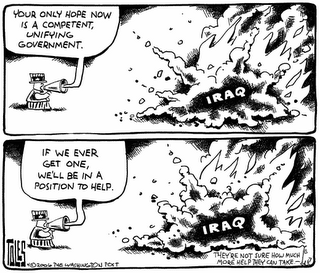 Shiite Drops Bid to Keep Post as Premier (NYT)
A Glimmer of Hope in Iraq (NYT Editorial)
Prosecutors Concede Doubts About Moussaoui's Story (NYT)
U.S. Suffers Setback in Case Of Alleged Enemy Combatant (WaPo)
Bush and Iran -- A threat that can't be outsourced any longer. (WSJ Editorial)
Rove's New Mission: Survival (WaPo Op-Ed)
Saturday, April 22, 2006
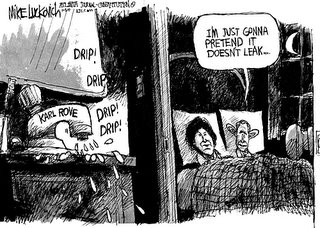
CIA Officer Is Fired for Media Leaks (WaPo)
Shiites Settle on Pick for Iraqi Premier (NYT)
[Ed. Note: Slow news day, I guess.]
Sunday, April 23, 2006
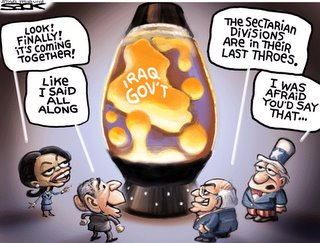 Iraq Breaks Impasse on Government (LAT)
Hamas, Abbas Supporters Clash (LAT)
Bush's third term (LAT editorial calling for Cheney to be put out to pasture!)
Young Officers Join the Debate Over Rumsfeld (NYT)
Colleagues Say C.I.A. Analyst Played by the Rules (NYT)
New Plans Foresee Fighting Terrorism Beyond War Zones (WaPo)
Monday, April 24, 2006
 Bin Laden Says West Is Waging War Against Islam (NYT)
Warily, Iraqis Investing Hope in New Leaders (NYT)
Bibliophiles inside the wire
Inspectors Find More Torture at Iraqi Jails -- Top General's Pledge To Protect Prisoners 'Not Being Followed' (WaPo)
In Iraq's Choice, A Chance For Unity (WaPo Op-Ed)
Tuesday April 25, 2006
30 Are Killed in Sinai as Bombs Rock Egyptian Resort City (NYT)
Rebuilding of Iraqi Pipeline as Disaster Waiting to Happen (NYT)
Dozens of Security Force Recruits Are Killed by Iraqi Insurgents (NYT)
Iran Is Described as Defiant on 2nd Nuclear Program (NYT)
Fired C.I.A. Officer Denies Role in Leak (NYT)
Rage at Don -- The war on Rumsfeld is really a bureaucratic turf battle (WSJ Op-Ed)
Shiite Militias Move Into Oil-Rich Kirkuk, Even as Kurds Dig In (WaPo)
Rice Says Progress In Iraq Might Aid Efforts on Turkey (WaPo)
Baghdad Rocked By Car Bombs: At Least 10 Killed; Police Find Bodies of 32 Security Recruits (WaPo)
U.S. to Free 141 Terror Suspects (LAT)
Leaks of Military Files Resume: Despite security efforts, flash drives stolen from U.S. base in Afghanistan are still sold at bazaar (LAT)
Envoy to Iraq Predicts U.S. May Need to Stay in Region for Years (LAT)
 Shiite Drops Bid to Keep Post as Premier (NYT)
A Glimmer of Hope in Iraq (NYT Editorial)
Prosecutors Concede Doubts About Moussaoui's Story (NYT)
U.S. Suffers Setback in Case Of Alleged Enemy Combatant (WaPo)
Bush and Iran -- A threat that can't be outsourced any longer. (WSJ Editorial)
Rove's New Mission: Survival (WaPo Op-Ed)
Saturday, April 22, 2006

CIA Officer Is Fired for Media Leaks (WaPo)
Shiites Settle on Pick for Iraqi Premier (NYT)
[Ed. Note: Slow news day, I guess.]
Sunday, April 23, 2006
 Iraq Breaks Impasse on Government (LAT)
Hamas, Abbas Supporters Clash (LAT)
Bush's third term (LAT editorial calling for Cheney to be put out to pasture!)
Young Officers Join the Debate Over Rumsfeld (NYT)
Colleagues Say C.I.A. Analyst Played by the Rules (NYT)
New Plans Foresee Fighting Terrorism Beyond War Zones (WaPo)
Monday, April 24, 2006
 Bin Laden Says West Is Waging War Against Islam (NYT)
Warily, Iraqis Investing Hope in New Leaders (NYT)
Bibliophiles inside the wire
Inspectors Find More Torture at Iraqi Jails -- Top General's Pledge To Protect Prisoners 'Not Being Followed' (WaPo)
In Iraq's Choice, A Chance For Unity (WaPo Op-Ed)
Tuesday April 25, 2006

30 Are Killed in Sinai as Bombs Rock Egyptian Resort City (NYT)
Rebuilding of Iraqi Pipeline as Disaster Waiting to Happen (NYT)
Dozens of Security Force Recruits Are Killed by Iraqi Insurgents (NYT)
Iran Is Described as Defiant on 2nd Nuclear Program (NYT)
Fired C.I.A. Officer Denies Role in Leak (NYT)
Rage at Don -- The war on Rumsfeld is really a bureaucratic turf battle (WSJ Op-Ed)
Shiite Militias Move Into Oil-Rich Kirkuk, Even as Kurds Dig In (WaPo)
Rice Says Progress In Iraq Might Aid Efforts on Turkey (WaPo)
Baghdad Rocked By Car Bombs: At Least 10 Killed; Police Find Bodies of 32 Security Recruits (WaPo)
U.S. to Free 141 Terror Suspects (LAT)
Leaks of Military Files Resume: Despite security efforts, flash drives stolen from U.S. base in Afghanistan are still sold at bazaar (LAT)
Envoy to Iraq Predicts U.S. May Need to Stay in Region for Years (LAT)
Tuesday, April 25, 2006
Oh, Never Mind. They Weren't A Threat After All
This distrubs me: U.S. to Free 141 Terror Suspects
The Pentagon plans to release nearly a third of those held at the prison for terrorism suspects here because they pose no threat to U.S. security, an official of the war crimes tribunal said Monday.What happened? Were they rehabilitated? Or are we finally figuring out -- four years later -- that they were never a threat to begin with?
Friday, April 21, 2006
The WSJ Calls For War -- Almost
Concluding that "the idea that Iran is still a decade away from a bomb . . . now looks like wishful thinking," and that "[t]he Iranian bomb will thus be a crisis for this Administration, not the next, The Wall Street Journal editorial page today stopped just short of calling for military intervention in Iran:
The analogy to the "appeasment" of Hitler is widely touted, but wrong. So far at least, Iran has not laid claims to any of its neighbors. And, if it did, that would be the appropriate point for NATO and the other Great Powers to forcefully intervene, much as it did in the First Gulf War. I guess the biggest threat is to Israel, but since Iran and Israel share no common border, that threat consists largely of the threat to lob nuclear tipped missles into Israel. Again, this is a threat that can probably be dealt with by deterrence, although I can see why the Israelis would not be all that sanguine about that approach.
Still, there is the core problem here, and it is a problem that underlies any deabte about preventative war. Why must we -- or any nation -- wait until a threat becomes clear and present before doing anything about it? That question has a bad rep right now becuase it was the theory that underlay the Iraq war. But the thing that made the Iraq war such a terrible mistake was not the principle of "prevention" but the fact that Saddam did not in fact have any WMDs and was not, therefore, even a theoretical threat. Would we be so opposed to the Iraq war if we had found the WMDs? I don't think so. The problem, then, is not that the Iraq war was wrong in principle; rather it was wrong becuase, as it turned out, it was unnecessary.
So, I ask myself: can we afford to let a nut case like Mahmoud Ahmadinejad have nuclear weapons? More precisely, are we sufficiently committed to preventing that to accept the consequences of bombing Iran? Zbigniew Brzezinski laid out some of those consequences in an April 23 Op-Ed piece in the LA Times . Those consquences are real and potentially awful. But are they more or less awful that an nuclear armed Iran? Frankly, I just don't know.
This much seems clear to me, though. We would have had a far better chance of containing this threat either diplomatically or militarily if we had not gotten ourselves mired down in Iraq.
The task now for the President is to begin speaking publicly about why a nuclear Iran is, as he calls it, "unacceptable." Far from preparing for war with Iran, the Administration has barely begun to confront the tough choices at hand. The reasons for this reluctance are easy to appreciate: The future of democratic Iraq is far from assured; Mr. Bush's approval ratings are in the tank and his political capital is depleted; and the military options against Iran have their own limitations and risks. But Mr. Bush remains President for 33 more months, with a Constitutional responsibility to ensure our safety. And there is no more clear and present danger than Iran's nuclear programs.I don't know if Iran's nuclear programs do pose the sort of clear and present danger that the WSJ supposes they do. I tend to agree with the WSJ that the prospects of stopping them diplomaticallyare close to nil, but I go back and forth on the question of which is worse: trying to stop them by force or accepting the inevitable and trying to contain a nuclear Iran via deterrence.
The analogy to the "appeasment" of Hitler is widely touted, but wrong. So far at least, Iran has not laid claims to any of its neighbors. And, if it did, that would be the appropriate point for NATO and the other Great Powers to forcefully intervene, much as it did in the First Gulf War. I guess the biggest threat is to Israel, but since Iran and Israel share no common border, that threat consists largely of the threat to lob nuclear tipped missles into Israel. Again, this is a threat that can probably be dealt with by deterrence, although I can see why the Israelis would not be all that sanguine about that approach.
Still, there is the core problem here, and it is a problem that underlies any deabte about preventative war. Why must we -- or any nation -- wait until a threat becomes clear and present before doing anything about it? That question has a bad rep right now becuase it was the theory that underlay the Iraq war. But the thing that made the Iraq war such a terrible mistake was not the principle of "prevention" but the fact that Saddam did not in fact have any WMDs and was not, therefore, even a theoretical threat. Would we be so opposed to the Iraq war if we had found the WMDs? I don't think so. The problem, then, is not that the Iraq war was wrong in principle; rather it was wrong becuase, as it turned out, it was unnecessary.
So, I ask myself: can we afford to let a nut case like Mahmoud Ahmadinejad have nuclear weapons? More precisely, are we sufficiently committed to preventing that to accept the consequences of bombing Iran? Zbigniew Brzezinski laid out some of those consequences in an April 23 Op-Ed piece in the LA Times . Those consquences are real and potentially awful. But are they more or less awful that an nuclear armed Iran? Frankly, I just don't know.
This much seems clear to me, though. We would have had a far better chance of containing this threat either diplomatically or militarily if we had not gotten ourselves mired down in Iraq.
Thursday, April 20, 2006
Billy Bob's Bulletins: Issue 1
A few daya ago, Billy Bob popped up again after an (enforced) absence of several weeks while he made his way into Iraq. In that post, he noted that "Ironically, Iraq is the hardest place to get good information on what's going on in Iraq." So, I decided to periodically put together a "basket" of links to articles on events in or potentially affecting Iraq. I had originally intended to do this on a weekly basis, but that's too much work, so I am going to do it whenever the spirit moves me. Here is the first issue:
Monday, April 17, 2006 [Tax Day]
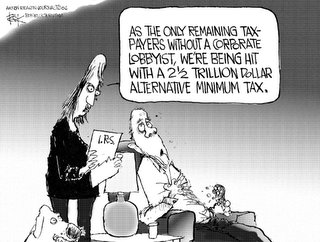
Iraqi Shiite Factions Struggle to Solve Political Impasse (NYT)
Despair Deepens as Iraqis Appear No Closer to Deal (LAT)
Outrage at Funeral Protests Pushes Lawmakers to Act (NYT)
General Defends Rumsfeld, With a Caveat (NYT)
The General's War (WSJ)
Tuesday, April 18, 2006
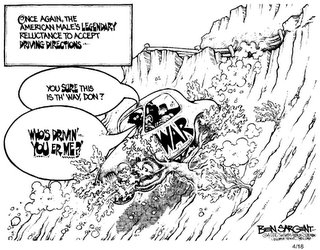 Ruined Treasures in Babylon Await an Iraq Without Fighting (NYT)
Sunni District in Baghdad Is Sealed Off (NYT)
Rumsfeld Says Calls for Ouster 'Will Pass' (NYT)
Books of the Times: A General Reports on the Dangers of Global Instability (NYT)
Battle Rages in Baghdad Neighborhood (LAT)
Wednesday, April 19, 2006
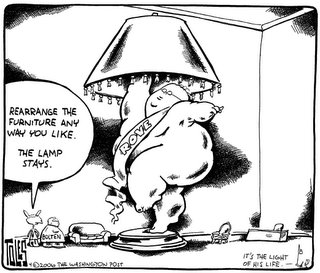 Iraqi Troops Move to Tame a Sunni District in Baghdad (NYT)
A Bright Career Unravels in Iraq (LAT)
Iraq's Kurds Aim for Own Oil Ministry (LAT)
At Heart of Iraqi Impasse, a Family Feud (WaPo)
Mission of Frustration in Afghan Villages (WaPo)
Mystery Hangs Over Baghdad Battle (WaPo)
Parsing the Polls: Iraq, Vietnam and Public Opinion (WaPo)
Thursday, April 20, 2006
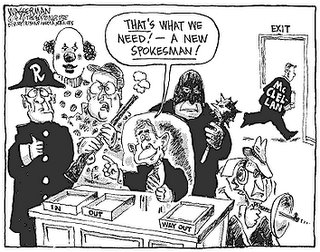
Rove's Role Reduced, McClellan Resigns in White House Shakeup
Iraqi Premier Allows Vote That Could End Deadlock (NYT)
Unforeseen Spending on Materiel Pumps Up Iraq War Bill (WaPo)
Bush Says Failure in Iraq 'Not an Option' (ABC)
Learn to bend, Mr. Bush. You won't break (WSJ)
Monday, April 17, 2006 [Tax Day]

Iraqi Shiite Factions Struggle to Solve Political Impasse (NYT)
Despair Deepens as Iraqis Appear No Closer to Deal (LAT)
Outrage at Funeral Protests Pushes Lawmakers to Act (NYT)
General Defends Rumsfeld, With a Caveat (NYT)
The General's War (WSJ)
Tuesday, April 18, 2006
 Ruined Treasures in Babylon Await an Iraq Without Fighting (NYT)
Sunni District in Baghdad Is Sealed Off (NYT)
Rumsfeld Says Calls for Ouster 'Will Pass' (NYT)
Books of the Times: A General Reports on the Dangers of Global Instability (NYT)
Battle Rages in Baghdad Neighborhood (LAT)
Wednesday, April 19, 2006
 Iraqi Troops Move to Tame a Sunni District in Baghdad (NYT)
A Bright Career Unravels in Iraq (LAT)
Iraq's Kurds Aim for Own Oil Ministry (LAT)
At Heart of Iraqi Impasse, a Family Feud (WaPo)
Mission of Frustration in Afghan Villages (WaPo)
Mystery Hangs Over Baghdad Battle (WaPo)
Parsing the Polls: Iraq, Vietnam and Public Opinion (WaPo)
Thursday, April 20, 2006

Rove's Role Reduced, McClellan Resigns in White House Shakeup
Iraqi Premier Allows Vote That Could End Deadlock (NYT)
Unforeseen Spending on Materiel Pumps Up Iraq War Bill (WaPo)
Bush Says Failure in Iraq 'Not an Option' (ABC)
Learn to bend, Mr. Bush. You won't break (WSJ)
A Peaceful Call to Arms - New York Times
I can't decide if this Op-Ed piece in today's NY Time is serious or not: A Peaceful Call to Arms:
What makes me wonder whether this is a joke is this:
To say that I think this is nuts would be an understatement.
THE American public needs to be prepared for what is shaping up to be a clash of colossal proportions between the West and Iran.Huh?
President Franklin D. Roosevelt masterfully prepared Americans before the United States entered World War II by initiating a peacetime draft under the Selective Training and Service Act of 1940.
Now, President Bush and Congress should reinstitute selective service under a lottery without any deferments.
What makes me wonder whether this is a joke is this:
President Bush has the perfect credentials overseas to execute this move, and little political capital at home to lose at this stage. Polls confirm that a wide majority of people in many countries view him and the United States as the major threat to global peace. Why let them down on this count? Go with the flow.But the rest of it is so damn earnest that one has to think that the guy just might be serious.
To say that I think this is nuts would be an understatement.
Monday, April 17, 2006
Questions For Taranto and Fund
It seems to be my day to try to engage Op-Ed writers. I posted one pair of questions I wrote to Paul Krugman earlier today, and here are two more:
The first is to James Taranto regarding two pieces he has written (see this and this) taking issue with a paper by the Harvard Kennedy School's Stephen Walt and the University of Chicago's John Mearsheimer. The Paper argues, apparently, that the pro-Isreal "lobby" has pushed the US into foreign policy positions that are inimicable to our actual national interests. You may need to read the Taranto pieces to make sense of this. You won't need to read the Mearsheimer/Walt paper, though, since this is about is Taranto's reaction to the paper, not the paper itself:
The first is to James Taranto regarding two pieces he has written (see this and this) taking issue with a paper by the Harvard Kennedy School's Stephen Walt and the University of Chicago's John Mearsheimer. The Paper argues, apparently, that the pro-Isreal "lobby" has pushed the US into foreign policy positions that are inimicable to our actual national interests. You may need to read the Taranto pieces to make sense of this. You won't need to read the Mearsheimer/Walt paper, though, since this is about is Taranto's reaction to the paper, not the paper itself:
Jimbo:The second is a much shorter note to John Fund re the fourth or fifth editorial he has written (I have lost count) on the Yale Taliban:
I gather you were disappointed that your March 20 "dissection" of the Mearsheimer/Walt paper has gone largely unnoticed, but you rallied to conclude that this also meant it had gone "unrebutted." Hmm.
Perhaps the reason no one was all that impressed is that you conceded the only point that really matters when you said that, although you found the arguments "wrong headed," you nonetheless would "stipulate that one can in good faith take the position that the costs to the U.S. of supporting Israel outweigh the benefits. " The rest of the piece tries to "dissect" the claim that Israel is not morally superior to the Palestinians.
I thought at the time I read this that it was strange: "Is he arguing," I wondered, "that we should take actions that he stipulates may not be in our national interests simply because it is 'moral' to do so? No, that can't be! Ruthless attention to self-interest is the neo-con creed, isn't it?"
Ruthless attention to self-interest SHOULD be our guiding principle, and I don't know why that should apply everywhere except in the case of Israel. If you concede that "one can in good faith take the position that the costs to the U.S. of supporting Israel outweigh the benefits" you have, I think, conceded that support of Israel is questionable. Morality just doesn't enter into it.
The other problem with you piece is this: all you succeeded in doing in "dissecting" the Mearsheimer/Walt moral arguments is to prove that even the moral superiority of Israel is debatable.
But the thing that really bothers me about both of your pieces is the idea that anyone that supports Israel has to deny the existence -- or at least the power -- of the pro-Israel "lobby." Of course there is a pro-Israel lobby. AIPAC is registered as such. And "lobbying" in favor of Israel and the Jews goes back at least as far as Chaim Weizman and Louis Brandeis. The question Mearsheimer/Walt raise -- legitimately, I think -- is whether, given where we are today, that lobbying has been too effective; i.e. whether it has led the US into positions that are inimitable to its national interests -- a question on which you agree reasonable minds could differ. Asking that question -- even making arguments on one side of it -- is very little different than asking whether -- and arguing that -- Pharma has been "too effective" in promoting the interests of the pharmaceutical companies.
Part of the problem with the whole Israel question is that it has become equated with anti-semitism. As you pieces demonstrate, one cannot long or seriously question our policies vis-a-vis Israel without being labeled an anti-semite. That is just wrong.
John:
Give it a rest, will you. Isn't there something more important going on in the world than one silly little 20 something student at Yale?
Quote Of The Day
From an editorial in today's Wall Street Journal on the "The Generals [sic] War" against Donald Rumsfeld comes this indisputably true observation :
We suspect the President understands that most of those calling for Mr. Rumsfeld's head are really longing for his.
Questions For Paul Krugman
Paul Krugman 's Op-Ed piece today excoriates Exxon for being an "Enemy of the Planet." The piece begins with a swipe at Lee Raymond's reported $686 million in compensation over the 13 years he has headed Exxon. Krugman obviously believes this is obscene. "But that," he says, "is not a reason to single him out for special excoriation. Executive compensation is out of control in corporate America as a whole, and unlike other grossly overpaid business leaders, Mr. Raymond can at least claim to have made money for his stockholders."
No, says Krugman, "There's a better reason to excoriate Mr. Raymond: for the sake of his company's bottom line, and perhaps his own personal enrichment, he turned Exxon Mobil into an enemy of the planet." Exxon, is an "enemy of the planet," of course, because it elected to "fight the science" regarding global warming.
Since Krugman holds himself out as an economist, I decided to send him an e-mail asking him the two questions that really bother me about both of these issues. Here is the e-mail:
Mr. Krugman:If he answers either question, I'll post the response. But don't hold your breath.
I have two questions [about your Exxon Op-Ed piece]:
1. What criteria do you use in concluding the Lee Raymond (or anyone) is "grossly overpaid" (or underpaid)?
2. On the issue of global warming, what do you make of George Will's point (see www.washingtonpost.com/wp-dyn/content/article/2006/03/31/AR2006033101707.html) that 30 years ago, we had a similar degree of scientific consensus that we were headed for another ice age? More generally, what do we do about the fact that the scientific consensus at any given moment in time can be spectacularly wrong. Think everything from Ptolemy to Piltdown man; from flat earth to alchemy, form swine flu to the idea (known as "acid rain") that SO2 emissions from power plants were responsible for acidification of Adirondack lakes.
I am not troglodyte on the issue of global warming that my question may make me appear to be. I am actually concerned about the issue. But I am also concerned about this: the costs of doing what the scientific consensus says we should be doing are stupefyingly large and that fact needs to be factored into this debate. Is the cost of preventing global warming times the probability that we will be able to do so greater or less than the cost of global warming itself times the probability that those costs (whatever they are) will occur if we do nothing? I do not know the answer to that, nor do I think anyone else does either. But I think it is unreasonable to ignore the fact that there are probability functions on both sides of the equations and that both of those probabilities are probably significantly less than 1.
Lest We Forget
Reminded of the horrors of 9/11 by the 911 tapes played in the Moussaoui trial, Bob Herbert vents:
As I listened to the victims pleading desperately for help as the smoke and flames closed in on them, the same thought came repeatedly to mind:
We were attacked by Osama bin Laden and Al Qaeda. What are we doing in Iraq?
. . . .
It is time for the American people to wise up. From the very beginning, the so-called war on terror was viewed by the Bush crowd as a magical smoke screen, a political gift from the gods that could be endlessly manipulated to justify all kinds of policies and behavior — including the senseless war in Iraq — that otherwise would never have been tolerated by the American people.
. . . .
The war has been a disaster. At the same time, the administration's unscrupulous exploitation of fear and patriotism has opened the door to such gruesome and morally indefensible activities as torture, warrantless spying on Americans and the wholesale incarceration of foreigners — perhaps for life — who have no real chance to confront their accusers or answer the charges against them.
All of this should be kept in mind as we consider the fact that the administration that once had its hostile eye on Iraq now has it trained like a laser on Iran.
Friday, April 14, 2006
Down a dangerous road - Los Angeles Times
Iraq as Lebanon, only worse: Down a dangerous road - Los Angeles Times
Subscribe to:
Posts (Atom)