Notwithstanding my concerns about billy bob and my continuing skepticism that we are doing any good in Iraq, I was pleased that the "Senate Reject[ed] Democrats’ Call to Pull Troops" yesterday.
For one thing, I am very cynical about the Democrats' motives in this. They have always known there was no chance such a resolution would ever actually go into effect, since it has always been clear that there is not enough support to overcome a filibuster much less a veto. Moreover, even if by some chance it did become effective, it would spark a Constitutional crisis of historic proportions, for there is no question Bush would ignore it. So what is the point?
Perhaps one could argue that even if the effort was obviously futile from the outset, it is important to make a statement as to one's beliefs. Well, maybe. But I am hard pressed to see why votes are required for this purpose. Coming on top of the non-binding resolution passed by House last month, one can't help but feel that the Democrats' real purpose has less to do with matters of conscience than it does with forcing the Republicans (as well as some Democrats) to again and again cast votes that the Democrats will be able to portray as "pro-war" two years from now.
These tactics no doubt serve to fire-up the bases on both sides. But elections are won and lost in the middle. And if I am any indication of how that middle feels about these antics, the Democrats are making a huge mistake playing politics with this war.
No one sensate is in favor of this war. The question is what to do about it. Like it or not, so long as Bush is President, the answer to that question is up to Bush. As an institution at least, Congress' choices come down to this: sit down shut up for the next two years and hope for the best or take responsibility and either cut off funding or impeach Bush.
Showing posts with label Iraq/Afghanistan. Show all posts
Showing posts with label Iraq/Afghanistan. Show all posts
Monday, March 19, 2007


Monday, February 12, 2007
Opposing The War But Supporting The Troops?
William Arkin, a national security/military affairs blogger for the Washington Post kicked of a regular firestorm with a January 31 column taking American soldiers to task for complaining about domestic opposition to the Iraq war. After quoting three soldiers who in various ways argued that you can not oppose the war and still claim to support the troops, Arkin unloaded:
There were well over 3,000 "comments" posted on the first three of these columns; yet this was just the tip of the iceberg of e-mail and blog reactions that the columns generated. The Post had finally had enough, as Arkin acknowledged in his final post:
Is it possible to support the troops but oppose the mission? At one level, the answer is an obvious "yes." I can certainly oppose the war and yet have and manifest pride in our troops, their efforts, and how they go about the job they have been assigned. In fact, in some ways, the more important it is to me to support the troops, then the more urgently I need to oppose the war since it is the war that is killing them.
But at another level, I guess I can see what the "support the troops, support the mission" crowd means. These guys and girls have left family and friends, homes and jobs, comfort and safety and are over in a hell hole the scope of which we cannot even imagine, and they are fighting and in some cases dying. How can I say I "support" them if I also say that their sacrifices are meaningless if not reprehensible. I know if I were doing something that entailed that amount of risk and suffering I would have mixed emotions about people who claimed to be proud of me but who thought what I was doing was a crime or worse. If you want the troops to believe that you are proud of them, you almost have to tell them that what they are risking their lives for is worth it. I think it is worth it, for now at least, but that is a story for another time.
The other question Arkin raises is even more difficult and certainly more important. How does a democratic society relate to an all-volunteer army? Do soldiers who volunteered give up the right to bitch about how they are used? Do they give up the right to complain about those who don't cheer for them? Do they have any right to anything more than what they were promised as an inducement to sign up?
And, what do we civilians owe to such an army? Aren't they just the "the hired help?" Do we owe them any more (or less) respect, any greater pay, benefits and support, than we do policemen, or firemen, or any of the other people we have hired to protect us from what we see as dangerous? Do we owe these men and women the same type of support we gave the GIs in WWII?
I think the answer is no. But I'm not sure. And, if the answer is "no," I'm even less sure what the right answer is.
These soldiers should be grateful that the American public, which by all polls overwhelmingly disapproves of the Iraq war and the President's handling of it, do still offer their support to them, and their respect.That wasn't the worst part. The line that gained the most attention was this one:
Through every Abu Ghraib and Haditha, through every rape and murder, the American public has indulged those in uniform, accepting that the incidents were the product of bad apples or even of some administration or command order. . . .
So, we pay the soldiers a decent wage, take care of their families, provide them with housing and medical care and vast social support systems and ship obscene amenities into the war zone for them, we support them in every possible way, and their attitude is that we should in addition roll over and play dead, defer to the military and the generals and let them fight their war, and give up our rights and responsibilities to speak up because they are above society?
[This complaining by the troops] is just an ugly reminder of the price we pay for a mercenary - oops sorry, volunteer - force that thinks it is doing the dirty work.The response to this was swift and ugly and personal and overwhelming. After two more columns one attacking his critics and another defending himself and half apologizing, Arkin finally threw in the towel with an embarrassingly maudlin effort, in his words, "to make sense of the worldview of those who have responded."
There were well over 3,000 "comments" posted on the first three of these columns; yet this was just the tip of the iceberg of e-mail and blog reactions that the columns generated. The Post had finally had enough, as Arkin acknowledged in his final post:
On the advice of my editors, this is the last column I will post for awhile on this subject. My impulse would be to continue to fight back and answer the critics, but I see the wisdom in their observation that nothing new is being said here and the Internet frenzy is adding nothing to the debate or our understanding of our world. I also see that I cannot continue to write about humanity and difficult questions if indeed what I wish is to vanquish those who attack me.But that was not quite enough. Yesterday, in a self-confessed effort to insulate the Post itself from the "Blast Damage" caused by Arkin, the Post's ombudsman published what amounted to a public rejection of its own columnist:
I am not about to defend Arkin's language or the entirely unwarranted anger it seems to betray. But I do think there are a couple of important issues buried in all of this.The fact that The Post and washingtonpost.com are interlocking yet separate is lost on most readers, who do not care that the two are miles apart physically and under different management. A great example is the recent firestorm over a column that never appeared in The Post -- but for which The Post was blamed. . . . Did one online column irreparably damage Post national security journalism? No. But it does show that an online column rubs off on the newspaper. . . .
What's the difference between opinion writing for the newspaper and for washingtonpost.com? The writing can be similar, but the editing is more intense at the newspaper. More experienced eyes see a story or a column before it goes into the paper; The Post has several levels of rigorous editing. There is "less of an editing process" for blogs at the more immediacy-oriented Web site, Brady said. . . .
Arkin's column did not meet Post standards, but then, newspaper editing isn't perfect, either. But "mercenary" surely is live ammo; such an incendiary word should have popped out in flames to Post editors.
Is it possible to support the troops but oppose the mission? At one level, the answer is an obvious "yes." I can certainly oppose the war and yet have and manifest pride in our troops, their efforts, and how they go about the job they have been assigned. In fact, in some ways, the more important it is to me to support the troops, then the more urgently I need to oppose the war since it is the war that is killing them.
But at another level, I guess I can see what the "support the troops, support the mission" crowd means. These guys and girls have left family and friends, homes and jobs, comfort and safety and are over in a hell hole the scope of which we cannot even imagine, and they are fighting and in some cases dying. How can I say I "support" them if I also say that their sacrifices are meaningless if not reprehensible. I know if I were doing something that entailed that amount of risk and suffering I would have mixed emotions about people who claimed to be proud of me but who thought what I was doing was a crime or worse. If you want the troops to believe that you are proud of them, you almost have to tell them that what they are risking their lives for is worth it. I think it is worth it, for now at least, but that is a story for another time.
The other question Arkin raises is even more difficult and certainly more important. How does a democratic society relate to an all-volunteer army? Do soldiers who volunteered give up the right to bitch about how they are used? Do they give up the right to complain about those who don't cheer for them? Do they have any right to anything more than what they were promised as an inducement to sign up?
And, what do we civilians owe to such an army? Aren't they just the "the hired help?" Do we owe them any more (or less) respect, any greater pay, benefits and support, than we do policemen, or firemen, or any of the other people we have hired to protect us from what we see as dangerous? Do we owe these men and women the same type of support we gave the GIs in WWII?
I think the answer is no. But I'm not sure. And, if the answer is "no," I'm even less sure what the right answer is.
Sunday, December 10, 2006
Stay or Leave Part II: The ISG Recommendations
I haven't read the Iraq Study Group Report, but I feel like I have, since it is just about all you hear and read about in the news. The report is getting lots of plaudits from opponents of the Bush Administration for the bleak picture it paints of the situation and for the none-to-subtle indictment its "realist" authors make of the neoconservative perpetrators of this mess. But that was not really the point of the ISG, was it? The point was not to dwell on the failures of the past, failures that have already been massively documented and that even Bush, Rumsfeld and most of the neo-cons now acknowledge. The point was to identify -- in the report's own slogan --"The Way Forward;" to make recommendations as to what to do now. On this score, I can find no one who has anything good to say about the report.
Since the report recommendations (as well as its recriminations) line up so well with the positions being articulated by most of the the Democratic Party leadership and the New York Times editorial page, I would have expected the New York Times' op-ed page to reflect whatever sense of optimism there may be out there. If that expectation is reasonable, then today's op-ed offerings indicate there is nearly universal disappointment in the ISG recommendations and a growing sense that there really is no middle road between "Go Big" and "Go Home".
The Sunday Times has two full pages of op-ed pieces. Today, most of that space was devoted, in one way or another, to the ISG report. The longest of these pieces, "79 Steps To Victory in Iraq," is a collection of a dozen short opinion pieces on the recommendations. Not a single one of them had anything remotely hopeful to say about them. They range between damning with faint praise and damning altogether with no praise at all. Several did agree that success in implementing some of the recommendations is essential if there is to be any hope, but one gets no sense even from these voices that success is actually achievable. The others are contemptuous of the recommendations for exactly that reason: the recommendations are seen as either being banal or as being so removed from reality as to be almost delusional. In total, the sense one gets from reading this dozen reviews is that, even if Bush accepted and attempted to implement, the recommendations, it would change nothing.
Frank Rich's "The Sunshine Boys Can't Save Iraq" makes this point explicitly and goes on to argue that we cannot let the ISG recommendations delude us into thinking there is still hope of achieving even the much watered-down goal of an Iraq "that can govern itself, sustain itself, and defend itself." He compares the ISG to a similar group of "wise men" convened by Lyndon Johnson in 1968.
So where does all of this leave me? Not much further than I was when I wrote this in response to Billy Bob's question, "Stay or Leave?" I admit to being disappointed that the ISG recommendations seem to be either banal or impractical. What did I expect? Not much really. But I did so want to find some reason to hope that I had allowed myself to begin to look forward to the release of those recommendations. When they came out, though, my first thought was the same one I had 4 years ago when Colin Powell made his pitch to the UN on why Iraq was dangerous: "Is THAT all you could come up with?"
So, I am right back where I started from: unable to join Frank Rich and John Murtagh in abandoning entirely any hope of avoiding the kind of future Brooks sees, but yet seeing no reason to believe that there is any way to succeed in doing so.
I can see only three courses that we might pursue at this point: Go Big and Long, Go Small and Long, or Go Home. The first of these is the preference of the right, and a long term occupation of Iraq may well be the course that has the best chance of avoiding a total collapse into chaos (although even that approach didn't work well for the Russians in Afghanistan). But there are neither enough troops nor enough electoral stomach to "go big," so this option is not any more realistic than hoping Iran and Syria will play nice. The "go home" option is the obvious choice if you have abandoned hope or if you believe that the Iraqis and their neighbors will learn to get along once we leave. I am not yet quite ready to do the former; nor am I willing to engage in the self-delusion required for the latter. This leaves the "go small and long" option, which is pretty much what the ISG recommended. So, as lame as those recommendations are, I guess that, for now, I am prepared to give them a try. However, I recognize that if the denoument in five years (or more) years is not any different than it would have been if we left now, the additional thousands of US casualities will lay heavy on my conscience. (I ignore the Iraqi caualities not out of indifference but out of a belief that they will occur regardless of what we do).
Note to Bush, Cheney, Rumsfeld, Wolfowitz, Feith and Perle: May you rot in hell for putting us in this situation. Better yet, may you be sent to spend the rest of your miserable lives in Baghdad. And then go to hell.
Since the report recommendations (as well as its recriminations) line up so well with the positions being articulated by most of the the Democratic Party leadership and the New York Times editorial page, I would have expected the New York Times' op-ed page to reflect whatever sense of optimism there may be out there. If that expectation is reasonable, then today's op-ed offerings indicate there is nearly universal disappointment in the ISG recommendations and a growing sense that there really is no middle road between "Go Big" and "Go Home".
The Sunday Times has two full pages of op-ed pieces. Today, most of that space was devoted, in one way or another, to the ISG report. The longest of these pieces, "79 Steps To Victory in Iraq," is a collection of a dozen short opinion pieces on the recommendations. Not a single one of them had anything remotely hopeful to say about them. They range between damning with faint praise and damning altogether with no praise at all. Several did agree that success in implementing some of the recommendations is essential if there is to be any hope, but one gets no sense even from these voices that success is actually achievable. The others are contemptuous of the recommendations for exactly that reason: the recommendations are seen as either being banal or as being so removed from reality as to be almost delusional. In total, the sense one gets from reading this dozen reviews is that, even if Bush accepted and attempted to implement, the recommendations, it would change nothing.
Frank Rich's "The Sunshine Boys Can't Save Iraq" makes this point explicitly and goes on to argue that we cannot let the ISG recommendations delude us into thinking there is still hope of achieving even the much watered-down goal of an Iraq "that can govern itself, sustain itself, and defend itself." He compares the ISG to a similar group of "wise men" convened by Lyndon Johnson in 1968.
In January 1968, L.B.J. replaced his arrogant failed defense secretary, Robert McNamara, with a practiced Washington hand, Clark Clifford. . . . Clifford commissioned a re-evaluation of American policy that churned up such ideas as a troop pullback, increased training for South Vietnamese forces and a warning to the South Vietnamese government that American assistance would depend on performance. In March, a bipartisan group of wise men . . . was summoned to the White House, where it seconded the notion of disengagement."Johnson did initiate peace talks, but it took another seven years, another 30,000 American deaths, and one of the worst domestic social upheavals since the Civil War before Johnson's successor's successor (Ford) finally threw in the towel and just left. Rich's closing comment on this parallel, and on the ISG itself, bears consideration:
The lesson in [the Vietnam analogy] is clear and sobering: As bad as things may seem now, they can yet become worse, and not just in Iraq. The longer we pretend that we have not lost there, the more we risk losing other wars we still may salvage, starting with Afghanistan.The third and bleakest column is David Brooks' "After The Fall". Despite being the Times' most conservative columnist, Brooks seems as ready as Rich to admit defeat, and he is focused instead on the consequences. Via the conceit of looking back on the present from the future, Brooks predicts that the ISG recommendations will be followed and American combat troops will be withdrawn in 2008; that this will result in a region-wide "30-Years War" during which political power and organization will be re-distributed on the basis of "family, tribe and faith" rather than existing states; and that this war will claim as victims all of the governments east of Egypt, south of Turkey and west Iran. Brooks acknowledges that this will be "a terrible era [with] horrific turmoil and the emergence of sociopolitical organizations whose likes the world ha[s] never seen." But with that he stops. There is no call to try to avert this outcome. He makes it sound as if he believes it is inevitable:
The members of the Iraq Study Group are all good Americans of proven service to their country. But to the extent that their report forestalls reality and promotes pipe dreams of one last chance for success in this fiasco, it will be remembered as just one more delusional milestone in the tragedy of our age.
The Middle East's weak national ties were ripped apart by the rising forces of the 21st century: religious fundamentalism, global terrorism, economic globalization, and transnational communication networks. Efforts to do nation-building without security faced long odds. Efforts to exhort Iraqi and other leaders to behave "responsibly" -- as defined by Western nationalist categories -- were doomed to failure. The American defeat sealed the deal."(It may be that Brooks believes all of this will occur only if we follow the recommendation to leave by 2008, but if that is his point, he doesn't make it).
So where does all of this leave me? Not much further than I was when I wrote this in response to Billy Bob's question, "Stay or Leave?" I admit to being disappointed that the ISG recommendations seem to be either banal or impractical. What did I expect? Not much really. But I did so want to find some reason to hope that I had allowed myself to begin to look forward to the release of those recommendations. When they came out, though, my first thought was the same one I had 4 years ago when Colin Powell made his pitch to the UN on why Iraq was dangerous: "Is THAT all you could come up with?"
So, I am right back where I started from: unable to join Frank Rich and John Murtagh in abandoning entirely any hope of avoiding the kind of future Brooks sees, but yet seeing no reason to believe that there is any way to succeed in doing so.
I can see only three courses that we might pursue at this point: Go Big and Long, Go Small and Long, or Go Home. The first of these is the preference of the right, and a long term occupation of Iraq may well be the course that has the best chance of avoiding a total collapse into chaos (although even that approach didn't work well for the Russians in Afghanistan). But there are neither enough troops nor enough electoral stomach to "go big," so this option is not any more realistic than hoping Iran and Syria will play nice. The "go home" option is the obvious choice if you have abandoned hope or if you believe that the Iraqis and their neighbors will learn to get along once we leave. I am not yet quite ready to do the former; nor am I willing to engage in the self-delusion required for the latter. This leaves the "go small and long" option, which is pretty much what the ISG recommended. So, as lame as those recommendations are, I guess that, for now, I am prepared to give them a try. However, I recognize that if the denoument in five years (or more) years is not any different than it would have been if we left now, the additional thousands of US casualities will lay heavy on my conscience. (I ignore the Iraqi caualities not out of indifference but out of a belief that they will occur regardless of what we do).
Note to Bush, Cheney, Rumsfeld, Wolfowitz, Feith and Perle: May you rot in hell for putting us in this situation. Better yet, may you be sent to spend the rest of your miserable lives in Baghdad. And then go to hell.
Wednesday, November 22, 2006
Mirages From The Quicksand
I always read Maureen Dowd's column, but it is mostly for laughs. She does have a way with words, but for the last two years she has done little with those talents other than to lob invective bombs at Bush, Rumsfeld and most especially Cheney. Not that they don't deserve it, and not that her rants don't make you smile, but mostly it is cheap humor, and, as with all such humor, it generates, along with a laugh, a twinge of sympathy for the targets and a rueful reconition that the vituperation and ridicule are little more than a sophisticated version of playground name-calling.
Today was a bit different, though. In a column entitled "Lost in the Desert" (subscription required), she writes with what comes close to anguish about the lack of options in Iraq. As she can do so well sometimes, she sums it all up in a single sentence:
Then there is the idea that the regional powers -- Iran, Syria, Saudi Arabia, Jordan, Turkey -- are the ones who can bring the warring factions together. There are (at least) two problems with this assertion. First, for the "regional powers" to play any role at all, they would have at least to agree on a desired end state. But these powers are not really all that much different than the factions warring within Iraq itself. Iran is militantly Shite, Saudi Arabia is militantly Sunni, Jordan and Turkey are largely secular, and the Assad regime is concerned only with preserving its own power. Contrary to Ignatius' assertion, there is an outcome that each of these powers fears more worse than a fragmented Iraq: a united Iraq dominated by one or the other (or, in the case ot Turkey and Jordan, either) of the religious sects currently at war. Getting these countries even to agree on an acceptable outcome does not seems much more likely than getting such agreement between the Mahdi Army and the Sunni insurgency. Ignatius makes the mistake so common to Americans: he takes as his premise that everyone else wants what we do. It just ain't so.
But, even if it were, even if we could hope that the regional powers could come to agreement on an end state to be pursued jointly, what in the world makes Ignatius or anyone else think they could achieve it? What are they going to do that the Americans are not? Is it just that they are Muslims and are therefore presumed to have greater influence over other Muslims? In some cases (e.g. Israel/Palestine), that idea may have some force. But in the case of Iraq, at least, it founders again on the sectarian/tribal nature of the conflict. This is not (at least not primarily) a war between Muslims and non-Muslims. It is a war between Shites and Sunnis. Being Muslim alone is not enough to give the regional powers influence any more than being "Christian" was enough to give the Pope influence over Heny the VIII.
But the part of Ignatius' "solution" that really appears to be preposterous is this: "Only the United States can broker the regional conference that will allow a political transition in Iraq." If there is any power in the world that is thoroughly discredited in the Islamic Middle East it is the US. We can't even get our allies to help us. What sort of delusion is it that allows one to suppse that the US has the ability to forge effective alliances between, say, Iran and Saudi Arabia? This sort of thinking is just more of the neoconservative nonsense -- the sense that America is all powerful -- that got us into Iraq in the first place. Despite 25 years of trying, we have not even been able to broker a peace between Israel and the Palestinians, despite the fact that we do have real influence over at least one of the parties to that conflict. How in the world are we to broker a peace between two parties both of which hate us and neither of which is dependent on us? Most of all, how do we persuade a charter member of the "axis of evil" -- a country against whom we are even now contemplating going to war -- to help us in that effort?
Today was a bit different, though. In a column entitled "Lost in the Desert" (subscription required), she writes with what comes close to anguish about the lack of options in Iraq. As she can do so well sometimes, she sums it all up in a single sentence:
It’s hard to remember when America has been so stuck. We can’t win and we can’t leave.She can't entirely eschew ridicule of Cheney, of course. (Note to Rob re your comment on this earlier post -- I think her predicition about Dick is closer to the truth):
Dick Cheney and his wormy aides, of course, are still babbling about total victory and completing the mission by raising the stakes and knocking off the mullahs in Tehran. His tombstone will probably say, "Here lies Dick Cheney, still winning."But apart from that, she does a good job of capturing the sense of sadness that I think so many of us share about the mess we are in. For those of you who don't have a "Times Select" subscription, here's an excerpt:
The good news is that the election finished what Katrina started. It dismantled the president’s fake reality about Iraq, causing opinions to come gushing forth from all quarters about where to go from here.While I think Maureen is right that no one knows what to do, there remains no shortage of people who talk like they do. Today's column by David Ignatius in the Washington Post is a case in point, and the real impetus to this post:
The bad news is that no one, and I mean no one, really knows where to go from here. The White House and the Pentagon are ready to shift to Plan B. But Plan B is their empty term for miraculous salvation. . . .
Kofi Annan, who thought the war was crazy, now says that the United States is “trapped in Iraq” and can’t leave until the Iraqis can create a “secure environment” — even though the Iraqis evince not the slightest interest in a secure environment. (The death squads even assassinated a popular comedian this week.)
The retired Gen. Anthony Zinni, who thought Mr. Bush’s crusade to depose Saddam was foolish and did not want to send in any troops, now thinks we may have to send in more troops so we can eventually get out.
Lt. Gen. Raymond Odierno, whose soldiers pulled Saddam out of his spider hole and who is returning to Iraq to take charge of the day-to-day fight, has given up talking about a Jeffersonian democracy and now wishes only for a government in Iraq that’s viewed as legitimate. He has gone from “can do” to “don’t know.” He talked to The Times’s Thom Shanker about his curtailed goals of reducing sectarian violence and restoring civil authority, acknowledging: “Will we attain those? I don’t know.”
At a Senate hearing last week, Gen. John Abizaid sounded like Goldilocks meets Guernica, asserting two propositions about the war that are logically at war with each other. He said we can’t have fewer troops because the Iraqis need us, but we can’t have more because we don’t want the Iraqis to become dependent on us.
He contended that increasing the number of our troops would make the Iraqi government mad, but also asserted that decreasing the number would intensify sectarian violence.
This a poor menu of options.
There are so many things I think are wrong with this that I don't know where to start. To begin with, Ignatius largely assumes away the core problem by characterizing forces like the Mahdi Army and the Sunni insurgency as being "nationalist." If that were the case, there wouldn't be much of a problem. But it is not. The warring factions in Iraq are not fighting for a nation, they are fighting for sectarian domination. They are in favor of a "nation" if, but only if, their sect or tribe gets to run it. As such, "common cause" between them is possible only if they are willing and able to become nationalists; i.e to sublimate their sectarian hatreds to the common cause of creating a nation. Does anyone see that as even being remotely likely in anything like the near term?What will contain the Iraqi civil war, in the end, is that none of the regional powers can tolerate a shattered Iraq -- not Iran, not Syria, not Saudi Arabia, not Jordan, not Turkey. Nor do most Iraqis want a dissolution of their unitary state. The Iraqis will restabilize their nation when the "nationalist forces" -- including ones we don't like, such as Moqtada al-Sadr's Mahdi Army and the Sunni insurgency -- make common cause under a regional mandate.
Only the United States can broker the regional conference that will allow a political transition in Iraq. That's our leverage now -- diplomatic clout, more than military power. If the neighboring powers can help apply a tourniquet to stop the bleeding in Iraq, America can begin to step away.
Then there is the idea that the regional powers -- Iran, Syria, Saudi Arabia, Jordan, Turkey -- are the ones who can bring the warring factions together. There are (at least) two problems with this assertion. First, for the "regional powers" to play any role at all, they would have at least to agree on a desired end state. But these powers are not really all that much different than the factions warring within Iraq itself. Iran is militantly Shite, Saudi Arabia is militantly Sunni, Jordan and Turkey are largely secular, and the Assad regime is concerned only with preserving its own power. Contrary to Ignatius' assertion, there is an outcome that each of these powers fears more worse than a fragmented Iraq: a united Iraq dominated by one or the other (or, in the case ot Turkey and Jordan, either) of the religious sects currently at war. Getting these countries even to agree on an acceptable outcome does not seems much more likely than getting such agreement between the Mahdi Army and the Sunni insurgency. Ignatius makes the mistake so common to Americans: he takes as his premise that everyone else wants what we do. It just ain't so.
But, even if it were, even if we could hope that the regional powers could come to agreement on an end state to be pursued jointly, what in the world makes Ignatius or anyone else think they could achieve it? What are they going to do that the Americans are not? Is it just that they are Muslims and are therefore presumed to have greater influence over other Muslims? In some cases (e.g. Israel/Palestine), that idea may have some force. But in the case of Iraq, at least, it founders again on the sectarian/tribal nature of the conflict. This is not (at least not primarily) a war between Muslims and non-Muslims. It is a war between Shites and Sunnis. Being Muslim alone is not enough to give the regional powers influence any more than being "Christian" was enough to give the Pope influence over Heny the VIII.
But the part of Ignatius' "solution" that really appears to be preposterous is this: "Only the United States can broker the regional conference that will allow a political transition in Iraq." If there is any power in the world that is thoroughly discredited in the Islamic Middle East it is the US. We can't even get our allies to help us. What sort of delusion is it that allows one to suppse that the US has the ability to forge effective alliances between, say, Iran and Saudi Arabia? This sort of thinking is just more of the neoconservative nonsense -- the sense that America is all powerful -- that got us into Iraq in the first place. Despite 25 years of trying, we have not even been able to broker a peace between Israel and the Palestinians, despite the fact that we do have real influence over at least one of the parties to that conflict. How in the world are we to broker a peace between two parties both of which hate us and neither of which is dependent on us? Most of all, how do we persuade a charter member of the "axis of evil" -- a country against whom we are even now contemplating going to war -- to help us in that effort?
Saturday, November 18, 2006
Stay or Leave: Billy Bob on Iraq
Below is a portion of a long e-mail I got from billy bob about a week and a half ago that I have only today gotten a chance to actually read (It's been a rough ten days work-wise):
One of the most surprising think about the aftermath of the election is how much it seems to have taken the wind out of the sails of the "leave now" crowd. The drubbing the Republicans took was a catharsis. It gave the electroate a chance to express their anger at the idiots who got us into this mess. And, having done that, they are now able to better focus on the question billy bob asks: "Where do we go from here?" The problem, though, is that no one seems to have a good answer.
How you feel about the "stay or leave" question is a function of whether you think there is any hope that we can reach an "end state" (sorry bb) that is at least tolerable. There is plenty of reason to be pessimistic about that and very little reason to be optomistic. And, when you consider that pursuing the "long shot" will cost hundreds and perhaps thousands of young Americam men and women their lives and limbs (and hundreds of billions of dollars), "staying" seems like betting your life on double zero.
But two things counterbalance that for many of us, including billy bob I gather. First, there is fear of what will happen if we leave. Second, there is a sense of responsibilty. It has become commonplace to refer to this sense of responsibilty as "the Pottery Barn rule," but that is both trite and demeaning. We are not talking about a broken lamp here. We are talking by what could be catastrophe of hstoric magnitude. Inside Iraq, it could well be worse than the Balkans in the late 90's. M aybe even owrse than The Sudan today. Maybe even worse than the Hutus and the Tutsis. But frankly, that is not even the worst part. A failed state in the midst of the Middle East on the border of a soon to be nuclear Iran is a truly scary proposition. And compounding this is the propaganda victory the Islamists would get. It is hard to imagine how bad that could get. When you are the ones who are responsible making all this possible, you can't give up on the effort to avoid it so long as there is the slightest glimmer of hope.
But what to do? The dream of a secular liberal democracy in Iraq was always delusional but is now manifestly dead. The "best" end state we can hope for is stability, and the best we can probably hope for is a new Tito. I'd settle for a new Saddam. But one cannot clearly see how to achieve even that.
One idea I have heard recently is to quit trying to be neutral and unleash the Shias. My first reaction was horror at the thought. But the more I think about it, the harder it becomes to rule out. We are in the midst of s civil war that remains "low-grade" (if at all) only becuase we are there damping it down. I don't think it is possible in a situation like this to make the opposing sides reach a stable accomodation. So, one side or the other is going to end up winning this battle. We can make that happen more quickly and probably less painfully in the long run by taking sides, much like we did in Afghanistan when we aligned with the warlords and much as we have done through much of the last 60 years aligning ourselves with the anti-communists regardless of how repressive they were. And, if you have to pick sides, the Shias have at least three things to recommend them: they are the majority; they are the ones who have been repressed; and they hate Al Queda. If we have to have a theocracy emerge in Iraq, I would much prefer it to me one that has the support of the majority and an antipathy to our main enemy. After all, the enemy of my enemy is my friend.
Stay or leave?What do I think?
Clearly things are not that simple. We’re not staying forever and we’re not leaving tomorrow. My greatest frustration here in Iraq has been the continued and ritualistic rants about the spineless ones on the left who don’t want to see this thing through. The problem is, no one has honestly asked us to see this thing though. Americans have faced the bi or tri-monthly declarations that, “history will show that this month marks the turning point and the beginning of the end of the insurgency.” A few hundred deaths and a couple months later things look the same, but after a small victory on one of the infinite fronts of this effort, the declaration of change returns. Thus the choice we’ve been presented with is reduced to ‘trust us, we’ll be right one of these times and things will get better – the details of what’s happening are not important’ or ‘pull out because we don’t know how things are going or when they’ll get better and we aren’t willing to commit the lives of Americans to an effort you’re not willing to honestly assess.’
There is a wealth of counter-insurgency experience in the world and its libraries. Unfortunately for many freedom-fries loving “patriots,” much of that experience comes from the French and their experience in Algeria. Oh well. Time to swallow the pride and start absorbing the wisdom of others. While swallowing that bitter pill, we might as well admit that a lot of smart people were ostracized from the Iraq effort from the outset due to their less-than-rosy forecasts of outcomes that didn’t center on flowers falling from the sky. We need to bring these people together and ask them to give us options. Things will change, of course, but the fragility of every plan is no reason not to have one. We need smart people, who the past few years of history have shown to be insightful, to develop several courses of action with associated markers to track our progress toward an end-state. (I use the term ‘markers’ because I have come to despise ‘measures of effectiveness – MOEs’ which are focal points of the effects based planning we operate under. MOEs are often ends unto themselves and have little connection to the efforts we can influence.)
End state. What a concept. In the Army we can hardly walk to lunch without a predetermined end state, yet this war seems to be conspicuously lacking a goal. Iraq will not be a democracy resembling Ohio in our lifetimes, so let’s set a reasonable goal. It’s clear an insurgency will linger far longer than our American attention spans, but we do have a responsibility to enable a government that can, for the most part, protect the vast majority of Iraqis who want to live, work, and raise their families in peace. There will still be violence and an ugly situation, but it was an ugly situation when we arrived.
So we have some smart people working on plans to reach a reasonable end state with progress markers along the way. Let them do their job, give them more than the 30-60 days Jay Garner was afforded to plan a coalition provisional authority, then pitch their plans to Americans. Present 1, 3, 5, 10, 25, and maybe even 50-year options with associated costs in lives (both American and Iraqi), dollars, and American international credibility. Let us know what Iraq will look like along the way and when we leave. Even after 50 years there will be disillusioned individuals prone to violence, so I don’t buy the argument that timelines enable our enemies. Let America decide what we are willing to commit to.
Those of you who know me may notice this is a pretty substantial departure from my feelings before I deployed – I formerly would have been in the get-out-now camp. But I’ve realized this thing is too important to take the easy way out…whether the easy way out is to actually leave now or to stay indefinitely because we won’t be forced to admit any level of failure. This will not be the last time we face a foreign threat from terrorism, and while this war has taught us much about how not to react, we still need to improve the situation for Iraqis.
I’m fading so I need to wrap this up, but I’d love to hear your thoughts. I realize I’ve conveniently omitted road blocks such as an Iraqi democracy that turns to Iran for protection or elects a fundamentalist leader who, with plurality support, digresses to brutal rule in the name of security, but those are discussions for another day. What do you think? Can America step back, reevaluate our options, swallow a bit of pride, and choose an option based on the future more than the past?
I hope so.
One of the most surprising think about the aftermath of the election is how much it seems to have taken the wind out of the sails of the "leave now" crowd. The drubbing the Republicans took was a catharsis. It gave the electroate a chance to express their anger at the idiots who got us into this mess. And, having done that, they are now able to better focus on the question billy bob asks: "Where do we go from here?" The problem, though, is that no one seems to have a good answer.
How you feel about the "stay or leave" question is a function of whether you think there is any hope that we can reach an "end state" (sorry bb) that is at least tolerable. There is plenty of reason to be pessimistic about that and very little reason to be optomistic. And, when you consider that pursuing the "long shot" will cost hundreds and perhaps thousands of young Americam men and women their lives and limbs (and hundreds of billions of dollars), "staying" seems like betting your life on double zero.
But two things counterbalance that for many of us, including billy bob I gather. First, there is fear of what will happen if we leave. Second, there is a sense of responsibilty. It has become commonplace to refer to this sense of responsibilty as "the Pottery Barn rule," but that is both trite and demeaning. We are not talking about a broken lamp here. We are talking by what could be catastrophe of hstoric magnitude. Inside Iraq, it could well be worse than the Balkans in the late 90's. M aybe even owrse than The Sudan today. Maybe even worse than the Hutus and the Tutsis. But frankly, that is not even the worst part. A failed state in the midst of the Middle East on the border of a soon to be nuclear Iran is a truly scary proposition. And compounding this is the propaganda victory the Islamists would get. It is hard to imagine how bad that could get. When you are the ones who are responsible making all this possible, you can't give up on the effort to avoid it so long as there is the slightest glimmer of hope.
But what to do? The dream of a secular liberal democracy in Iraq was always delusional but is now manifestly dead. The "best" end state we can hope for is stability, and the best we can probably hope for is a new Tito. I'd settle for a new Saddam. But one cannot clearly see how to achieve even that.
One idea I have heard recently is to quit trying to be neutral and unleash the Shias. My first reaction was horror at the thought. But the more I think about it, the harder it becomes to rule out. We are in the midst of s civil war that remains "low-grade" (if at all) only becuase we are there damping it down. I don't think it is possible in a situation like this to make the opposing sides reach a stable accomodation. So, one side or the other is going to end up winning this battle. We can make that happen more quickly and probably less painfully in the long run by taking sides, much like we did in Afghanistan when we aligned with the warlords and much as we have done through much of the last 60 years aligning ourselves with the anti-communists regardless of how repressive they were. And, if you have to pick sides, the Shias have at least three things to recommend them: they are the majority; they are the ones who have been repressed; and they hate Al Queda. If we have to have a theocracy emerge in Iraq, I would much prefer it to me one that has the support of the majority and an antipathy to our main enemy. After all, the enemy of my enemy is my friend.
Monday, July 24, 2006
Billy Bob's Bulletins
As anyone who reads this can tell, I have pretty much quit doing this series of posts. It was started in response to Billy Bob's observation in an e-mail that news about Iraq was hard to come by in Iraq. So, I thought posting links that he could read (and if the spirit moved him comment on) more or less anonymously might serve a useful function. However, the longer I did this, the more uncomfortable I became. The news from all over the Middle East is just so consistently awful that I began to wonder if making it more accessible to someone fighting there was really the right thing to do.
However, the Washington Post today published the first two of what I gather will be a series of articles adapted from a new book by its lead reporter on military affairs, Thomas E. Ricks. The articles and the book (entitled "Fiasco: The American Military Adventure In Iraq") are pretty critical of American strategy and of the tactics that flowed from that strategy. As such, my initial reaction was that this was still another example of the kind of stuff I shouldn't burden Billy Bob with. But two things led me to go ahead. First, the intro to the series comes with links to a whole series of articles Ricks has written over the last 4 years on the debates within the military and between the military and the Administration that reads like a history of the Iraq war. It is just fascinating to see how close we came to getting it right. Second, the criticisms are not just carping. Nor are they just the ruminations of some jounalist. The criticisms come from within the military establishment itself and they contain some insights that seem to me to be still worth learning. As such, I thought Billy Bob might find some of these insights useful in terms of his own mission.
Hope I am not wrong on all of this.
Anyway, here is a link to Ricks' prior articles and here are links to the two new articles that appeared today:
However, the Washington Post today published the first two of what I gather will be a series of articles adapted from a new book by its lead reporter on military affairs, Thomas E. Ricks. The articles and the book (entitled "Fiasco: The American Military Adventure In Iraq") are pretty critical of American strategy and of the tactics that flowed from that strategy. As such, my initial reaction was that this was still another example of the kind of stuff I shouldn't burden Billy Bob with. But two things led me to go ahead. First, the intro to the series comes with links to a whole series of articles Ricks has written over the last 4 years on the debates within the military and between the military and the Administration that reads like a history of the Iraq war. It is just fascinating to see how close we came to getting it right. Second, the criticisms are not just carping. Nor are they just the ruminations of some jounalist. The criticisms come from within the military establishment itself and they contain some insights that seem to me to be still worth learning. As such, I thought Billy Bob might find some of these insights useful in terms of his own mission.
Hope I am not wrong on all of this.
Anyway, here is a link to Ricks' prior articles and here are links to the two new articles that appeared today:
In Iraq, Military Forgot Lessons of Vietnam (an overall critique of the strategy), andTwo quotes from the first of the new articles stick with me:
'It Looked Weird and Felt Wrong' (a more particularized critique of the 4th Infantry Division's implementation of that strategy).
"When you're facing a counterinsurgency war, if you get the strategy right, . . . eventually you'll get the tactics right [as well]," said retired Army Col. Robert Killebrew, a veteran of Special Forces in the Vietnam War. "If you get the strategy wrong . . ., you can refine the tactics forever, but you still lose the war."
As civil affairs officers found to their dismay, Army leaders tended to see the Iraqi people as the playing field on which a contest was played against insurgents. In [fact], the people are the prize.
Thursday, July 13, 2006
Supporting The Troops: Is It Possible To Do Too Much?
During my "hiatus" I had set aside a few things things that I thought might eventually be worthy of comment. Most of those seem a bit dated by now, overcome by further developments. But one exception is an op-ed piece by Max Boot of the LA Times entitled Our Enemies Aren't Drinking Lattes.
Returning from Iraq and elsewhere, Boot was surprised, impressed and a bit disturbed by the creature comforts available to our soldiers:
But there are costs involved in supporting our troops in this way (and to this extent) that are enough to give anyone pause.
The first of these is the threat isolation and relative privilege poses to the mission itself. "Successful counterinsurgency operations require troops to go out among the people, gathering intelligence and building goodwill. But few Iraqis are allowed on these bases, and few Americans are allowed out — and then only in forbidding armored convoys." The fact that our troops can and do spend most of their time in bases that provide security and creature comforts unimaginable to most Iraqis seems at least as likely to build resentment and jealously as it does gratitude among those we are trying to help. It also serves to reinforce the essential "alieness" of Americans. We say we are "in it with them," but in fact we are not. To the extent this envy and alieness hampers our ability to fight the insurgency, it at least extends the time over which our commitment must be maintained and may well doom that effort entirely.
But the even more compelling problem is that people are dying -- literally -- in the effort to ensure that Joe and Jane GI have lattes and Hagen Daz in Iraq. Boot cites some stunning statistics:
Boot ends with an interesting observation:
Returning from Iraq and elsewhere, Boot was surprised, impressed and a bit disturbed by the creature comforts available to our soldiers:
In the past few months, I have traveled across U.S. Central Command's area of operations — a vast domain stretching from the deserts of Arabia to the mountains of the Hindu Kush. Everywhere, I have found massive bases fortified with endless rows of concrete barriers and stocked with every convenience known to 21st century Americans.Boot is obviously torn by this, as am I. After all, what sort of venal, unpatriotic, scrooge could possibly object to providing our men and women in harm's way with anything that that might mitigate even somewhat the hardship, dangers and loneliness they are enduring on our behalf?
Some front-line units continue to operate out of spartan outposts where a hot meal is a luxury and flush toilets unknown. But growing numbers of troops live on giant installations complete with Wal-Mart-style post exchanges, movie theaters, swimming pools, gyms, fast-food eateries (Subway, Burger King, Cinnabon) and vast chow halls offering fresh-baked pies and multiple flavors of ice cream. Troops increasingly live in dorm-style quarters (called "chews," for "containerized housing units") complete with TVs, mini-refrigerators, air conditioning/heating units and other luxuries unimaginable to previous generations of GIs.
But there are costs involved in supporting our troops in this way (and to this extent) that are enough to give anyone pause.
The first of these is the threat isolation and relative privilege poses to the mission itself. "Successful counterinsurgency operations require troops to go out among the people, gathering intelligence and building goodwill. But few Iraqis are allowed on these bases, and few Americans are allowed out — and then only in forbidding armored convoys." The fact that our troops can and do spend most of their time in bases that provide security and creature comforts unimaginable to most Iraqis seems at least as likely to build resentment and jealously as it does gratitude among those we are trying to help. It also serves to reinforce the essential "alieness" of Americans. We say we are "in it with them," but in fact we are not. To the extent this envy and alieness hampers our ability to fight the insurgency, it at least extends the time over which our commitment must be maintained and may well doom that effort entirely.
But the even more compelling problem is that people are dying -- literally -- in the effort to ensure that Joe and Jane GI have lattes and Hagen Daz in Iraq. Boot cites some stunning statistics:
According to Centcom, there are 20,000 combat service support troops in its area of operations and another 80,000 contracted civilians. . . . U.S. troops in those countries consume 882,000 liters of water and 2.4 million gallons of fuel every day, plus tons of other supplies that have to be transported across dangerous war zones. Centcom has more than 3,000 trucks delivering supplies and another 2,400 moving fuel — each one a target that has to be protected.. As Boot enthused about the latte he had just finished, a Marine captain brought him back to earth with this question: "I wonder how many men had to die to get those coffee beans to Baqubah?" And I wonder how much comfort it provides to the parents/spouses/children of soldiers killed to know that their sons/daughters/husbands/wives/fathers/mothers died in the effort to get cherry pie filling to the troops at the front.
Boot ends with an interesting observation:
How to explain this seemingly counterproductive behavior? My theory is that any organization prefers to focus on what it does well. In the case of the Pentagon, that's logistics. Our ability to move supplies is unparalleled in military history. Fighting guerrillas, on the other hand, has never been a mission that has found much favor with the armed forces.
Friday, June 16, 2006
Billy Bob's Bulletins -- June 16, 2006
Congress Erupts in Partisan Fight Over Iraq War (NYT) 
U.S. Portrayal Helps Flesh Out Zarqawi's Heir (NYT)
Maliki Aide Who Discussed Amnesty Leaves Job (WaPo)
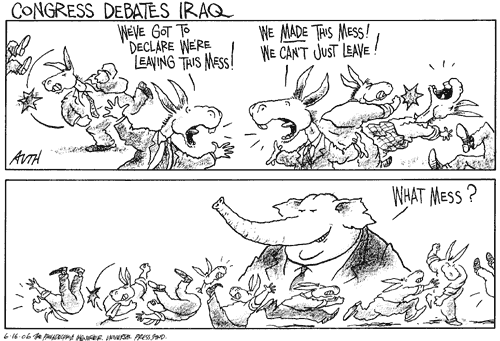
The House and the Senate engaged in angry, intensely partisan debate on Thursday over the war in Iraq, as Republicans sought to rally support for the Bush administration's policies and exploit Democratic divisions in an election year shadowed by unease over the war.
U.S. Portrayal Helps Flesh Out Zarqawi's Heir (NYT)
American military officers on Thursday put a face on the new chief of Al Qaeda in Mesopotamia, releasing a photograph and details of the man they say succeeded Abu Musab al-Zarqawi after he was killed in an airstrike last week.The State of Iraq: An Update (NYT Op-Ed)
After his surprise trip to Baghdad this week, President Bush struck a hopeful tone. "I do think we'll be able to measure progress," he declared at a news conference on Wednesday. "You can measure progress in capacity of Iraqi units ... in megawatts of electricity delivered ... in oil sold on the market .... There's ways to determine whether or not this government's plans are succeeding."
We agree. Unfortunately, according to our latest tally of metrics (compiled from a variety of government and news media sources), Iraq has a long way to go. To be successful, the new Iraqi government will have to do things that its predecessors and the United States have generally failed to accomplish.

Maliki Aide Who Discussed Amnesty Leaves Job (WaPo)
Prime Minister Nouri al-Maliki's office on Thursday accepted the resignation of an aide who had told a reporter that Maliki was considering a limited amnesty that would likely include guerrillas who had attacked U.S. troops, the aide said.Prayers in the Military: Oh, Lord, help Congress to stop its meddling (WaPo Op-Ed)
THE MILITARY has been making a good-faith effort in recent months to write rules on religious activities that preserve both the rights of free expression among service members and the separation of church and state. It's unfortunate, therefore, that the House of Representatives, responding to pressure from evangelical Christian groups, has unnecessarily inserted itself into this debate, with a provision in the recent defense authorization bill aimed at ensuring that evangelical chaplains can pray in Jesus's name at public ceremonies. The Senate is debating a version that wisely leaves out the House provision and lets the military services continue to work out this complex issue the right way -- without congressional interference.
Thursday, June 15, 2006
Billy Bob's Bulletin's -- June 15, 2006
The contrasting views on the future of Iraq are well summed up by the following:
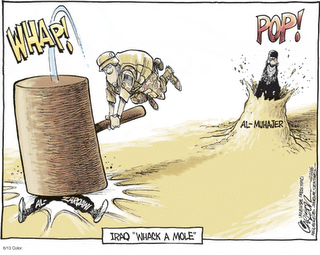
I don't know, which view will turn out to be more accurate. While I hope for the former, experience suggests that the latter is more likely. In any case, though, the Republicans are, per force, betting big that the American people will decide that Bremer is closer to the truth:
Seize the Day:"Our objective in Iraq is victory", by Paul Bremer in the WSJ:George Bush made his trip to Baghdad, he told the new prime minister, Nuri Kamal al-Maliki, "to look you in the eye." Yet his surprise visit established more than a first-hand connection. It signposted the dramatic events of the past week, which bode well both for Iraq's future and for the broader war on terrorism. As he stood in the hall of one of Saddam's former palaces--quite literally in the eye of the storm--Mr. Bush implored the Iraqis to "seize the moment." There are now emerging indications that they are doing just thatand these two political cartoons:

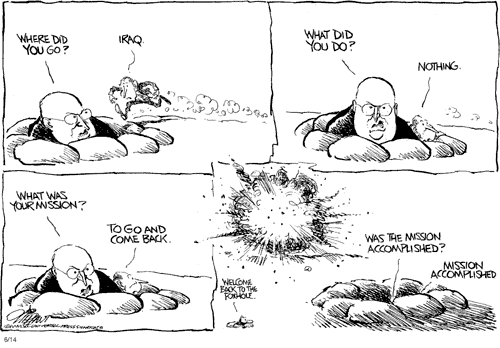
I don't know, which view will turn out to be more accurate. While I hope for the former, experience suggests that the latter is more likely. In any case, though, the Republicans are, per force, betting big that the American people will decide that Bremer is closer to the truth:
Bush Sees Progress in Iraq (WaPo)And, in other news:President Bush said yesterday that the United States is making steady progress in Iraq toward its goal of standing up a government that can sustain and protect the country, but he emphasized that the ultimate success of the U.S.-led venture lies in the hands of Iraqis.
The Republican Party's Iraq Offensive (LAT)The Iraq war is the most immediate foreign policy problem besetting the Bush administration. But as a political issue, the White House and top Republican strategists have concluded that the war is a clear winner.GOP Measure Forces House Debate on War (WaPo)Nearly four years after it authorized the use of force in Iraq, the House today will embark on its first extended debate on the war, with Republican leaders daring Democrats to vote against a nonbinding resolution to hold firm on Iraq and the war on terrorism.
In the wake of Abu Musab al-Zarqawi's death and President Bush's surprise trip to Baghdad, Republican leaders are moving quickly to capitalize on good news and trying to force Democrats on the defensive.
Iraq Amnesty Plan May Cover Attacks On U.S. Military (WaPo)Prime Minister Nouri al-Maliki on Wednesday proposed a limited amnesty to help end the Sunni Arab insurgency as part of a national reconciliation plan that Maliki said would be released within days. The plan is likely to include pardons for those who had attacked only U.S. troops, a top adviser said. [Emphasis supplied].Jihadist or Victim: Ex-Detainee Makes a Case (NYT)When President Bush ordered Moazzam Begg's release last year from the Guantánamo prison camp, United States officials say, he did so over objections from the Pentagon, the C.I.A. and the F.B.I. — all of which warned that Mr. Begg could still be a dangerous terrorist.Palestinians Mount Violent Protest Over Lack of Paychecks (NYT)
But American officials may not have imagined the sort of adversary Mr. Begg would become in the war of perception that is now a primary front in the American-led campaign against terrorism.Palestinian civil servants stormed the parliament building in the West Bank on Wednesday demanding back pay and chanting "We are hungry!"Judge Rules That U.S. Has Broad Powers to Detain Noncitizens Indefinitely (NYT)
Fistfights broke out as protesters hurled plastic water bottles at legislators from Hamas, the militant group that controls parliament, forcing the speaker to flee the building.
It was the second violent protest this week at parliament, in Ramallah, and underscored growing pressure on the Hamas government on several fronts.A federal judge in Brooklyn ruled yesterday that the government has wide latitude under immigration law to detain noncitizens on the basis of religion, race or national origin, and to hold them indefinitely without explanation. . . . But the judge, . . .[also]allowed the lawsuit to continue on other claims, mostly that the conditions of confinement were abusive and unconstitutional . . . [and] require[d] top federal officials, including former Attorney General John Ashcroft and Robert S. Mueller III, the F.B.I. director, to answer to those accusations under oath.U.S.-Led Forces in Afghanistan Poised for New Strike on Taliban (LAT)The U.S. military said more than 11,000 Afghan, American, British and Canadian troops would begin Operation Mountain Thrust against Taliban fighters today in the four southern provinces where the insurgents are strongest: Zabol, Kandahar, Helmand and Oruzgan.
Wednesday, June 14, 2006
Billy Bob's Bulletins -- June 14, 2006
With Bush out of the country for his surprise visit to Iraq, it was a slow news day (apart from the trip itself, of course) :
The emerging story that most concerns me is this one:
And finally (in both senses):
In Baghdad, Bush Pledges Support to Iraqi Leader (WaPo)The editorials from the Washington Post and New York Times on Bush's trip provide an interesting contrast:President Bush told Iraq's prime minister and his cabinet Tuesday that "we'll keep our commitment" not to withdraw troops from the country until the new government is capable of defending itself.Security Crackdown Begins in Baghdad (Lat)
During an unannounced visit to Baghdad aimed at buttressing the newly formed government of Prime Minister Nouri al-Maliki, Bush pledged his support for the country's new leader and declared that "the fate of the Iraqi people is in their hands, and our job is to help them succeed."American and Iraqi troops launched a large-scale security sweep in Baghdad this morning after a surprise 5 1/2 -hour visit to the Iraqi capital by President Bush on Tuesday.
Police and troops began installing checkpoints throughout the city and enforcing new security measures, including a weapons ban, as part of a crackdown intended to stem the blood bath in the capital.
A Boost From Mr. Bush (WaPo)When it comes to Iraq (and the Bush Administration in general) the NYT editorial page has become utterly incapable of seeing anything as good, or even potentially hopeful, news. They see sunshine and think skin cancer. While no friend of the Bushies, the Post can still recognize that it is in our national interest to achieve a favorable outcome in Iraq and is willing to celebrate postive developments along those lines when they occur.
Too Soon to Cheer in Baghdad (NYT)
The emerging story that most concerns me is this one:
A civil war looms between Palestinian factions, threatening U.S. interests in Iraq (LAT Ed)With Fatah fighting Hamas, in part at least, over the question of "two-state solution" using the 1967 borders, perhaps this is the death rattle of the "death to Israel" school of Palestinian foreign policy. If so, that is all to the good. But it seems equally likely that what we are witnessing in both Iraq and Palestine is the beginning of the end of civil order in the Middle East. Given the sectarian enmities that so plague that poor, benighted and in some sense ridiculous part of the world, the genie of civil/sectarian war will be hard to get back in the bottle once fully loosed.AS PRESIDENT BUSH WAS PREPARING to pay a surprise visit to Iraq, where he arrived Tuesday and where the news lately has broken his way, U.S. interests were taking a beating on another front in the Middle East. Unhappily for the president, the bad news from the West Bank and Gaza — the site of the proposed Palestinian state that he envisions existing alongside Israel — is also bad news for the U.S. mission in Iraq.
And finally (in both senses):
Rove Will Not Be Charged In CIA Leak Case, Lawyer Says (WaPo)
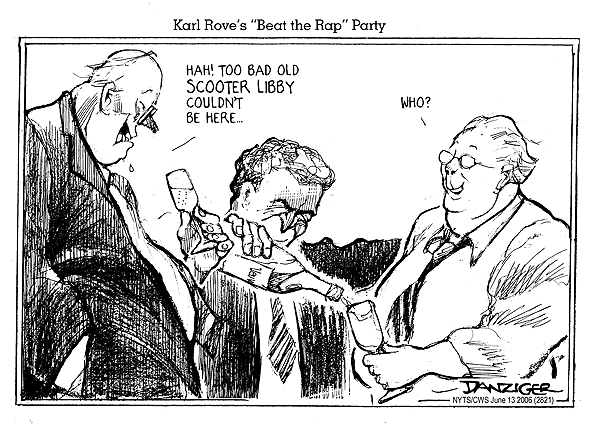
Tuesday, June 13, 2006
Billy Bob's Bulletins -- June 13, 2006
Zarqawi Attack Put Jordan Hot on His Trail (LAT)
And, in what might be called the "bottom" story of the day:
Shocked into action by violence on their own soil, Jordanian officials months ago began an intensive campaign of spying on insurgents in neighboring Iraq, a gambit that ultimately helped lead to the death of militant leader Abu Musab Zarqawi, Jordan's top spies said Monday.Palestinian Infighting Hits West Bank (LAT)
Clashes between rival Palestinian factions spread to the West Bank on Monday as armed followers of Palestinian Authority President Mahmoud Abbas' Fatah movement ransacked and set fire to the offices of the Hamas-led government and briefly abducted a Hamas lawmaker.Oil, Politics and Bloodshed Corrupt an Iraqi City (NYT)
Politics, once seen as a solution to the problems of a society broken by years of brutal single-party rule, has paralyzed the heart of Iraq's south.Life During Wartime (NYT Ed)
This once-quiet city of riverside promenades [Basra] was among the most receptive to the American invasion. Now, three years later, it is being pulled apart by Shiite political parties that want to control the region and its biggest prize, oil. But in today's Iraq, politics and power flow from the guns of militias, and negotiating has been a bloody process.
Reading the Iraqi bloggers who have been posting for The Times has helped to fill one of the big gaps in Americans' view of the war in Iraq.[Ed. Note: The Iraqi blogs are fairly interesting, but they, like much else from the Times, can only be accessed through the NYT's premium service "Times Select", which costs ~$50/year unless you have a subscription the the paper. So, the summary provided by this editorial will have to do as a glimpse into what they say. I think the Times has made a terrible mistake restricting access to so much of its content, but that is a story for another day. The Times like so much of the MSM (particualrly the print media) is struggling to find a way to make money in the face of ever declinibg subscription rates.]
And, in what might be called the "bottom" story of the day:
German Brothels Expect Nil From Soccer Fans (LAT)There'll be a lot of naughty boys in town during the World Cup, but few, if any, will be handcuffed and spanked on the leopard-skin rug of Karolina Leppert, a dominatrix with a wall of whips and a shrewd instinct for market economics.That reporting is a tough and dirty job, but somebody's gotta do it.
Billy Bob's Bulletins -- Has Moved
I took the weekend off to go see my oldest boy graudate, but when I got home I had the following e-mail from Billy Bob waiting for me under the caption "Uh Oh . . . "
Anyway, the simplest way to get around this (assuming they haven't blocked access to everything at blogspot.com) is to start another blog. The blogger software is so easy that I can start blogs a lot faster than they can block 'em. So, that is what I did. See Billy Bob's Bulletins at www.billybobsbulletins.blogspot.com.
For the moment, all I have put up an the new site are the "bulletins" about mideast and related domestic news that I have been posting here for a while. I can't decide what I will do with the rest of the stuff. Maybe I'll just co-post everything at both places. It's just copy and paste, after all.
There is some bad news here… the blog Nazis have blocked parentheticals. I don’t know if I’ll be able to get back on…several people mentioned some of their favorite sites recently disappeared. I don’t know that I’ll be able to work around it… Maybe you could periodically email me some of your posts that I might like to comment on? I’d love to stay involved in the conversation.I must admit to have had an interesting mix of reactions to this. Mostly it was disgust at the silliness -- so much so, that I realized that it was most likely a mistake. SNAFU. But, I must also admit to feeling a bit . . . flattered. Could it be that what I write is actually important enough to have (a) gotten the attention of the DOD censors and (b) been considered "dangerous" enough to block?. Sheesh: Che, Ho, Mao and me. Who'd have thunk? There is a downside though. as I told BB in response, "I'll have to be on the lookout for black crown vics with two guys in bad suits, sunglasses and earpieces parked near my house."
Anyway, the simplest way to get around this (assuming they haven't blocked access to everything at blogspot.com) is to start another blog. The blogger software is so easy that I can start blogs a lot faster than they can block 'em. So, that is what I did. See Billy Bob's Bulletins at www.billybobsbulletins.blogspot.com.
For the moment, all I have put up an the new site are the "bulletins" about mideast and related domestic news that I have been posting here for a while. I can't decide what I will do with the rest of the stuff. Maybe I'll just co-post everything at both places. It's just copy and paste, after all.
Monday, June 12, 2006
Billy Bob's Bulletins -- June 12, 2006
Raids Target Zarqawi Group (LAT)
And finally,
A Time and a Place (NYT Op-Ed)
The United States conducted at least 56 raids against targets connected with Abu Musab Zarqawi's Al Qaeda in Iraq organization in the 48 hours after his death, seeking to capitalize on the killing by disrupting his network of fighters, military officials said.Hamas Pledges Attacks on Israel (LAT)
The military wing of Hamas vowed Friday to resume attacks against Israel after Palestinian Authority officials blamed Israel for the deaths of at least 10 Palestinians, including seven civilians at a beach.Compensation Payments Rising, Especially by Marines (NYT)
Zarqawi Built Global Jihadist Network on Internet (NYT)Almost half of the more than $19 million in compensation that the American military allocated last year to compensate for killing or injuring Iraqis and damaging property came from Marine-led units in Anbar Province, Defense Department records show.
Over the last two years, Abu Musab al-Zarqawi established the Web as a powerful tool of the global jihad, mobilizing computer-savvy allies who inspired extremists in Iraq and beyond with lurid video clips of the bombings and beheadings his group carried out.Death Could Shake Al-Qaeda In Iraq and Around the World (WaPo)
The death of Abu Musab al-Zarqawi could mark a turning point for al-Qaeda and the global jihadist movement, according to terrorism analysts and intelligence officials.Iraqi Leader Charts Nation's Priorities (WaPo)
As the dust settled Friday from the news that Iraq's most notorious insurgent leader had been killed and that its new government had finally been completed, Prime Minister Nouri al-Maliki outlined a plan to confront the country's deeper problems of rampant violence, economic stagnation and rapacious corruption.Iraq's Attorneys Practicing in a State of Fear (WaPo)
"We are living in terror," Kamal Hamdoun, the head of Iraq's lawyers' union, said as he sat in a shadowy, cavernous office redolent of better days.Guantanamo's First Suicides Pressure U.S. (LAT)
As usual, there was no electricity in Hamdoun's second-floor office in Baghdad's Mansour neighborhood. Sunlight slanted in through vertical blinds, shining on ornate chairs painted gold and a huge desk piled with legal folders. . . .
Such is the life of a lawyer in a nearly lawless society. Iraq's legal system, once one of the most secular in the Middle East, is a shambles. If a "Law and Order" spinoff were set in Baghdad, it would feature police who are afraid to investigate sectarian murders (or are complicit in them, many say), lawyers afraid to take either side of a case and risk the wrath of powerful militias or well-armed gangs, judges assassinated for the decisions they have handed down, and the occasional car bombing at the courthouse.
Three Middle Eastern detainees being held without charges at the U.S. detention facility at Guantanamo Bay hanged themselves, military officials said Saturday, becoming the first captives to take their own lives at the prison and prompting new calls for an immediate shutdown.Fear of Big Battle Panics Iraqi City (LAT)
Fears of an imminent offensive by the U.S. troops massed around the insurgent stronghold of Ramadi intensified Saturday, with residents pouring out of the city to escape what they describe as a mounting humanitarian crisisPalestinian Vote on Statehood Plan Set for July (LAT)
Palestinian Authority President Mahmoud Abbas on Saturday set a date of July 26 for a territorywide referendum on a statehood plan that would implicitly recognize Israel, a proposal bitterly opposed by the ruling Hamas movement.In this paper, war heroes are MIA (LAT Op-Ed)
During the last two weeks, the Los Angeles Times has printed at least four front-page articles, and several others on inside pages, about a Marine squad accused of killing 24 Iraqi civilians in Haditha and possibly falsifying reports about the incident. Some of the information reported by The Times was based on the military's own investigation. The Times' reports seemed fair, stressing the conditions of combat and confusion faced by our troops.Iraq's Pentagon Papers (LAT Op-Ed)
Taliban Surges as U.S. Shifts Some Tasks to NATO (NYT)Today, there must be, at the very least, hundreds of civilian and military officials in the Pentagon, CIA, State Department, National Security Agency and White House who have in their safes and computers comparable documentation of intense internal debates — so far carefully concealed from Congress and the public — about prospective or actual war crimes, reckless policies and domestic crimes: the Pentagon Papers of Iraq, Iran or the ongoing war on U.S. liberties. Some of those officials, I hope, will choose to accept the personal risks of revealing the truth — earlier than I did — before more lives are lost or a new war is launched.
A large springtime offensive by Taliban fighters has turned into the strongest show of force by the insurgents since American forces chased the Taliban from power in late 2001, and Afghan and foreign officials and local villagers blame a lack of United States-led coalition forces on the ground for the resurgence.Terrorists Trained by Zarqawi Went Abroad, Jordan Says (NYT)
At the time of his death, Abu Musab al-Zarqawi was still trying to transform his organization from one focused on the Iraqi insurgency into a global operation capable of striking far beyond Iraq's borders, intelligence experts here and in the West agree.U.S. Seeking New Strategy for Buttressing Iraq's Government (NYT)
His recruiting efforts, according to high-ranking Jordanian security officials interviewed Saturday, were threefold: He sought volunteers to fight in Iraq and others to become suicide bombers there, but he also recruited about 300 who went to Iraq for terrorist training and sent them back to their home countries, where they await orders to carry out strikes.
President Bush's two-day strategy session starting Monday at Camp David is intended to revive highly tangible efforts to shore up Iraq's new government, from getting the electricity back on in Baghdad to purging the security forces of revenge-seeking militias, White House officials said. . . . One of the senior officials involved in the strategy session characterized it as a "last, best chance to get this right," an implicit acknowledgment that previous American-led efforts had gone astray.Lawyers Defend Marines in [Haditha] Raid (LAT)
Attorneys for Marines being investigated for possible war crimes in the deaths of 24 Iraqis in Haditha said Sunday that their clients did nothing wrong and were following the military's rules on how to combat armed insurgents hiding inside homes.Details on Detainee Suicides Emerging (LAT)
With the U.S. detention camp for terrorism suspects under renewed scrutiny, a top U.S. general arrived here Sunday to review the investigation into the first three deaths at the 4 1/2 -year-old facility.Commander Says U.S. Likely to Shrink Its Numbers in Iraq (LAT)
With the death of militant leader Abu Musab Zarqawi, the U.S. will seek to press its advantage against Al Qaeda in Iraq, even as it probably will draw down American forces in the months to come, the top U.S. commander in Iraq said Sunday.Rice's Offer to Iran Spurs Unease From Right (LAT)
Gen. George W. Casey's comments on Sunday news shows underscored tension in the military's position. The U.S. suddenly finds itself with a chance to build on its blow against Al Qaeda in Iraq while taking advantage of the stability offered by Iraq's new government to reduce the U.S. presence.
While the Bush administration's offer to negotiate with Iran was winning praise from many quarters, conservative commentator Michael Ledeen sat down last week to write a column with a far different point of view.Adviser Has President's Ear as She Keeps Eyes on Iraq (NYT)
Under the title "Is Bill Clinton Still President?" Ledeen compared President Bush's conditional offer to Iran to the Clinton administration's "appeasement" of North Korea in the 1990s.
At the end of each day, President Bush gets a three-to-four-page memo from the National Security Council staff about developments over the previous 24 hours in Iraq. The document, said to be written in the crisp, compelling style that the president prefers, can cover a range of issues — the killing of Abu Musab al-Zarqawi, new nominees for cabinet posts or the progress, or lack of it, in ending the three-year insurgency. The person responsible for the memo is someone who is largely unknown outside the administration, but who colleagues say is instrumental in shaping Mr. Bush's views: Meghan L. O'Sullivan, the 36-year-old deputy national security adviser for Iraq and Afghanistan, and the most senior official working on those nations full time at the White House.Smoke of Iraq War 'Drifting Over Lebanon' (WaPo)
The war in Iraq has generated some of the most startling images in the Middle East today: a dictator's fall, elections in defiance of insurgent threats and carnage on a scale rarely witnessed. Less visibly, though, the war is building a profound legacy across the Arab world: fear and suspicion over Iraq's repercussions, a generation that casts the Bush administration's policy as an unquestioned war on Islam, and a subterranean reserve of men who, like Abu Haritha, declare that the fight against the United States in Iraq is a model for the future.Karzai to Arm Afghan Tribesmen In Bid to Stem Taliban Attacks (WaPo)
Afghan President Hamid Karzai said Sunday that his government would give weapons to local tribesmen so they could help fight the biggest surge in Taliban violence in years. . . . Speaking to a group of tribal elders from eastern Afghanistan, Karzai said he did not want to form militias that could clash with rival tribes. . . Western diplomats briefed on the plan expressed concern that the effort could fuel factional fighting by arming forces loyal to warlords with long histories of factional disputes.
And finally,
A Time and a Place (NYT Op-Ed)
As a daughter of the fallen and a friend to families of today's casualties, I implore antiwar protesters to show some respect. March to the steps of Congress and the White House. Shout your protests at the president who drummed up this war. But grant some peace to the men and women trying to heal in our military hospitals, and the families grieving at funerals and memorials. Haven't we earned a moment of silence?
Thursday, June 08, 2006
Billy Bob's Bulletins -- June 8, 2006
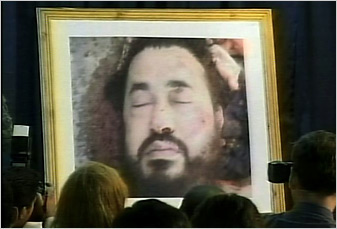 Well, we got al-Zarqawi finally. No one is quite sure how much difference it will make, and there is a lot less crowing than there was when Saddam was captured or his sons were killed. But still, if ever it is approrpiate to be happy to see someone dead, this is one of those times.
The Zarqawi story has knocked right off front pages what would otherwise have been the biggest story of the day:Iraqi Parliament Selects Top Security Ministers:
The Iraqi parliament agreed upon candidates to lead the country's three top security ministries Thursday, ending a weeks-long stalemate among the country's largest political factions.Talk about bad serendipity, the poor NYT editorial page was made to look pretty silly on both of these counts. The Times' lead editorial today opened with this paragraph:
The selection of an interior minister, a defense minister and a national security adviser gives Iraq a complete government for the first time since elections in December 2005 and it provides a key opportunity to promote political reconciliation between members of the country's Sunni Muslim minority and the Shiite-dominated government.
Almost six months after Iraqis voted for their first full-term government, two of the most essential jobs in that government remain unfilled: the interior minister, who oversees the police, and the defense minister, who oversees the army. That would be a serious political crisis in any country. It is little short of calamitous for Iraq.Ooops! Never mind.
Bob Herbert then had a similar "never mind" moment when he used this piece of evidence in an op-ed argument that Iraq is beyond hope, that:
Instead of beginning to pull our troops out of Iraq, we are sending more in. The permanent Iraqi government, which was supposed to be the answer to everybody's prayers, is a study in haplessness. Abu Musab al-Zarqawi, Al Qaeda's man in Iraq, remains at large.Double oops!
The rest of the news is sorta thin, but here it is:
Iraqi Ties to Iran Create New Risks for Washington (NYT)And finally, on the lighter side:As the Bush administration seeks simultaneously to stabilize Iraq, in part by empowering its Shiite majority, and contain Iran, it must carefully navigate the complex relationship between the countries. It is not just Iran's influence in Iraq that the United States must confront, but Iraq's connection to Iran, as well.Hundreds of Iraqi Detainees Get First Taste of FreedomThe first of 2,500 Iraqi prisoners set for release stepped off a bus to freedom on Wednesday morning at Baghdad's central bus station, with many dropping to their knees and pressing their foreheads to the scalding pavement to offer thanks.Iranian President Signals Readiness to Negotiateranian President Mahmoud Ahmadinejad on Thursday signaled Iran's readiness to renew negotiations "to resolve misunderstandings in the international arena."Frontline Care for 'At Risk' Soldiers
The statement, while not specifically answering numerous outstanding questions about Iran's position, was the most straightforward indication so far of its willingness to engage six world powers, including Washington, in discussions aimed at ratcheting back the mounting confrontation over its nuclear program.ver the course of a year in Iraq, the 3rd Brigade of the U.S. Army's 3rd Infantry Division saw action in some of the country's most violent places, insurgent strongholds such as Ramadi in the west and Baqubah in the north. By the time the brigade's 4,000 members returned home in January, as many as 800 had been flagged as potentially "at risk" in a psychological screening process conducted in Iraq, according to commanders and medical personnel.
Yet four months after their return, fewer than 80 are still in treatment. Psychologists here attribute what they call a relatively small number of persistent psychological issues to an unprecedented program of battlefield therapy and follow-up care, including having mental health experts assigned to most brigades and combat stress experts deployed for the first time to frontline bases throughout Iraq.
Bush Wants To Borrow A Canadian Terrorist For Fall Elections
Wednesday, June 07, 2006
Fighting The Last War II
I learned a new word today:"lawfare." Actually , I'm not sure it is a new word, and it is sufficiently opaque in terms of what it refers to that it may never become a word. But I am informed by an Op-Ed piece in today's WSJ that "the advent of modern media coverage--coupled with a growing and valid concern among democracies about humanitarian norms during warfare--has provided [Al Queda and its confederates with] a new tactical innovation, increasingly known as 'lawfare.' "
Like the WSJ article that provided part of the impetus for the previous post, today's WSJ piece appears to imply (without ever really saying it) that the way to respond to this "lawfare" is for Western media and elites to reduce the amount of attention paid to such events as Haditha. (The subhead for the article is "The administration's domestic opponents play into the enemy's hands"). After all, we are apprised,
So what? The fact is that even one such incident is one too many. Yet, as all seem to agree, such incidents are an inevitable consequence of war.
It is here that I diverge from the mainstream. I agree that such incidents probably are an inevitable consequence of putting soldiers into the type of situation our soldiers are in today in Iraq and Afghanistan. But I disagree that the answer to that is for the American (or world) media to downplay such events (as if that were possible) or to shrug it off as just another inevitable consequence of war.
The difficulty is that the armed services are the wrong tool for the job, yet they keep getting used for such jobs because they are the only tool we have. And, when the few f@#* up, as we all agree they inevitably will when they are used for such jobs, it undermines our "will" to continue the fight.
The authors of the WSJ article see this as an issue of tactics:
Al Qaeda and the Iraqi insurgents thus routinely claim that American forces systematically violate the laws of war by targeting civilians and abusing prisoners. These claims are not targeted at the Iraqi people . . . but at public and, especially, elite opinion in the U.S. and other democracies. With Vietnam as its model, the Iraqi insurgency well understands that it can win only by undermining America's political will to win, and the center of gravity in this conflict lies in Washington, not Baghdad or the Sunni Triangle.Sound familiar? In a post last Friday, I observed that one of the main differences between this war and WWII is that the "center of gravity" in the conflict -- for both sides -- is the will to win. I also acknowledged that the opposition in this war had a significant advantage over the US in this regard, not because the American public is supine or weak or decadent or unwilling to make sacrifices, but because we are (admirably) an essentially peaceful people.
Like the WSJ article that provided part of the impetus for the previous post, today's WSJ piece appears to imply (without ever really saying it) that the way to respond to this "lawfare" is for Western media and elites to reduce the amount of attention paid to such events as Haditha. (The subhead for the article is "The administration's domestic opponents play into the enemy's hands"). After all, we are apprised,
it is worth noting that abuses and violations of the laws of war have occurred in every armed conflict in human history, regardless of how well-led or disciplined were the troops involved. Indeed, by the standards of past conflicts, U.S. forces in Iraq and Afghanistan have behaved in exemplary fashion, using force in combat with unprecedented precision, minimizing collateral damage and civilian deaths--often at risk to themselves and to their mission. In Iraq, this has been the case even though American forces are fighting in the toughest possible urban insurgency environment.Let's ignore the fact that the authors cite no support for these assertions regarding the restraint America's armed forces have exhibited in these wars. Let's also ignore the fact that there is much in the news that leads one to wonder how "precise" our use of force actually is and how rare things like Abu Grahib and Haditha actually are. I, for one, will take it on faith that 99.9% of our service men and women and the people ordering them into action are behaving exactly as the authors claim.
So what? The fact is that even one such incident is one too many. Yet, as all seem to agree, such incidents are an inevitable consequence of war.
It is here that I diverge from the mainstream. I agree that such incidents probably are an inevitable consequence of putting soldiers into the type of situation our soldiers are in today in Iraq and Afghanistan. But I disagree that the answer to that is for the American (or world) media to downplay such events (as if that were possible) or to shrug it off as just another inevitable consequence of war.
The difficulty is that the armed services are the wrong tool for the job, yet they keep getting used for such jobs because they are the only tool we have. And, when the few f@#* up, as we all agree they inevitably will when they are used for such jobs, it undermines our "will" to continue the fight.
The authors of the WSJ article see this as an issue of tactics:
Ultimately, the Haditha incident must remind American policy makers--and the American people--of the challenges of modern warfare. Although the individual actions of U.S. forces on that day may have been exceptional, the surrounding circumstances are not--and our enemies will look more and more to such irregular tactics.I, on the other had, see this as an issue of strategy -- perhaps even grand strategy. We are, unquestionably, faced with a new kind of war and we can expect this new kind of war to predominate for the foreseeable future. To rely on an armed force that is built, organized, armed, equipped and trained for fighting a war that differs from WWII only in scale is to doom ourselves to failure in what, in the end, is a war not of materiel, but of will. We need -- must -- begin to think seriously about how to fight this new kind of war; about how to go after the enemy's will to fight while buttressing, or at least not undermining, or own.
Billy Bob's Bulletins -- June 7, 2006
Sorry for the late post. Blogger has been having "database issues" all day.
Anyway, it was a fairly slow news day, at least as far as the primary topics of this coulmn are concerned:
The best read of the day is this Op-Ed piece from the WSJ 'Lawfare' Over Haditha I will have more to say about this article later, but it bears on the same issues I was struggling with last week in "Fighting The Last War", except that I think the authors miss the real point of their own argument.
Anyway, it was a fairly slow news day, at least as far as the primary topics of this coulmn are concerned:
Talks in Iran Described as Constructive (LAT)And finally . . .Iran suggested Tuesday that it would seek changes in the package of incentives offered here on behalf of world powers by European Union foreign policy chief Javier Solana, but comments made by both sides also made it clear that for now, diplomacy had replaced confrontation over Iran's nuclear aspirations.)Iraq to Release Detainees in Bid to Ease Tensions (NYT))Iraq's new government said Tuesday that it would release 2,500 detainees, nearly 10 percent of those held in Iraqi and American detention centers, and that it would adopt a "national reconciliation" plan to reintegrate former members of Saddam Hussein's ruling Baath Party into society.)Data Theft Affected Most in Military (WaPo))Social Security numbers and other personal information for as many as 2.2 million U.S. military personnel -- including nearly 80 percent of the active-duty force -- were among the data stolen from the home of a Department of Veterans Affairs analyst last month, federal officials said yesterday, raising concerns about national security as well as identity theft.)Terrorism Allegations Detailed In Canada (WaPo))Suspects arrested last weekend in an alleged terrorism plot planned to storm the Canadian Parliament and hold politicians hostage, and at least one wanted to behead the prime minister if demands to withdraw Canada's troops from Afghanistan were not met, according to a summary of prosecutors' allegations read in court Tuesday.Inquiry Ties European Nations to C.I.A. PrisonsFourteen European countries acted willingly or indirectly with the Central Intelligence Agency in the secret transfer of terrorism suspects, and two of them — Romania and Poland — probably harbored secret C.I.A. detention centers, according to a report from the Council of Europe issued today.
The best read of the day is this Op-Ed piece from the WSJ 'Lawfare' Over Haditha I will have more to say about this article later, but it bears on the same issues I was struggling with last week in "Fighting The Last War", except that I think the authors miss the real point of their own argument.
Tuesday, June 06, 2006
Billy Bob's Bulletins -- June 6, 2006
The devil's day: 666
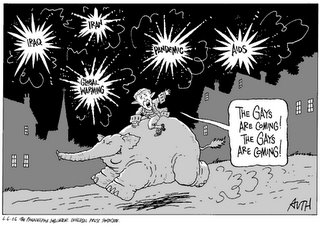
No Escaping Iraq Violence (LAT)And then, a propos of this -- Senate Debates Measure to Ban Gay Marriage -- there is this from Tony Auth:Clad in camouflage uniforms, the gunmen came peeling through the thick morning heat in police trucks. They stopped at a downtown strip of travel companies where Iraqis gather each morning to board buses bound for the safer lands of Syria and Jordan.Iran Seems Open to Incentives Package (LAT)
The gunmen leaped to the ground, witnesses said, and they worked fast. They seized more than 50 bystanders, pulling men away from their families and hauling drivers from behind the wheels of the buses. They handcuffed the men, blindfolded them and stuffed them into the backs of the trucks like human loot. They covered some of their captives with sheets. And then they were gone.Iranian officials signaled Monday that they would look seriously at a package of incentives world powers are offering the country if it will suspend its nuclear program.U.S. Is Offering Deals on Trade to Entice Iran (NYT)The European Union's foreign policy director, Javier Solana, arrived in Tehran on Monday night with incentives intended to resolve the nuclear crisis with Iran, including a proposal to allow Iran to upgrade its aging civilian air fleet through the purchase of aircraft parts from an American company, Boeing.Minor Figure in Iraqi Kidnapping Gets a Life Sentence (NYT)A judge imposed a life sentence on Monday on a man who apparently played a minor role in the kidnapping of Margaret Hassan, a British-Iraqi aid worker whose disappearance and death showed that no one was immune from insurgent viciousness.Abbas Will Put Two-State Issue to a Vote of Palestinians (WaPo)Palestinian leader Mahmoud Abbas decided early Tuesday to hold a referendum to determine whether Palestinians favor creating a state on territory Israel occupied in the 1967 Middle East war. He made his decision after talks with the rival Hamas movement failed to result in a political consensus on the question.

Monday, June 05, 2006
Billy Bob's Bulletin's -- June 5, 2006
There is actually a fair amount of stuff that may prove to be of interest in today's papers. The one most worth reading, though is this one:
The rest is "just" news, but some of it is fairly interesting
Bonded by Loss, Divided by War (WaPo)Amid the sadness that has looped through his life since the death in Iraq of his only son, Derga has found a spark that drives him to defend President Bush, the war and the troops who are fighting it. He has begun to speak out, urging Americans "to have the guts as a nation to stay the course."
Forty miles north, Paul Schroeder and Rosemary Palmer, whose only son lived and died in the same Marine Reserve unit as Derga's son, have also been driven by anguish to speak out. But they do not believe in this war or this president or in staying the course. They are convinced that their son's life was wasted. They want negotiations to begin, the war to end and the troops to come home.
The rest is "just" news, but some of it is fairly interesting
Army Manual to Skip Geneva Detainee Rule (LAT)The Pentagon has decided to omit from new detainee policies a key tenet of the Geneva Convention that explicitly bans "humiliating and degrading treatment," according to knowledgeable military officials, a step that would mark a further, potentially permanent, shift away from strict adherence to international human rights standards. The . . . State Department fiercely opposes the military's decision to exclude Geneva Convention protections and has been pushing for the Pentagon and White House to reconsider, the Defense Department officials acknowledged.Eskimo Troops Brace for Iraq (LAT)For nearly 50 years during the Cold War, being in Alaska's National Guard meant a potential front-line deployment — right at home [againts Russia]. . . . But now, for the first time since World War II, Guard reserve troops in tiny Yupik Eskimo villages such as Kongiganak are being called up, and this time they are being sent halfway around the world — to Iraq.2 [Saddam-era] Mass Graves Unearthed in Iraq (LAT)Two recently excavated mass graves containing the bodies of at least 38 people allegedly killed by Saddam Hussein's regime after a 1991 Shiite uprising in southern Iraq will probably provide key evidence for a third war crimes trial against the deposed Iraqi president.Maliki Fails to Name Key Cabinet Picks (LAT)Prime Minister Nouri Maliki again failed to announce appointees for Iraq's powerful security ministries Sunday, missing his latest self-imposed deadline since naming the rest of his Cabinet last month.U.S. Station Seeks Ear of Iran's Youths (WaPo)The typical listener is probably a male (but might be a female), most likely under 30 (but might be over), and is almost certainly listening in a house (but might be in a car). When it comes to knowing its audience, the U.S.-funded Radio Farda knows only two things for sure: that the audience is surreptitiously listening somewhere inside Iran, and that the Iranian government doesn't want anyone to hear what a U.S.-funded radio service has to say.Iran's Religious Leader Renews Anti-U.S. Rhetoric (WaPo)Ayatollah Ali Khamenei unleashed a flurry of broadsides Sunday at the United States and other countries confronting his government over its nuclear program, saying that suggestions of a consensus against Iran were "a lie."
"There is no consensus against Iran. . . . Some 116 member states of the Non-Aligned Movement supported Iran's brave achievements in nuclear technology. The consensus is among a few monopolist countries. Their consensus is of no value."
Sunday, June 04, 2006
Billy Bob's Bulletins -- June 4, 2006
I was so late getting yesterday's Bulletins up that it looks like I got much of the stuff in today's papers there. But here are a couple more of potential interest:
Security Comes at a Cost in Iraq's South (LAT) [Security and freedom are uneasy bedfellows].
Attacks on Iraq Oil Industry Aid Vast Smuggling Scheme (NYT)
War's Risks Include Toll on Training Values (NYT) [A fairly sympathetic look at the soldiers' side of Haditha].
Rice Key to Reversal on Iran (WaPo)
Iran to Make Offer by Six Powers Public
Analysis: Iraqi Government Has Rocky Start (AP via Houston Chronicle)
Security Comes at a Cost in Iraq's South (LAT) [Security and freedom are uneasy bedfellows].
Attacks on Iraq Oil Industry Aid Vast Smuggling Scheme (NYT)
War's Risks Include Toll on Training Values (NYT) [A fairly sympathetic look at the soldiers' side of Haditha].
Rice Key to Reversal on Iran (WaPo)
Iran to Make Offer by Six Powers Public
Analysis: Iraqi Government Has Rocky Start (AP via Houston Chronicle)
Subscribe to:
Posts (Atom)