Tuesday, June 06, 2006

Billy Bob's Bulletins -- June 6, 2006

The devil's day: 666
No Escaping Iraq Violence (LAT)
Clad in camouflage uniforms, the gunmen came peeling through the thick morning heat in police trucks. They stopped at a downtown strip of travel companies where Iraqis gather each morning to board buses bound for the safer lands of Syria and Jordan.

The gunmen leaped to the ground, witnesses said, and they worked fast. They seized more than 50 bystanders, pulling men away from their families and hauling drivers from behind the wheels of the buses. They handcuffed the men, blindfolded them and stuffed them into the backs of the trucks like human loot. They covered some of their captives with sheets. And then they were gone.
Iran Seems Open to Incentives Package (LAT)
Iranian officials signaled Monday that they would look seriously at a package of incentives world powers are offering the country if it will suspend its nuclear program.
U.S. Is Offering Deals on Trade to Entice Iran (NYT)
The European Union's foreign policy director, Javier Solana, arrived in Tehran on Monday night with incentives intended to resolve the nuclear crisis with Iran, including a proposal to allow Iran to upgrade its aging civilian air fleet through the purchase of aircraft parts from an American company, Boeing.
Minor Figure in Iraqi Kidnapping Gets a Life Sentence (NYT)
A judge imposed a life sentence on Monday on a man who apparently played a minor role in the kidnapping of Margaret Hassan, a British-Iraqi aid worker whose disappearance and death showed that no one was immune from insurgent viciousness.
Abbas Will Put Two-State Issue to a Vote of Palestinians (WaPo)
Palestinian leader Mahmoud Abbas decided early Tuesday to hold a referendum to determine whether Palestinians favor creating a state on territory Israel occupied in the 1967 Middle East war. He made his decision after talks with the rival Hamas movement failed to result in a political consensus on the question.
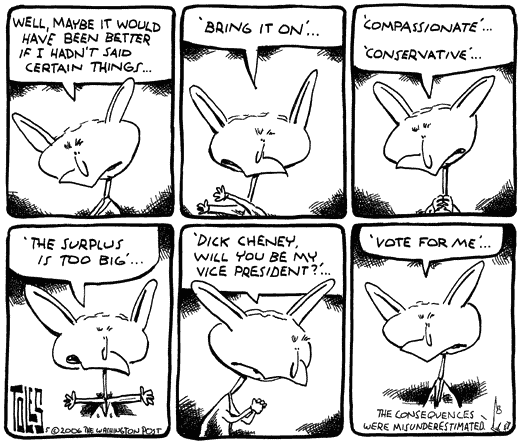
And then, a propos of this -- Senate Debates Measure to Ban Gay Marriage -- there is this from Tony Auth:

Monday, June 05, 2006

Billy Bob's Bulletin's -- June 5, 2006

There is actually a fair amount of stuff that may prove to be of interest in today's papers. The one most worth reading, though is this one:
Bonded by Loss, Divided by War (WaPo)
Amid the sadness that has looped through his life since the death in Iraq of his only son, Derga has found a spark that drives him to defend President Bush, the war and the troops who are fighting it. He has begun to speak out, urging Americans "to have the guts as a nation to stay the course."

Forty miles north, Paul Schroeder and Rosemary Palmer, whose only son lived and died in the same Marine Reserve unit as Derga's son, have also been driven by anguish to speak out. But they do not believe in this war or this president or in staying the course. They are convinced that their son's life was wasted. They want negotiations to begin, the war to end and the troops to come home.

The rest is "just" news, but some of it is fairly interesting
Army Manual to Skip Geneva Detainee Rule (LAT)
The Pentagon has decided to omit from new detainee policies a key tenet of the Geneva Convention that explicitly bans "humiliating and degrading treatment," according to knowledgeable military officials, a step that would mark a further, potentially permanent, shift away from strict adherence to international human rights standards. The . . . State Department fiercely opposes the military's decision to exclude Geneva Convention protections and has been pushing for the Pentagon and White House to reconsider, the Defense Department officials acknowledged.
Eskimo Troops Brace for Iraq (LAT)
For nearly 50 years during the Cold War, being in Alaska's National Guard meant a potential front-line deployment — right at home [againts Russia]. . . . But now, for the first time since World War II, Guard reserve troops in tiny Yupik Eskimo villages such as Kongiganak are being called up, and this time they are being sent halfway around the world — to Iraq.
2 [Saddam-era] Mass Graves Unearthed in Iraq (LAT)
Two recently excavated mass graves containing the bodies of at least 38 people allegedly killed by Saddam Hussein's regime after a 1991 Shiite uprising in southern Iraq will probably provide key evidence for a third war crimes trial against the deposed Iraqi president.
Maliki Fails to Name Key Cabinet Picks (LAT)
Prime Minister Nouri Maliki again failed to announce appointees for Iraq's powerful security ministries Sunday, missing his latest self-imposed deadline since naming the rest of his Cabinet last month.
U.S. Station Seeks Ear of Iran's Youths (WaPo)
The typical listener is probably a male (but might be a female), most likely under 30 (but might be over), and is almost certainly listening in a house (but might be in a car). When it comes to knowing its audience, the U.S.-funded Radio Farda knows only two things for sure: that the audience is surreptitiously listening somewhere inside Iran, and that the Iranian government doesn't want anyone to hear what a U.S.-funded radio service has to say.
Iran's Religious Leader Renews Anti-U.S. Rhetoric (WaPo)
Ayatollah Ali Khamenei unleashed a flurry of broadsides Sunday at the United States and other countries confronting his government over its nuclear program, saying that suggestions of a consensus against Iran were "a lie."

"There is no consensus against Iran. . . . Some 116 member states of the Non-Aligned Movement supported Iran's brave achievements in nuclear technology. The consensus is among a few monopolist countries. Their consensus is of no value."

Sunday, June 04, 2006

Billy Bob's Bulletins -- June 4, 2006

I was so late getting yesterday's Bulletins up that it looks like I got much of the stuff in today's papers there. But here are a couple more of potential interest:


Security Comes at a Cost in Iraq's South (LAT) [Security and freedom are uneasy bedfellows].

Attacks on Iraq Oil Industry Aid Vast Smuggling Scheme (NYT)

War's Risks Include Toll on Training Values (NYT) [A fairly sympathetic look at the soldiers' side of Haditha].

Rice Key to Reversal on Iran (WaPo)

Iran to Make Offer by Six Powers Public

Analysis: Iraqi Government Has Rocky Start (AP via Houston Chronicle)

Saturday, June 03, 2006

Billy Bob's Bulletins -- June 3, 2006

Ditto yesterday.

Iraq news is dominated by the firestorm over Haditha and some other investigations of potentially similar incidents that the press has uncovered in the feeding frenzy Haditha engendered. The Iraqis themselves have jumped all over the issue. Your upcoming "ethics training" will no doubt provide you with more of that than you or anyone can stand on that subject., so I won't go into it any further except to say this:

So far at least, the press and the public have not generalized from these events to soldiers in general. So far, both are accepting the "bad apples" defense and/or placing the ultimate blame on the Bush administration. Maureen Dowd is not atypical in this:
American troops are under spectacular emotional pressure. They go out every day, not knowing Arabic, not understanding the culture, not knowing who the insurgents are, not knowing when they can go home or which of their buddies will be blown up before their eyes by an unseen enemy.

The troops were not trained for a counterinsurgency, because Bush hawks ignored the intelligence reports that predicted an insurgency and civil war. These kids were turned into sitting ducks because the neocon con to sell the war needed a gauzy prediction of Iraqi gratitude and a quick exit.
However simplistic these sentiments may be, I can only hope the consensus holds.

The news on the other "big" issue in that part of the world -- Iranian nukes -- is not much better. There has been a lot of hoopla about the change in the US position on direct talks with Iran and about how that has "force[d the] mullahs into [a] corner." But I'm not so sure. There was a condition on the US willingness to talk -- that the Iranians stop their uranium enrichment first -- and the Iranians (initially at least) categorically rejected that condition. Later, though, Iranian Foreign Minister Manouchehr Mottaki told Kofi Annin that a Nuclear Breakthrough Is Possible if the six powers were willing to talk without preconditions. Whether the US will talk without preconditions and whether the Iranians are serious about a "breakthrough" if they do both remain to be seen. But there is, I guess, hope, however slim.

The domestic news is not much better. The following Houston Chroicle headline says it all: "Gays, flag-burning and indecency! Did that get your attention?" Besieged on every front, the Bush administration is "going to the mattresses" by appealing to the very worst in the American electorate in an effort to stave off a political defeat in November. But I will go no further into that either lest it serve to further exacerbate your querulousness as to what exactly it is you're fighting for.

The one piece of good news I have found in the (now 2-day) news cycle is this: The Royal Canadian Mounted Police appear to have foiled a terrorist plot: 17 Held in Plot to Bomb Sites in Ontario. Good for the Mounties.

I hope all is well with you. Write when you can. And, if you have any, send me some good news from Iraq. I hope I am the one who needs cheering up.

Friday, June 02, 2006

Fighting The Last War

[Ed .Note: In violation of my pledge to "lighten things up," the following is a long and rambling post that was motivated by an effort to articulate what I think is the real cause of events like Haditha. It could sorely use a good editor, but, while it may take some patience to find, I think there is something important buried in the verbiage.]

Over the last two days, I have read several op-ed pieces and editorials that attempt to assign blame for Haditha. The first was an essay by Dan Henninger in yesterday's WSJ. Henninger argues, in effect, that such incidents are an inevitable consequence of war and that the only thing that distinguishes Haditha and similar events during the Viet Nam war from those that occurred in other wars is relentless (and Henninger implies irresponsible, perhaps even disloyal) press coverage. Excerpts:
You knew it had to happen. Haditha, an "incident" involving American troops in Iraq, is now part of the erosion of support for the war in Iraq. The Iraq Syndrome has finally arrived. . . Haditha is indeed the new Abu Ghraib. What this most importantly means is that any U.S. military action overseas now, no matter its level of justification, can be taken down by the significance assigned to events by the modern machinery of publicity. . . One suspects that U.S. troops were party to some awful events in the Pacific and European theaters of World War II, all gone in the mists of history and the enemy's defeat. Not now.
Not surpisingly, Tom Friedman and Maureen Dowd have different perspectives. (Unfortunately you can't read these perspectives unless you pay for a subscription that gives you access to "Times Select," so you will have to trust my elisions).

Friedman agrees that incidents such as Haditha were inevitable but blames that inevitablity not on war itself, but on the mistakes of the Bush Administration:
The report that U.S. marines were involved in a massacre of Iraqis in Haditha — which the Pentagon needs to clarify fast — is a tragic reminder that a foreign occupation by U.S. forces can't go on for years. Most U.S. soldiers in Iraq have done heroic work, but occupations that drag on inevitably lead to Hadithas.

Right now we are paying for all the Bush team's missteps in Iraq: allowing looting after the fall of Baghdad, disbanding the Iraqi Army without an alternative security force or enough U.S. troops in place, fostering a culture of torture at Abu Ghraib and then letting the politics in Iraq drift for months without any outcome.
Maureen Dowd also blames the Bush administration, but does not think such events are inevitable. Rather, after acknowledging that the "troops are under spectacular emotional pressure" as a result of the "neocon con" of pretending that the troops would be met with gratitude rather than an insurgency, she goes on to argue that Haditha was also the result of some moral deficiency in the troops themselves, or at least a few of them:
There's no way to teach someone not to shoot an unarmed woman or child. If somebody doesn't already know why they shouldn't murder a baby, it's not clear that a refresher course will help.

The problem with brushing up on core values is that if you don't know them by a certain point you can't learn them. The problem with brushing up on core values is that if you don't know them by a certain point you can't learn them. You can't teach remedial decency . . . .

As Norman Schwarzkopf said, in a quote that is part of the military's slide show on core warrior values: "The truth of the matter is that you always know the right thing to do. The hard part is doing it."
She also argues that these moral failures are themselves the result of, or at least a reflection of, the moral bankruptcy of the Bush administration, but I will spare you that feverish manifestation of her obsession. If a meteor hit New York, Dowd would write an article from the grave blaming Dick Cheney.

Apart from that, there is some truth in all of these analyses. Henninger grossly exaggerates the power of the press to shape public opinion. In matters such as these, the press is a follower of public sentiment, not a leader. Witness the fawning press coverage of the lead-up to and early days of the Iraq. It was not until the war turned unpopular that the press started its feeding frenzy. The difference between the press coverage of Iraq (and Viet Nam before it) and that of WWII has less to do with the press than it has to do with differences in public support for the wars.

But still, Henninger is doubtless right that incidents like Haditha have happened in all wars, and Friedman and Dowd are right that the terrible emotional stress imposed on troops by a long occupation of another country doubtless contributes to this inevitability. And Friedman and Dowd are also right that errors in the planning and execution of this war contributed to that emotional stress.

But, I think all three miss an even deeper failure that underlies all of this: the failure of the American National Security appartus not just of this administration but of all administrations since at least Viet Nam to recognize that a military built and armed around what worked in World War II is incapable of winning the kinds of wars that militray has been and will be asked to fight in the last quarter of the 20th Century and beyond.

It is almost trite to observe that victorious countries are always ready to re-fight the last war but rarely ready to fight the next one. The French, victors in the static meat grinder of WWI, built the the static Maginot Line and were overrun in less than a month by a new form of war characterized by mobility and maneuver. The United States, victors in WWII built the most mobile military machine the world has ever seen. Yet that machine has been thwarted again and again -- in Vietnam, Lebanon, Somalia and now Iraq and Afghanistan -- by a new sort of war that does not, at bottom, involve armies at all.

Military thinkers from Lao Tzu to Liddell Hart point out that the key to victory in any war is to sieze or destroy the enemy's "center of gravity:" the thing the enemy cannot lose if it is to have any hope of winning. In WWI (and indeed all wars prior to that time), the center of gravity was considered to be the enemy's armies. Over time, though, technological advances (artillery, machine guns, planes, etc.) and improvements in defensive strategy rendered any two armies of even remotely equal capabilities essentially invulnerable to each other. Moroever, systems of alliances among modern nation states assured that, when war came, the armies involved would have essentially equal capabilities. That process culminated in WWI. While WWI failed to be the "war to end all war" it certainly was the war that ended wars in which people other than soldiers were in harm's way.

The "genius" of the German general staff at the outset of WWII was to recognize that the "true" center of gravity was not the armies themselves but the supply lines and communications that supported them. As a result, the German tactics were not to attack armies directly but go after their lines of supply and communication.Once those were captured, rolling up the armies was, with rare exceptions (Staligrad stands out), not much harder than herding sheep into a pen.

The Allies, in defeating Germany, went them one better, realizing that the armies were also dependent on the economies of the countries supporting them. Previously, naval blockades had been used for this purpose, but there had been no way to directly reach a country's means of production without defeating the enemy's armies first. The airplane changed that, and the Allies won WWII first by adopting the German's own tactics of surrounding rather than attacking opposing armies, and second by using a massive advantage in air power to directly strike at the German and Japanes economies and population centers.

In the years since WWII, The United States has focused its military preparedness around a conviction that the key to victory in all future wars would be exactly what it was in WWII: the ability to sieze and hold or destroy the enemy's supply lines, communications and means of production. In pursuit of this conviction, the US has built the most mobile military machine the world has ever known and it has coupled that with an unprecendented strategic bombing capability. The result is an ability to take down not just armies but entire countries in amazingly short periods of time.

The problem, though, is that taking down armies and countries no longer enough to assure victory. Indeed the theory on which the WWiI victory was based -- that lines of supply and communications, means of production, and control of territory represneted the "center of gravity" in war -- is flawed. The true center of gravity is none of these things. The true center of gravity and the thing that must be destroyed if you are to win a war is the enemy's will to fight; its will and willingness to keep fighting no matter what and -- equally importnat -- to bear the consequences of doing so. It in this battle of wills that America lags significantly behind many of the countries in which they now finds itself fighting.

Dan Henninger cames closest to recognizing this when he says "it's the phenomenon of the so-very-public 0.01%--at Abu Ghraib, on an Afghan street, at Haditha--that is breaking America's will this time." But his assumption that the loss of will is caused by press coverage of the realities of war is wrong, and his solution -- don't tell them about those realities -- is just silly.

But he is right in his sense that, at least in a democracy, even a stupefyingly overhwelming military superiority counts for little absent a public will to fight.

Unlike many (Henninger included I suspect), I do not bemoan this "deficeit of will" as a defect in the American character or as a symptom of a decadent, declining civilzation. To the contrary, it is a reflection of something I admire. The will to fight requires, first and foremost, something the fighters believe is worth killing and dying for. For Anericans there are very few of those causes. Americans will readily go to war to avenge an attack on this country and, if they believe the threat is real enough, to prevent such an an attack. But you will never convince Americans that they should go to or stay in a war to spread an ideology, much less to secure oil or territory. That is actually pretty rare in world history.

In most of the wars we have fought since WWII a "cause" sufficient to motivate Americans to fight and keep fighting has not existed. Initially at least, the public believed we had a such cause in Afghanistan and Iraq (correctly in the first case and incorrectly in the second). "But, hey!" they say,"we won those wars! We crushed their armies and occupied their countries. We've won! Why are our solldiers still dying? Why can't those guys just accept the fact that they lost and re-make themsleves in our image? I'll send them money, but if nation-building requires lives, we're outta here!"

Americans, in short, are as much victims of the WWII mindset as their leaders have been. War today is different. Military victory, even total victory, is not enough to win the kinds of war we are being called upon to fight today. Once we have achieved such a victory, we lose the will to fight on, since anything after that is unrelated to any clear and present danger to ourselves or our country. We revert to our essentially peaceful norm. What we have not internalized yet is that, unlike WWII, total victory does not end the adversary's will to fight. In fact, it may actually strengthen that will. As a result, our adversaries still have a cause that they believe to be worth the price. However silly, even evil, those causes may seem to us, the fact remains that in the new wars our adversaies are (and can expected to continue to be) willing to fight and die and keep on fighting an dying in it's name.

So, I do not bemoan America's "lack of will." To the contrary I admire the aspect of our national ethos that underlies it. What I do bemoan, though, is the failure of our political and military leadership to anticipate the shape of the new wars and the disadvanatges we would have in them, and to shape their stratregic and tactical planning around those realities. This failure goes back at least to Viet Nam and it is no less serious (and no les obvious in hindsight) than the French failure to anticipate the effect that planes, tanks and moltorized infantry would have on the Maginot line.

Partly -- perhaps mainly -- this has been a failure of political leadership. Bedazzled by our military capabilities, our leadership has all too often led us into war for causes that Americans simply do not believe are worth the cost. Such public value judgments cannot be changed, at least not for long, by flag-waving, rhetoric, appeals to patriotism or challeneges to theloyalty of those who disagree. For Americans to send its young men and women off to war for any appreciable time and to accept many of them back in caskets or on crutches requires a cause that sells itself: a clear and present danger to ourselves and our way of life.

But there is also a failure of military planning. For military planners, the reasons for a war are irrelevant. Their task is to figure out how to win it. To an extent that should now be clear, the focus of American military planners since WWII has been to confined to assuring that US could do those things it did in WWII better than any other country in the world. They have succeeded spectacularly in that regard. But they failed to adequately apppreciate was that some of the new wars they would be asked to fight would be fundamentally different from WWII and that creating an asymetry, even a massive one, in conventional military might would not be enough.

Even today, we can't quite believe that. But the proof can be found everywhere. To win wars such as those the Israelis have been fighting in Palestine, that the French fought in Algeria, that the British fought in Ireland, that we fought in Viet Nam, that the Russians fought in Afghanistan and that we are now fighting in both Afghanistan and Iraq, it is not enough, perhaps not even necessary, perhaps, in fact, even counter-productive, to do the things that brought us victory in World War II.

The only way for a conventional armed force to attack a committed people's will to fight is to inflct such horrendous casulaties that the populace simply gives up. As the Battle of Britian and all the wars listed above illustrate, killing people in small or even relatively large numbers over a long period of time actually increases the will of the survivors to fight. To be effective is sapping a people's willingness to fight, the caualities have to be truly massive, sudden and utterly unexpected: Hiroshima and Nagasaki are examples. Short of something like this, the military machine we have built is utterly incapable of winning the one battle that ultimately matters in the types of wars we are invoved in today: the battle of wills.

Friedman comes close to capturing this point when he says:
We are not losing Iraq to the Iraqi Vietcong — traditional nationalists. Iraq has a freely elected nationalist government. No, we are losing in Iraq to sectarian theocrats, Islamo-fascists and local and regional tyrants, who have only one thing in common: the belief that America and its Iraqi allies must fail, that neither modernity nor democracy must be allowed to take root in Iraq.

It will be a global tragedy if they succeed, but it is hard to fight an enemy whose only concern is that you lose, not what happens after. . . . We can't keep asking Americans to sacrifice their children for people who hate each other more than they love their own children.
The distinction Friedman draws between the Viet Cong and the Iraqi insurgents is true but irrelevant. Yes, the Viet Cong were motivated by nationalism where the Iraqis and Afghan Taliban are motivated by sectarianism. But when it comes to winning a war against these groups, that is a distinction without a difference. What unites all three of these groups and what makes them all so difficult to defeat is a passionate belief in a cause for which they are willing to fight on and die for, even in the face of overwhelming military superiorty.

Yes, it is hard to fight such people and it is especially hard when we ourselves are not similarly motivated. But that is the situation we are faced with, and our only alternative to hoping they will just go away or losing is to find a way to win the war of wills.

I do not have any idea how to do that. But one thing does seem clear: we need to get by the idea that we can win these types of wars by doing what we did in WWII. In this context, our faith in our military might is as delusional as the French faith was in the Maginot line.

It's a different world, and the evolutionary maxim continues to apply: adapt or die.

Billy Bob's Bulletins -- June 2, 2006

Billy Bob:

No news today.

Or, no new news.

Just the same old depressing, mind-numbingly repetitive crap.

I'm taking the day off.

Indeed, press coverage of Iraq, Iran and the MIddle East is so unrelentingly bleak, that it has me re-thinking the whole "Billy Bob Bulletin" idea.

If all this is getting me depressed, what's it doing to you?

See you tomottow. Maybe.

Wednesday, May 31, 2006

Ooooh! That's Harsh!

But funny.

Some Good News From Africa?

Report Shows AIDS Epidemic Slowdown in 2005

Hope it's real.

Correction

Yesterday, I was pretty hard on the marines for their apparent reluctance to undertake a serious investigation of the Hadith incident. In one respect, though, I appear to have either been misled by or misinterpreted the Time report on which I was relying. Time reported that the initial investigation, conducted by an unnamed colonel, had concluded that "Marines, not a bomb, killed the civilians but that the deaths were the result of 'collateral damage.' " I interpreted this to mean that the initial investigation had itself been an effort to sweep the incident under the "collateral damage" rug.

A more detailed report on the early investigation appeared in the New York Times today, and it places the investigators in a considerably better light. True, nothing at all happened until Time confronted the marines with videotape, but my inference that the investigation began with what the Nixon boy's once called "a modified, limited hangout" was probably unjustified.

The colonel who conducted the prelimianry investigation, Col. Greogory Watt, was primarily concerned with evaluating the original claim that the civilians had been killed by a bomb. He concluded that they had not been and had instead been shot by marines. According th the Times, his investigation "also raised questions about whether the marines followed established rules for identifying hostile threats when they assaulted houses near the site of a bomb attack, which killed a fellow marine. "

Col. Watt then reported his findingings to Lt. Gen. Peter Chiarelli, the senior ground commander in Iraq.
[The findings] raised enough questions about the marines' veracity that General Chiarelli referred the matter to the senior Marine commander in Iraq, who ordered a criminal investigation that officials say could result in murder charges being brought against members of the unit.

Colonel Watt's findings also prompted General Chiarelli to order a parallel investigation into whether senior Marine officers and enlisted personnel had attempted to cover up what happened.
Perhaps they should not have waited until being confronted by the media, but once the investigation started, it is hard to find fault with it.

I am sometimes glad to have my inferences rebutted.

Ooops! Not There Either

F.B.I. Calls Off Its Latest Search for Hoffa

Ask yourself why these guys are spending time and money looking for Jimmy Hoffa, especially since anyone who had anything to do with his disappearnce is now probably as dead as he is. In the age of golbal terrorisim, doesn't the FBI have anything better to do?

Gee, Thanks For The Reminder.

From a WSJ Review of "An Inconvenient Truth," Al Gore's global warming potboiler (some editorial license exercised):
Talk about an inconvenient truth: In a million years, the time it takes the earth to sneeze, the planet will likely be shorn of any conspicuous sign we were ever here, let alone careless with our CO2, dioxins, etc.
That's your happy-thought for today.

Billy Bob's Bulletins -- May 31, 2006

Hopes for Iraq Pullback Fading (LAT)

Nations Move Closer to Unity on Iran Strategy (LAT)

Afghans Call for Trial of U.S. Troops (LAT)

Files Contradict Account of Raid in Iraq (NYT) [Note: This more detailed account of the investigation of the Hadith shootings places the army/marines in a somewhat better light that what I inferred from the Time article in yesterday's post on the topic].

U.S. Accepts Draft on Iran That Omits Use of Force (NYT)

Shaken by Riots, Afghans Gripped By Uncertainty (WaPo)

50 Die in Rising Iraq Violence (WaPo)

Iraq PM to declare state of emergency in Basra (Reuters) (But not Ramadi?? I guess he figures he can be tough on his fellow Sunnis and let the Americans deal with the Shiites?]

Tuesday, May 30, 2006

When The News Gets You Down . . .

When the daily load of depressing news just gets too much to bear, take a side trip to Bill Doty's Broken Newz. The news is the same, but Doty provides a whole new (and sometimes very funny) perspective. Some examples of "Broken Newz" headlines:
New Poll: If Bush Breaks Leg, Majority Approve Putting Him Down

Canada Orders Mounties to U.S. Border to Prevent Influx of Crappy Film Productions

72 Virgins Club Relaxes Membership Rules

Osama bin Laden Releases Latest Message on Myspace Page [Be sure to click the proffered link].

FDA Denies Benefits of Medicinal Marijuana; Little Debbie Stocks Plummet [This one is an inside joke for those of us who, like WJC, "didn't inhale."]
The humor is uneven (after all, who can be funny 24/7) and sometimes descends to the truly pornographic (see Helen Thomas Hooks Up With Cancun Boy-Toy). Also, there is a whole ton of ads to ignore, although some of them will be intriguing to the males among us. But, if you can tolerate the unevenness and clutter, it'll brighten your day.

Oh, and for those of you who are tired of reading, there are some great White House greeting cards and political cartoons: For example:


Ouch!

Pre- and post-op x-rays of Barbaro's broken leg, courtesy of the University School of Veterinary Medicine where he is being treated:


Pretty guesome, but amazingly there is hope. From a CBS/AP Report:
Dr. Dean Richardson, the surgeon who repaired Barbaro's shattered bones after the colt broke down at the Preakness Stakes on May 20, said Tuesday the prized patient has had an "incredibly good week — far better than I would have ever hoped so far, so far, so far."
But as the same report indicates, he far from out of the woods:
Following Barbaro's five-hour-plus surgery May 21, Richardson had said the prospects of recovery were "50-50." That has changed slightly:

"I was going to call a news conference to say it's officially 51 percent," Richardson said, smiling. "Seriously, every day that goes by is a big day, and in terms of some of the complications, some of them were more likely to rear their head in the earlier stages in the convalescence (such as infection within 10-14 days) . . . . But it's still a long, long way from being discharged from the hospital."
I for one am rooting for him. After all, I liked Dreamer.

Omerta and Haditha

In yesterday's post on the Haditha killings, I asserted, without much evidence, that "the amazing, truly amazing thing, is how rarely [military discipline] beaks down in a big way." In a comment to that post, Billy Bob, my only correspondent with anything close to real-world experience in this area, agreed:

We have people in harm's way all the time, and their actions are governed by strict rules of engagement and escalation of force procedures (ROE and EOF). I obviously can't elaborate on specifics, but I will say that every time I hear of an engagement, the reports say that our soldiers followed the ROE and EOF precisely. This is no small feat. These are soldiers on strange roads in a strange country in a strange war. That there aren't more incidents at this level says a lot to me about the character of these soldiers.

There will always be flukes, but the little things being done right every day say more about the soldiers. These are good people doing difficult things very well. That's why I do what I do.
I have no doubt that Billy Bob is right that there are many, many "little things being done right every day" by our armed forces and that soldiers are overwhelmingly "good people doing difficult things very well." But I am less certain today than I was yesterday that this means the apparent rarity of events like Haditha and My Lai is a true picture of what is actually going on.

What I didn't know yesterday is that, according to a report in Saturday's LA Times, the marines had an investigation team on-site taking pictures very shortly after the "incident," that the pictures indicated "execution-style" killings of the victims, but that, according to Time reports, no formal investigation was commenced until Time confronted the Marines with a videotape two months later. What I also didn't know was that the conclusion of this initial investigation was that "Marines, not a bomb, killed the civilians but that the deaths were the result of 'collateral damage.' " When combined with the LA Times article, the following account of the history of the investigation (from the Time article linked above) is troubling:
The military's initial report stated that Terrazas and 15 civilians were killed in a roadside blast and that shortly afterward, the Marines came under attack and returned fire, killing eight insurgents. . . .

The day after the killings, an Iraqi journalism student videotaped the scene at a local morgue and the homes where the shootings had occurred. "You could tell they were enraged," the student, Taher Thabet, said last week. "They not only killed people, they smashed furniture, tore down wall hangings, and when they took prisoners, they treated them very roughly. This was not a precise military operation." A delegation of angry village elders complained to senior Marines in Haditha about the killings but were rebuffed with the excuse that the raid had been a mistake. TIME learned about the Haditha action in January, when it obtained a copy of Thabet's videotape from an Iraqi human-rights group. But a Marine spokesman brushed off any inquiries. "To be honest," Marine Captain Jeff Pool e-mailed McGirk, "I cannot believe you're buying any of this. This falls into the same category of AQI (al-Qaeda in Iraq) propaganda." In late January, TIME gave a copy of the videotape to Colonel Barry Johnson, a U.S. military spokesman in Baghdad. After reviewing it, he recommended a formal investigation. The ensuing probe, conducted by a colonel, concluded that Marines, not a bomb, killed the civilians but that the deaths were the result of "collateral damage," not deliberate homicide. Nevertheless, after reviewing the initial probe, senior military officials launched a criminal investigation.
What I also did not know is that, as the LA Times reports today, both of the ranking members of the Senate Armed Services Committee (Republican John Warner and Democrat John Murtha) say they have "direct evidence of top officers trying to suppress information."

In short, but for the media, we might never even have heard of Haditha. This inevitably makes one wonder how many more incidents there are like this that never come to light simply becuase the media itself never hears about them. Is it true, as General Pace assured us over the weekened, that such events are rare? Or are they are just rarely discovered by the media? Are the military's after-action reports saying "that our soldiers followed the ROE and EOF precisely" accurate or are they more frequently than anyone realizes just self-serving BS?

I take some comfort in this thought: in a world of ubiquitous cameras, sooner or later everything comes to light. Thus, the relative rarity of reports on events such as this may still be a reflection of their actual frequency. But I must admit to some doubt on this score. At a minimum, these types of reports call into question the military's willingness to police itself. And, if the military is only willing to come to grips with such incidents when forced to by media reports, the credibility of assurances such as General Pace's is significantly undermined.

It would be sad to learn (as we did in Viet Nam) that what we hear about is actually just the tip of the ice berg.


Update(5/31) : A New York Times article today, sheds a somewhat more favorable light on the investigation. See my mea culpa above.

From The "Oh Shit!" Department

Courtesy of "booty girl," from Worth1000.com, I gather, some funny pics.

I assume (hope) these are doctored, but who knows. We all know the feeling:


Billy Bob's Bulletins -- May 30, 2006

U.S. Is Sending Reserve Troops to Iraq's West (NYT)

2 on CBS Crew Killed in Iraq (LAT)

Anti-U.S. Rioting Erupts in Kabul; at Least 14 Dead (NYT)

On a Marine Base, Disbelief Over Charges (NYT)

And finally, the following cartoon is not really a propos of anything in particular in today's news, but I lauged out loud when I saw it. Note that you can substitute a whole bunch of other words for "deficit" on the face of the wave and still have a "true" cartoon:


Monday, May 29, 2006

We Must Condemn This. But Still . . .

The LA Times had today -- Memorial Day, of all days -- the first article I have seen that places some context around the Marine shooting in Haditha, Iraq (a city I suspect is likely to become as familiar to us all as My Lai): Bloody Scenes Haunt a Marine .

I reserve judgment on the facts. The marine interviewed in the story was not a witness to the killing of Iraqi civilians. He just helped clean up the mess. So, it is premature, perhaps, to say what exactly happened and why. There may yet (hope, hope) be a defensible explanation. But, the likelihood of that seems small. There is such an overwhelming incentive to keep this type of stuff "under wraps" that once a story like this hits the public media -- out of DOD's own mouth -- one has some justification to conclude that something truly horrible -- out of control -- probably happened.

I am sorry Truman Capote is dead. If this is as bad as it seems likely to be, the best outcome for the long term -- for the good of ourselves and our armed forces -- would be for a great journalist/documentarian to get behind the sorts of facts that are presented in investigations and trials and to get inside the minds and histories of the people and the effect of the circumstances of the event on those minds. If it happened, the only really important question is WHY? And we need something considerably more sophisticated than a trial transcript to answer than question.

You can get the barest hint of the context from the article linked above:
Shortly after 7 a.m. on Nov. 19, Briones, who received a Purple Heart during a previous tour in Iraq that included fierce fighting in Fallouja, said his team of five men was called to respond to a roadside bomb explosion about 300 yards outside Kilo Company's Firm Base Sparta, located in an abandoned school.

When they arrived about 10 minutes later at the smoky, chaotic scene in a residential neighborhood, he said he saw the remains of his best friend, Lance Cpl. Miguel "T.J." Terrazas, his body split in half, resting in the destroyed Humvee in which he had been riding.

"He had a giant hole in his chin. His eyes were rolled back up in his skull," Briones recalled of the 20-year-old Texan. Briones said he draped a poncho over the body of his drinking buddy and workout partner and said a short prayer over his body: "Rest in peace. You are my brother by another mother. I love you, man."
The attachments that men-in-arms make with each other is the stuff of legend. Everyone who ever wrote on or thought about the subject will tell you that men fight not for country, not for the cause, not for such abstractions as freedom or democracy -- not for anything we thank them for on Memorial Day. They fight and are willing to risk death for only one thing: each other. The only thing that keeps a man in line in the face of terror none of us can even imagine is a sense that he is responsibile to and for of his "buddies." With very few exceptions, the ONLY thing soldiers are willing to risk dying for is the other men (and women) in their units.

So, when one of those buddies gets cleaved in half by something as random as a roadside bomb, after months and months of trying to fight so faceless an enemy, it is not hard to understand why they would go slightly or even totally insane. And, in that moment, the only thing they will want is revenge.

It is a real conundrum for the armed services. To make an effective fighting force, they need to instill a sense of "unit" that borders on family. Yet they have to also train them, when a member of their "family" is destroyed by a faceless enemy, to act with restraint and reason and something akin to a presumption of innocence.

That's a very, very hard thing to do, and the amazing, truly amazing thing, is how rarely that training beaks down in a big way.

In case anyone was wondering, I do not condone or excuse what happened (assuming it did). This is something we must condemn, and, if they did it, the perpetrators deserve little sympathy and no mercy. But, as the man said, "before you criticize someone, walk a mile in his shoes."

Billy Bob's Bulletins -- May 28 & 29, 2006

Took a couple days off. We had Bill and Jenny and Jon home for the weekend. You and your compadres were never far from our minds, though. It's Memorial Day, and for the first time in my life I have someone I know well in a war zone. Freaky deaky. Hope all is especially well with you today.

Anyway, here are some of the headlines from Sunday and Monday:

Sunday May 28:

Bringing It All Back Home (NYT) [Note to BB: I went back and forth on whether to include this. It's about re-entry problems faced by National Guard troops coming home from Iraq. You can decide whether this is something you want to read or not].

4 Iraqi Areas May Be Handed Over( LAT)

Marines Held in the Slaying of Iraqi Man
(LAT)

Iraqi Lawmakers Stalled on Ministries, in Accord on Safer Cars (WaPo)

The Price of Iraq (NYT Editorial)

Iran Chief Eclipses Power of Clerics (NYT)

Iran and Iraq to Join to Seal Border Against Insurgents (NYT)

Hastert: Unlikely Center of Latest Political Storm (LAT)

Constitutional Squabble May Have Earlier Roots (NYT)

Old Guard Faithfully Places Arlington Flags (LAT)

And finally, how's this for irony?

With Illegal Immigrants Fighting Wildfires, West Faces a Dilemma (NYT)


Monday, May 29: Memorial Day

Iraqis' Accounts Link Marines to the Mass Killing of Civilians (NYT)

Bloody Scenes Haunt a Marine (LAT) [The other side of the story; or some of it]

Iran's Drive to Nuclear Fuel Slows, Diplomats Say (NYT)

Frist Breaks With Others in G.O.P. Over Raid (NYT)

Three Op-Ed Pieces in today's NY Times you may find interesting:
G. I. Bills

The Troops Have Moved On

An Army of One

Saturday, May 27, 2006

Billy Bob's Bulletins -- May 27, 2006

Photos Indicate Civilians Slain Execution-Style (LAT)

U.S. Is Debating Talks With Iran on Nuclear Issue (NYT)

Iraq Official Says Iran Has Right to Atomic Power Goal (NYT)

I won't bore your with too much of this domestic stuff, but the Republican meltdown continues:

Immigration Issue Splits the GOP (WaPo)

Gonzales Said He Would Quit in Raid Dispute (NYT)

The first of these pits the law-and-order Republicans against the business Republicans, and the second pits the congressional Republicans against the executive branch Republicans. The first of these splits has been developing for some time; the second is what is really new: a party of iron-clad discipline among electred officilas is coming apart at the seams. The second is also profoundly ironic from a political perspective. As David Brooks observed, William Jefferson handed the Republicans a huge political prize: a Democratic corruption scandal without any scintilla of ambiguity. Yet within one news cycle, the Republicans led by Dennis Hastert had taken that issue right off the front page and turned the news story into one about an interncine sturggle between Republicnas over the powers and perogatives of the excutive and legislative branches. Karl Rove has to be just shaking his head.

Update: I just ran across this in the WSJ: Fighting Words It is a list of a former Marine's favorite books on the military.
I have read (and loved) 3 and 5 on this list, so the rest may be good as well. But the real reason I include this here was that it led me to wonder how hard it is for you to get books. If you ever think of something you want, let us know and we will try to send it to you. In this reagrd, as well, see the list here.

Friday, May 26, 2006

The New Bush: Finally? Or Just In Time For The Elections?

I woke up this morning to NPR's coverage of the Bush/Blair press conference yesterday. The foregoing link includes both a full transcript of the press conference and a recording of NPR's on-air report, which included recordings of portions of both Blair's and Bush's remarks. But it was such a signal event, that I wanted to find video. After a half hour or so of google search, though, I came up empty, so I gave up. The audio provided by NPR is a close as I have been able to come to the "real deal."

My first reaction on hearing W. talk was "Who are you and what have you done with the President!?" While the accent was right on, neither the content nor the delivery was anything like what we have become used to over the years since 9/11. Not only did Bush admit mistakes regarding both Iraq and his own cowboy lingo ("bring 'em on", "wanted: dead or alive" being the two examples he himself referred to as mistakes), he did so without the any of the qualifications and self-justification that has so tainted other expressions of possible misjudgments. The assertiveness, belligerence, bravado and (obviously feigned) determination were entirely gone. He still believes in what we are (now) trying to do in Iraq, but his defense of that was characterized by a genuine modesty that made him at once both sympathetic and (dare I say it?) likeable.

Some of this was apparent in his immigration speech as well -- so much so that even as die-hard a Bush hater as my wife recognized and responded positively to it. But, to me at least, his responses at the press conference with Blair were the clearest indication yet that Bush has adopted a new persona.

There is a very significant possibility that this change in persona is simply political: that Karl Rove or someone like him convinced Bush that his and the party's best hope for limiting their loses in November is for him, as the embodiment of the party, to soften his image and rhetoric, to become more human and less angry, more accommodating and less confrontational. The "new Bush" may, in short, be no less phony that the old one was.

I am sure there is some of this behind the transformation, but am I not entirely cynical about it. Being President is a humbling experience, and people -- even those as non-reflective as Bush -- do grow and learn from their experiences. In part at least, a big part of this "new Bush" may well be a reflection of genuine changes in his attitudes. More importantly, though, Ithink this kinder, gentler, less certain persona is probably much closer to the essential Bush than the persona he has maintained for the last 5 years. The "old Bush" always seemed much more of a calculated "pose" than a true reflection of the man.

My guess is that a those 15 minutes during which Bush sat in an elementary school classroom doing nothing except trying (unsuccessfully) to hide his fear and confusion while plane after plane crashed into buildings around the country wreaked a good deal of havoc on W's psyche. He and his handlers no doubt concluded (although there were doubtless many other reasons as well) that those 15 minutes were a mortal danger to both Bush's political future and his place in history. At all costs, the paralyzation that so obviously gripped Bush in that classroom had to be driven from the national consciousness. And from that conviction emerged the "bring 'em on," "dead or alive", "I-can't-think-of-a-single-mistake-I-have-ever-made", "never-a-doubt" Bush we have had to put up with for the ensuing 5 years. But I never really believed that was the "real" George Bush. The confidence always seemed more like bravado.

It may be that the real George Bush is now re-emerging simply because it is politically expedient. But, if that's the case, so be it. I like this George Bush a whole lot better than the old one.

Billy Bob's Bulletins -- May 26, 2006


Military to Report Marines Killed Iraqi Civilians (NYT)

Top Marine Visits Iraq as Probe of Deaths Widens (WaPo)

Iraqi Suburb Is More Secure, but Hemmed In (LAT)

Bush and Blair Concede Errors, but Defend War (NYT)

Blair and Bush Are Duo Even in Descent (WaPo)


And finally:

Honor Soldiers. Don't Pity Them (WSJ Op-Ed) [Billy Bob: This is worth reading and I would be interested in your reactions].

Thursday, May 25, 2006

Blood Fued

As a part of my commitment to myself to listen to people I don't agree with, I am on a number of Israeli right-winger e-mail distribution lists. For the most part, I read and delete. But every once in a while I find myself compelled to respond. It is invariably a mistake. But it is sometimes informative. I had one of those moments today.

I won't try to reproduce the whole exchange, but the staring point was an email my interlocutor (Mordechai) sent out a couple of days ago that had the following re line: "For all the morons out there who haven't figured this out for themselves. Olmert is destroying Israel. He must go!"

I did not respond to that one, but Mordechai apparently got a fair amount of feedback form others objecting to his "strong language," and he felt compelled, I guess, to send out a defense of the language (not the ideas, mind you, just thelanguagee). I weighed in at that point, with this:

The strong language does not bother me, but the paucity of ideas does. If the Sharon/Olmert plan is moronic, what approach is not? The status quo is unacceptable to Israel, the Palestinians, the Arabs, the United States, indeed, the world. So give us something better before you start labeling people who are trying to find a way "morons."
And, we were off.

About 15 minutes later (do these guys do anything besides lurk beside their e-mail? In terms of "rapid response" they make the Republicanss look like rank amateurs), Mordechai responded with a long e-mail, most of which was non-responsive and self-justificatory. But he did get to some concrete proposals eventually. They were, in toto:
I do not think there is any 'off-the-shelf' solution. I would begin with total application of the law to all Arabs living in Israel. In other words, if a Jew drives a car and picks up passengers for payment, this is called a taxi and he needs a license. If he does not have one, his car is confiscated. I want the same to apply to Arabs. If I attempt to build without a license, the building will be torn down and I will be fined. I want the same for Arabs (there are presently some 84,000 illegal Arab buildings). If a Jewish young adult attends university, they pay tuition, and Arab does not. If own a business, I need to pay taxes income, VAT etcetera. I want the same to apply to Arabs.

Let's see what 'demographic' issue exist if Arabs have to spend three years in national service in order to vote. A Yeshiva boy must serve in the army to vote, and Arab votes with no service. (I did not say 'army' -- there are many types of service, let them clean bed pans in the Hospital).

This is where I would begin with a 'solution'. I can continue on, but this would be too long. All of this are things that I have stated many times in the past.
Two minutes later, he then appended this:

As to the 'war' in general, I agree with Churchill. The only solution to total war is total defeat followed by total surrender.
To which I, growing more impatient by the minute, responded thus:
The Arabs/Muslims have suffered total defeat any number of times.

Militarily they are a joke. Israel has beaten them soundly 4 times.The US has taken down two Muslim countries in 5 years. Yet total surrender remains chimerical. The more total their defeat the more fanatical their resistance becomes. If insanity is doing the same thing over and over but expecting different results, those who argue that we Israel and the US) should continue doing the same things we have been
doing for 60 years are damn near certifiable. Another form of insanity is a deeply held belief in propositions for which there is no evidence. There is no evidence for the proposition that "total surrender" of the Palestinians, or the Muslim world generally, is even remotely attainable. Believing that this should be the goal is a form of lunacy.

Oh, and yes. Let's insist that Arab taxi drivers get licenses. That will help.
(That last was not, I admit, really conducive to reasoned discussion, but I succumbed to my baser impulses).

But then, in response, came this, which is really the point of this whole post:

I wish I could agree. They [the Muslims] have received serious setbacks, but none of these are comparable to what Churchill meant. . . .

The US, did not 'take down' two Muslim countries. They are still there; and they are very aware that they are still there, simply waiting for the US to tire, again. . . .

Is Islam defeatable? A good question and certainly not one with a trivial answer. I believe they are. . . . How about seeing a few battalions of US Marines marching down the streets of Mecca? (Infidels are not allowed in Mecca, under pain of instant, albeit slow, death.) Do you think this would affect their perception of their ability to defeat the West? I think it has a good chance to shake things up.

Marines in Mecca? Defeats more "total" than they suffered in Iraq and Afghanistan? Defeats so "total" that they result in "total surrender? What, exactly, is he talking about here?

The response I penned was simply this: "Sadly Mordecahi, the differences between you and them are far samller than you would like to believe."

I did not send it though. After all, what is the point? These people are simply beyond talking to. They have no more sense of what is possible (much less appropriate) than the jihadists do. Our national security -- and economy -- is the hostage of a Hatfield-McCoy blood fued.

A pox on both their houses!

Billy Bob's Bulletins -- May 25, 2006

Hussein's Former Envoy Gushes With Adulation on Witness Stand (NYT)

The Persian Complex: Iran's Centureis-Old Quest For Respect (NYT Op-Ed)

Maliki Predicts Iraqis at Helm Within 18 Months (LAT) [Note: That will be about 10 months before the next US Presidential election. But I'm sure that is just coincidence].

Iraq's War Cabinet (WSJ Editorial)

From 'Eternity' to Here: Americans didn't always appreciate our soldiers the way we do today (WSJ Op_Ed)

Tuesday, May 23, 2006

The Biters Bit

Finally, something funny:

There is not that much Congressional reaction to FBI claims to have a viedotape of Rep. William Jefferson (D-La.) taking a $100,000 bribe and to have found $90,000 of that wrapped like food, hiding in William's freezer. However, the fact that the FBI invaded the hallowed grounds of a congressional office -- now that has got people excited.

Some reactions culled from various news reports:
House Majority Leader John Boehner of Ohio told reporters Tuesday that the Congress will somehow speak to "this issue of the Justice Department's invasion of the legislative branch. In what form, I don't know. I've got to believe at the end of the day it's going to end up across the street at the Supreme Court," Boehner said.

"The Founding Fathers were very careful to establish in the Constitution a separation of powers to protect Americans against the tyranny of any one branch of government. They were particularly concerned about limiting the power of the Executive Branch," [Dennis Hastert] said in a statement.

Democratic Leader Nancy Pelosi of California said congressional independence from the executive branch protects Americans from abuses of power. "Justice Department investigations must be conducted in accordance with Constitutional protections and historical precedent," she said.

House Minority Whip Steny Hoyer, D-Md., said the raid raises questions about why the Justice Department raided the offices of a Democrat but not Republican lawmakers under investigation. "It certainly has been disparate treatment," he said.

Senate Majority Leader Bill Frist, R-Tenn., said that he was "very concerned" about the incident and that Senate and House counsels would review it.
And saving the best for last, there is this:
"When I first saw [reports of the search], I thought: 'Wonder if the federal government needs to be reined in,' " said Rep. Zach Wamp (R) of Tennessee.
Now you wonder if the federal government needs to be reined in?? Courtesy of OnTheIssues.Org, here's a brief rundown on Wamp's positions on civil rights:
Voted YES on making the PATRIOT Act permanent. (Dec 2005)
Voted YES on Constitutional Amendment banning same-sex marriage. (Sep 2004)
Voted YES on protecting the Pledge of Allegiance. (Sep 2004)
Voted YES on constitutional amendment prohibiting flag desecration. (Jun 2003)
Voted YES on banning gay adoptions in DC. (Jul 1999)
Voted YES on ending preferential treatment by race in college admissions. (May 1998)
Supports anti-flag desecration amendment. (Mar 2001)
Rated 7% by the ACLU, indicating an anti-civil rights voting record. (Dec 2002)

I can't find anything about Wamp's position on the right of privacy or the NSA wiretap issue, but my guess is he's agin the first and in favor of the second. But let the FBI search a Congressional office, with a warrant mind you, and suddenly he wonders if the federal government might not be out of control.

Maybe there is a Constitutional question luking somewhere in all of this. But the spectacle of Boehner, Hastert, Wamp and First suddenly becoming chanpions of the right to be free from intrusions by the Executive is just too rich to pass up.

Glenn Reynolds jumps on the irony:
[M]embers of Congress who are offended by an unannounced late-night raid on an office might profitably be asked what they think about late-night unannounced raids on private homes, which happen all the time as part of the Congressionally-mandated War on Drugs.
Reynolds also provides a link to this:
One can almost hear Speaker Hastert trying to defend himself: ”Look, I said something about executive branch overreaching just this morning. Ya know, I’ve signed off on some extraordinary police powers over the years, but there’s gotta be a limit to those powers. The Constitution is clear: The right of members of Congress to be secure in their offices and homes shall not be violated!”
I wonder what Hastert et al will say when they find out the NSA has been monitoring their phone calls for years.

The "Truth" About Global Warming . . . Is Awfully Damn Hard To Find

Today's WSJ has an Op-Ed piece by former Delaware Governor Pete DuPont on global warming entitled "Don't Be Very Worried" The title is an obvious allusion to Time Magazine's recent "Special Report" on the same topic, entitled, oh so temperately: "Be Worried. Be Very Worried" (The Time Headline actually did have the "very" in red. Isn't that embarassing?)

The DuPont WSJ piece is actually an advertisement for a newly minted report on "Climate Change and Its Impacts" issued by the National Center For Policy Analysis, an organization DuPont himslef heads. I don't know too much about the NCPA, but a brief scan of their other postings makes it pretty clear that it is what the "Angry Left" would characterize as a right wing propaganda machine disquised as a "think tank." Still, the report provides an interesting counterweight to the overheated rhetoric of the Time article. So, if you read and were impressed with the Time article, you owe it to yourself to at least skim the NCPA report as well. It may not convince you not to worry, but it may convince you that it is a complicated issue.

My biggest frustration with the whole global warming debate is how difficult it is to get information that is not suffused with spin. Becuase of the ambiguities in the science, the debate is almost entirely political. As such, nothing you read in the popular press can be entirely trusted.

I'm going to start looking for more nuanced sources of information on this issue, and if any of you have some suggestions in this regard, please pass them on. Just please, please dont refer me to An Incovenient Truth as place to look for unbiased information.

If You Can't Trust Grandma, . . . ?

When little old ladies make the news, it is usually becuase they are being defrauded, abused or worse.

But, from the Washington Post and the LA Times comes this story (quoting the WaPo version):
Two elderly women devised a complex plot in which they befriended homeless men, took out life insurance policies on them, and then killed the men in hit-and-run accidents in alleys around Los Angeles to collect $2.2 million in payments, police said Monday.
The LA Times article emphasizes the sophistication of the crime:
A pair of elderly women accused of fraudulently collecting more than $2 million in life insurance on two homeless men demonstrated a remarkable knowledge of the intricacies of life insurance policies, officials said, and aggressively used this expertise in pressing their claims.

Insurance industry experts familiar with the prosecution's case said that Helen Golay and Olga Rutterschmidt took advantage of a provision that makes a policy valid after two years even if it was obtained using fraudulent information on the application.

"They were bullying the insurance companies into making sure they paid off, threatening a lot of lawsuits," said Marty Gonzalez, chief investigator for the fraud division of the California Department of Insurance. "In one instance, they filed a complaint with the Department of Insurance, saying their claims were not being handled properly. They knew how to deal with these companies. They were very comfortable trying to collect on the money they felt they had coming to them."
I'm not sure why I find this story amusing, becuase certainly it is not funny in fact, but these women are so far out of stereotype that you alomost have to laugh. Can you imagine some poor schmuck flim flam artist trying to run an insurance con -- or any kind of a con -- on these two? It would be a little like snatching a backpack off a suicide bomber.


Billy Bob's Bulletins -- May 23, 2006

New Government of Iraq Faces a Tough Old Foe: Corruption (LAT)

Iraqi Charities Plant Seed of Civil Society (NYT)

Bush Says U.S. Is Set to Shift Burden After 'Turning Point' (WaPo)

Blair, in Iraq, Discusses Future of Troops (NYT)

Revisionist History: Antiwar myths about Iraq, debunked. (WSJ Op-Ed)


And finally . . .

War's Joyous Fallout in San Diego: Baby Boom (LAT)

There's a little bit of that goin' around in Duluth, too.

Monday, May 22, 2006

Good Books -- Supposedly

I say "supposedly" becuase I wouldn't know. I have read an embarassingly small number of these.

The NYT asked "a couple of hundred prominent writers, critics, editors and other literary sages, . . . to identify 'the single best work of American fiction published in the last 25 years.' " The results appeared in the Books section of yesterday's paper.

The winner was Tony Morrison's "Beloved." Interestingly, though, the rest of the list was dominated by only three authors: Philip Roth, Don DeLillo and Cormac McCarthy, who together wrote 10 of the 22 books reciving more than one vote (12 of 24 if you count McCarthy's "Border Trilogy" as 3 books rather than 1). Regardless of how you count, Roth takes the "quantity cup" with 5.

The runners up to "Beloved" were:
"Underworld" by Don DeLilo;

"Blood Meridian" by Cormac McCarthy;

The "Rabbit" quadrilogy by John Updike (not really fair since this is really four novels the first three of which all appeared more than 25 years ago); and

"American Pastoral" by Philip Roth
Others that "recived multiple votes" were:
"A Confederacy of Dunces" by John Kennedy Toole

"Housekeeping" by Marilynne Robinson

"Winter's Tale" by Mark Helprin

"White Noise" by Don DeLillo

"The Counterlife" by Philip Roth

"Libra" by Don DeLillo

"Where I'm Calling From" by Raymond Carver

"The Things They Carried" by Tim O'Brien

"Mating" by Norman Rush

"Jesus' Son" by Denis Johnson

"Operation Shylock" by Philip Roth

"Independence Day" by Richard Ford

"Sabbath's Theater" by Philip Roth

"Border Trilogy" by Cormac McCarthy

"The Human Stain" by Philip Roth

"The Known World" by Edward P. Jones

"The Plot Against America" by Philip Roth
I am chastened to admit that I have read only 3 of these -- "The Plot Against America," "The Human Stain," and "The Things They Carried." (I also read the first of the Updike quadrilogy -- "Rabbit Run," -- but that hardly counts since it was published in 1960.) I am downright embarassed to admit that I have never even heard of Cormac McCarthy or a lot of the other writers listed.

I am going to keep this list and try to work through it over the next year. I'll probably start with "White Noise" and "Libra", since I own both of those (gifts from people with better literay taste and awareness than I have, obvioulsy). Any suggestions on where I should go after that?

Billy Bob's Bulletins -- May 22, 2006

Iraqis Lack Faith in Leaders (LAT)

How Iraq Police Reform Became Casualty of War (NYT)

On a Violent Day, Iraq's New Leader Unveils Ideas for Tackling Security Challenges (NYT)

An Iraqi Mother's Most Dreaded Mission (WaPo)

Iraq, Britain eye troop pullout as Blair visits (Reuters)

A Now-Common Attack, and a Family Loses Its Men

U.S. Airstrikes Target Taliban in Afghanistan (WaPo)

Sunday, May 21, 2006

I'm Gonna Try To Lighten Up

The discussions here over the past couple weeks have been so damn depressing that I have promised myself to make a concerted effort to lighten things up. This idea springs partly from the Ray Bradbury poem linked here and partly from a comment Left Coast Rob made in response to my rantings on Iran. In an as yet not entirely successful effort to bring me back to my senses, Rob wrote one of the most eloquent testimonies to the essential goodness of the American people that I have read in a long while, a quote that has been banging around in may head ever since:
I don't think we have it in us as a people to drive an enemy to its knees, then simply walk away with the promise to do it again if they don't get it right next time. That is partly driven by a genuine kindness that I'm convinced is an aspect of the American character. The rest is driven by the sincere belief that we simply know how to it better (being it governing, or building refineries, or saving women from their abusive, fundementalist husbands/fathers/uncles/whatever. We can't help ourselves in that regard...we simply have to do it.


He's right. And, while that "kindness-mixed-with-confidence" may yet be our undoing, I for one admire both attributes.

But the idea of trying to find some thing happy to write about actually crystallized yesterday. After a spectacular April, we have had an incredibly cold and rainy May (where is global warming when you need it?), but yesterday dawnwed absolutely beautiful, just in time for the wedding Judy and I were (more or less) obligated to attend. It was a wedding of the daughter of some friends we know primarily through a professional association between Judy and the bride's mother, so for me at least, it was boring as only a wedding where you know almost none of the attendees can be. But the day was so beautiful, and the people so gay that it tuned out to be fun in a quiet sort of way: dressier ceratinly that your average large family picnic, but with the same sort of relaxed, carefree atmosphere. I met some interesting people at dinner, and we talked for about an hour or so without once mentioning any of the topics on which I have been so obsessed here. The whole thing reminded me that despite its outrage and polarization, life in America is pretty damn good, and that a large part of our problems stem from a failure to keep that in mind. As Ray Bradubry said, "We are the dream that others dream."

So, when I sat down with the papers this morning, I decieded to try to find something to write about that was happy or funny or at least not depressing.

I failed.

Iraq? Some potentially good news there, but as always, it is accompanied by so much bad news that you find it hard to be hopeful, much less happy about anything going on in that poor country.

Iran? No good news of any sort there.

Isreal/Palestine? Ditto.

The US? It is a little like Iraq. Sure there are tidbits of good news, but they are overwhelmed by the seeminbg endless number of ideological struggles in which we are currently involved. Even this -- Religious Liberals Gain New Visibility: A Different List Of Moral Issues -- which I initially took as good news, gains its newsworthiness only from the fact (or hope) that is countervailing voice in America's kulturkampf.

Sports? Well there is this: The Detroit Tigers(!) have ths best record in baseball: 28-14 (.667)! (Ok, Ok. They're tied by the Chisox, but it's still the best record in baseball). But for those who have suffered with the Tigers for the last decde or so, even that is tinged with the conviction that it is a fluke and can't last. And besides, the sports news today is dominated by Barbaro's broken leg (an unmitigated tragedy) and Barry Bonds' 714th home run (a source of very mixed emotions).

Movies? There are some good ones around. I saw one the other night -- Paradise Now -- that I would recommend, but it is hardly a "good news" sort of movie. Perhaps the best news in movies this summer is that both MI3 and Da Vinci code are bombing. There is little I would like more than to see a lot less of Tom Cruise and hear a lot less about the Da Vinci code. So, perhaps that is good news. But it is good only in a pervers sort of way: I like it only becuase it discomfits things/people I have grown to despise.

So, I for now will take solace in the little things. It's another speactacularly beautiful day. Judy is busily planting fowers. I am about the start watching the 7th game of the Detroit/Cleveland NBA playoff game. So far as I know, everyone I care about is well and reasonably happy. And, despite it all, I really do remian pretty optimistic about the future both for myself and my family and friends.

Hope that is not too mawkish.

Billy Bob's Bulletins -- May 21, 2006

Some of the coverage of the new Iraqi government:

Iraqi Premier, Cabinet Sworn In: Sectarian Bickering Over Unfilled Posts Interrupts Ceremony (WaPo)

As New Leaders Seek Unity, Fresh Attacks Deepen Rifts (NYT)

For Some, a Last, Best Hope for U.S. Efforts in Iraq (NYT)


Other stuff of potential interest:

Amid War, Troops See Safety in Reenlisting (LAT)

L.A. Doubles for Iraq as Bomb Site (LAT)

Violence Invades Baghdad's Emergency Rooms (WaPo)

French and U.S. Soldiers Die in Afghan Violence: Taliban Fighters Attack in 2 Provinces (WaPo)

Religious Liberals Gain New Visibility: A Different List Of Moral Issues (WaPo)

Surprise. Hussein Acts as if He's on Trial (NYT)

Friday, May 19, 2006

Mill Revisited: The Ambiguity Of Everything

For those of who have read-- and swooned at-- On Liberty by John Stuart Mill (perhaps the core document in the Libertarian catechism of which I, for one, am such a devotee) here is something to read and think about: "Thoroughly Modern Mill, A utilitarian who became a liberal--but never understood the limits of reason." The concluding few sentences are, perhaps, enough to get you to read the rest:
Yet Mill . . . never understood that wisdom is deeper and rarer than rational thought. He never understood that the intellect, which flies so easily to its conclusions, relies on something else for its premises. Those conservatives who upheld what Mill called "the despotism of custom" against the "experiments in living" advocated in "On Liberty" were not stupid . . . . They were, on the contrary, aware that freedom and custom are mutually dependent, and that to free oneself from moral norms is to surrender to the state. For only the state can manage the ensuing disaster.
Could this be true? Could it be, as Bork argues, that the more liberty is unconstrained the more likely it is to lead to totalitarianism?

I have to think about this one.

Billy Bob's Bulletins -- May 19, 2006

This a little late, but . . .

As Death Stalks Iraq, Middle-Class Exodus Begins (NYT)

Iraqi Leader Acts To Defuse Shiite Rivalry in Basra (WaPo)

Afghanistan Rocked As 105 Die in Violence [Note: the good news here is that the Afghan national police apparently did most of the fighting and were largely succesful in repelling the Taliban attacks, albeit with some western help].

U.S. Moves to Weaken Iran (LAT)

Iran's Secrecy Widens Gap in Nuclear Intelligence (NYT)

The Weapon [Oil]Iran May Not Want to Use WaPo)

Oh, and a propos of this -- FBI Searches Mich. Land for Clues on Hoffa, there is this:


Thursday, May 18, 2006

The Leader Of The Free World

I just couldn't resist this picture (the caption is mine):


I feel so much better knowing that this man is watching out for me, my family, and my country.